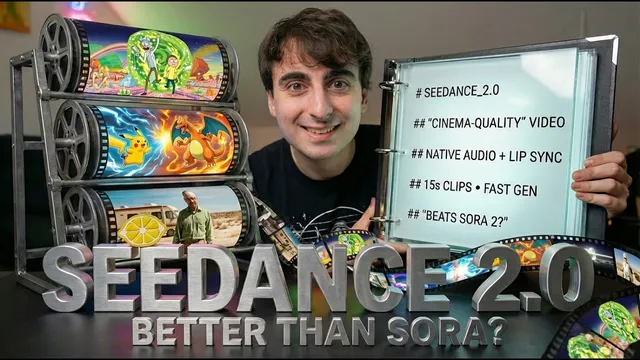
Seedance 2.0 FEELS like old Sora but BETTER. Fight Scenes Are Finally GOOD!
Based on MattVidPro's video on YouTube. If you like this content, support the original creators by watching, liking and subscribing to their content.
Seance 2.0 is being praised for coherent animated action—especially anime-style fight scenes—where motion stays readable across the clip.
Briefing
Bite Dance’s “Seance 2.0” is being pitched as a major leap in text-to-video quality—especially for animated action—while also standing out for being less restrictive than competing models. Early reactions focus on fight choreography that stays readable frame-to-frame, more convincing physical effects (including smoke and water-like behavior), and audio that often lands with a “cinema” feel. Viewers also describe the model as closer to Sora-style motion quality than to purely cinematic “look-at-this-shot” generators, with the added promise that clips can be built for longer workflows.
A key theme is coherence: action sequences don’t just look dynamic; they maintain continuity across the duration of the clip. Animated fight scenes—particularly anime-style work—are repeatedly singled out as a standout use case. One example blends live-action environments with 2D anime characters, where the character’s entrance, camera rotations, and 3D-realistic body presence are said to remain consistent enough to feel intentional rather than randomly assembled. Even when artifacts appear—like occasional finger problems or impossible movements—users describe the hallucinations as increasingly “sussable,” suggesting the model is getting better at staying within the rules of a scene.
The transcript also emphasizes multimodality and control options. The platform is described as allowing references for images, backgrounds, videos, and audio, plus “first and last frame” controls for steering motion. Aspect ratio choices range from classic 4:3 to widescreen 21:9 and vertical formats like 9x6, with “smart aspect ratio” and “smart length” settings that let the system decide resolution and duration. The creator’s hands-on test uses text-only prompting (because uploads weren’t available at the moment), targeting a 15-second Atlantis criminal-hiding movie scene, and notes that generation speed can be fast—often under a minute—though it can also stall during longer batches.
Community outputs are used as proof points. Discord-made clips are described as “uncensored” and are compared favorably against Sora 2 and “Sora 2 Pro,” with recurring praise for audio realism and animation adherence. Examples include Rick and Morty-style scenes, sports-like ball interactions, anime-meets-real-world action, and even mashups resembling GTA 6 rendered with Pixar-like aesthetics. Still, limitations remain: a separate test is cited where a duck fails to follow a maze and instead passes through walls, showing that the model can produce visually plausible motion without reliably obeying constraints.
Overall, the transcript frames Seance 2.0 as a model that feels “fresh” and broadly capable—particularly for animation and action—while acknowledging that it’s not yet dependable at strict rule-following. The closing sentiment is that competition among video generators should accelerate progress, with hopes for open, high-quality models in the coming years, while the immediate focus stays on experimentation and sharing results.
Cornell Notes
Seance 2.0 from Bite Dance is being received as a step up in text-to-video quality, with particular strength in animated action and anime-style fight scenes. Reactions highlight better motion coherence, more convincing physical effects (like smoke and water behavior), and audio that often feels realistic enough to be “cinema-grade.” The platform also offers multimodal inputs and controls such as aspect ratio presets and “first/last frame” steering, plus smart settings for duration and resolution. Even with improvements, the model still shows hallucinations and can fail at strict constraints, such as a duck ignoring a maze and moving through walls. The net takeaway: visually impressive coherence is improving faster than rule-based reliability.
What makes Seance 2.0 stand out for action and animation compared with earlier models mentioned in the transcript?
How does the hands-on workflow described in the transcript suggest Seance 2.0 can be controlled?
What limitations still show up, even when outputs look high quality?
Why do community clips matter in the transcript’s evaluation of Seance 2.0?
What does the transcript imply about generation speed and practical usability?
Review Questions
- Which specific features (e.g., coherence, audio, physical effects, control options) are repeatedly credited as Seance 2.0’s strengths in the transcript?
- What are the two categories of failure modes described—visual/artifact issues versus rule/constraint failures—and how does each show up in examples?
- How do aspect ratio presets and “smart” settings change the way a user can steer output style and duration?
Key Points
- 1
Seance 2.0 is being praised for coherent animated action—especially anime-style fight scenes—where motion stays readable across the clip.
- 2
Audio quality is repeatedly highlighted as a differentiator, often described as realistic and immersive rather than background noise.
- 3
Physical effects such as smoke and water-like behavior are cited as more convincing than in earlier comparisons.
- 4
The platform is described as multimodal and control-friendly, including reference inputs and “first/last frame” steering, plus multiple aspect ratio presets and smart settings.
- 5
Hands-on testing used text-only prompting due to temporary upload limits, targeting a 15-second Atlantis criminal scene with API-like controls.
- 6
Despite visual improvements, hallucinations and anatomical glitches (like finger issues) still occur.
- 7
Rule-following remains unreliable, with examples like a duck ignoring a maze and passing through walls.