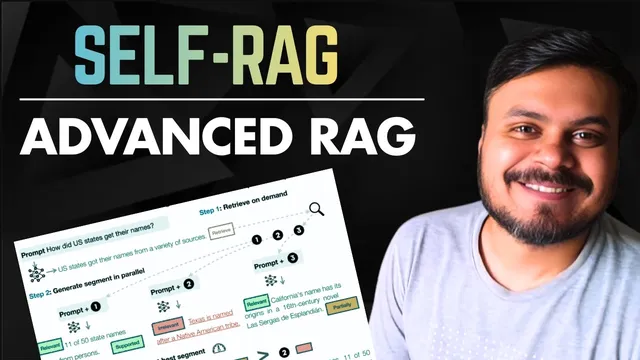
Self-RAG Tutorial: How to Make Your AI Fact-Check Itself | Advanced RAG | CampusX
Based on CampusX's video on YouTube. If you like this content, support the original creators by watching, liking and subscribing to their content.
Self-RAG reduces indiscriminate retrieval by first deciding whether retrieval is needed for a given query, skipping external context when parametric knowledge suffices.
Briefing
Self-RAG is built to stop retrieval-augmented generation from “going along for the ride” when it shouldn’t—by forcing the system to judge its own retrieval and its own answers. Instead of trusting whatever documents were fetched and whatever text the LLM produced, the workflow repeatedly checks whether retrieval is necessary, whether the retrieved evidence is relevant, whether the generated response is grounded in that evidence (not fabricated), and whether the final response actually answers the user’s question. The payoff is a more reliable fact-checking loop inside the RAG pipeline, reducing both wasted computation and hallucinations.
Traditional RAG fails in three recurring ways. First, it can retrieve even when the question is simple enough for the model’s parametric knowledge—leading to unnecessary context injection and lower confidence. The transcript’s example asks how many seconds are in a minute; even though the LLM can answer directly, retrieval adds irrelevant or overly specific chunks, making the response hedgier (“depending on the context”). Second, traditional RAG can blindly trust retrieved documents based on semantic similarity, even when the retrieved text doesn’t actually support the user’s causal framing. In the diabetes example, retrieved content discusses effects on blood sugar processing rather than causes, yet the LLM is pushed to answer “what causes diabetes,” producing a logically mismatched response. Third, once an answer is generated, conventional pipelines often don’t verify whether the claims are grounded in the retrieved evidence—so hallucinated or partially supported facts can slip through as final.
Self-RAG addresses these issues with “self-reflection.” The system actively questions each step: (1) should retrieval happen at all for this query? (2) are the retrieved documents relevant to answering it? (3) is the generated response fully grounded in the retrieved documents, or only partially, or not at all? (4) does the response justify and actually answer the user’s question in a useful way? The transcript illustrates hallucination detection by showing responses that mix evidence-backed claims with additional facts the model likely inferred from parametric knowledge—then categorizing them as fully supported, partially supported, or unsupported. When support is incomplete, a “revise answer” node rewrites the response using only the provided context, and the system loops until the answer becomes fully supported or a maximum retry limit is reached.
After grounding checks, Self-RAG adds a second gate: usefulness. An answer can be grounded yet still fail to justify the question—such as when the model ignores the most relevant document and produces a correct-sounding statement that doesn’t actually address the user’s requested policy. If usefulness fails, the system rewrites the query, re-runs retrieval with an updated “retrieval query,” and repeats the cycle. Again, retry limits prevent infinite loops.
The tutorial then demonstrates how to implement this in LangGraph step-by-step: start with a routing node that decides whether retrieval is needed, add a relevance-filter node to keep only documents judged relevant, then merge relevant documents into a context string for generation. Later steps implement hallucination support classification, revision loops with max retries, and usefulness classification with query rewriting. The final result is an end-to-end Self-RAG graph that can return “no answer found” when evidence is missing or the system can’t produce a fully supported, useful response after repeated attempts.
Cornell Notes
Self-RAG upgrades RAG by adding internal “self-reflection” checks that decide when to retrieve, which documents to trust, and whether the final answer is both grounded and useful. It first asks whether retrieval is needed; if not, it answers directly from the LLM’s parametric knowledge. If retrieval happens, each document is filtered for relevance, then the response is generated from the remaining context. A hallucination judge classifies the response as fully supported, partially supported, or unsupported; partially/unsupported answers trigger a revise step that rewrites using only the provided evidence, looping until fully supported or a retry cap is hit. Finally, a usefulness judge checks whether the answer actually justifies and addresses the user’s question; if not, the system rewrites the query and repeats retrieval and generation.
Why does Self-RAG treat “retrieval necessity” as a first-class decision rather than always fetching documents?
How does Self-RAG prevent the common failure where retrieved documents are semantically similar but not actually supportive of the question?
What does “groundedness” mean in Self-RAG, and how is hallucination categorized?
What happens when the response is only partially supported or unsupported?
Why does Self-RAG also check “usefulness” after groundedness passes?
Review Questions
- In Self-RAG, what are the four reflection questions, and which ones directly target hallucinations versus answer relevance?
- Describe the difference between “partially supported” and “no support” responses in the groundedness check, and what the revise node does in each case.
- Why might a response be fully grounded but still labeled “not useful,” and how does the system recover from that state?
Key Points
- 1
Self-RAG reduces indiscriminate retrieval by first deciding whether retrieval is needed for a given query, skipping external context when parametric knowledge suffices.
- 2
Retrieved documents are filtered for relevance document-by-document before generation, preventing mismatches like causal questions answered using effect-only evidence.
- 3
A groundedness judge classifies responses as fully supported, partially supported, or unsupported by checking whether claims appear in the provided evidence.
- 4
Partially supported or unsupported answers trigger a revise step that rewrites using only the retrieved context, with a max-retry cap to avoid infinite loops.
- 5
After grounding checks, a usefulness judge verifies that the response actually answers and justifies the user’s question; grounded-but-misaligned answers are rejected.
- 6
If usefulness fails, Self-RAG rewrites the query (as a retrieval query optimized for the internal documents) and repeats retrieval, filtering, generation, and verification.
- 7
The LangGraph implementation is built incrementally: routing (retrieve vs direct), relevance filtering, context merging, groundedness classification, revision loop, and usefulness-based query rewriting.