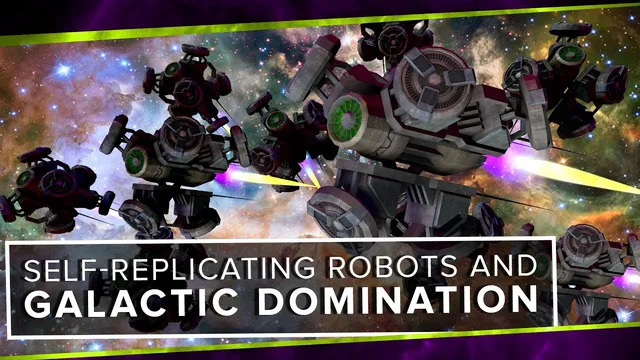
Self-Replicating Robots and Galactic Domination
Based on PBS Space Time's video on YouTube. If you like this content, support the original creators by watching, liking and subscribing to their content.
Von Neumann probes are self-replicating, resource-harvesting spacecraft that could spread between star systems and multiply exploration efforts exponentially.
Briefing
A galaxy-wide “paper trail” may exist even if interstellar travel is rare: self-replicating robotic spacecraft—Von Neumann probes—could spread exponentially, leaving little doubt that someone, somewhere, would have seeded the stars by now. That expectation matters because it reframes the Fermi Paradox: the silence of the night sky may not mean advanced civilizations never arise, but that the conditions for building and deploying self-replicators are uncommon.
The argument starts with a contrast between the galaxy’s apparent stillness and the disruptive potential of machines. Stars, pulsars, and black holes follow predictable physics; humanity is the only known species to build large-scale technology. Yet the Milky Way is old enough that earlier expanding civilizations should have crossed and colonized it. Competing explanations include self-destruction before interstellar maturity or a preference for inward-focused futures like virtual worlds. Even if those are partly true, the case for “missing evidence” weakens when self-replicating probes enter the picture.
Von Neumann probes are described as unmanned spacecraft capable of traveling between star systems, extracting local resources, and building copies of themselves to continue exploration. The concept traces to John von Neumann’s mid-20th-century theoretical framework for a “universal assembler,” later associated with the Von Neumann machine idea. Various thinkers have imagined applications: Edward Moore’s self-replicators intended for harvesting, Freeman Dyson’s speculative designs such as a “Astro-chicken,” and broader visions for terraforming and large-scale automation.
With modern progress in 3-D printing, material science, nanofabrication, and increasingly capable automation software, the discussion claims it’s plausible to shrink the “assembler” relative to the infrastructure it can build—making cosmic-scale replication more feasible. A hypothetical deployment plan begins with a fast interstellar launch (possibly fusion-powered) carrying a universal assembler plus minimal mining and processing tools. After decelerating near a target star, the system would generate power, mining operations, fuel collection (including harvesting deuterium or tritium from gas giants), and exploration probes that stream data home or support terraforming and megastructures like Dyson swarms.
Replication would take time—modeled as ~10% light speed with ~10 light-year jumps and up to ~500 years to produce each “daughter” probe—but the growth is exponential. Under those assumptions, the galaxy could be covered in a few million years, far shorter than the Milky Way’s age. That leads to a stark inference: either no one builds such probes, or technological civilizations capable of doing so are extremely rare—so rare that even thousands of generations across many worlds might still miss the “one relatively easy act” of launching a successful self-replicator.
The transcript then attacks “alien psychology” as a decisive barrier. Human history shows that a single motivated actor can drive large, irrational, large-scale projects. If many civilizations existed, the odds of at least one attempting self-replicating spacecraft would be high. The more reasonable conclusion, it argues, is that the numbers are wrong: far fewer civilizations exist than naive estimates suggest.
Finally, the discussion turns to an anthropic-style explanation for why observers find themselves here. In any universe that produces intelligence, someone will eventually ask why they are alone—possibly because they are among the first to begin exploring the still-untamed cosmos. The episode closes by pivoting to related megastructure debates, including Dyson swarms and their logistical and political challenges, before returning to the broader theme of what advanced technology would leave behind.
Cornell Notes
Von Neumann probes—unmanned spacecraft that replicate by using local resources—could spread through the galaxy exponentially. If a successful probe can be built, the model suggests the Milky Way could be saturated with such machines in roughly a few million years, far faster than the galaxy’s age. That timing makes the Fermi Paradox harder to dismiss as “too slow” or “too hard,” and shifts attention to rarity: either self-replicators are never built, or technological civilizations capable of building them are extremely uncommon. The transcript argues that “alien psychology” is unlikely to prevent at least one attempt, given how quickly ambitious projects can emerge in human history. An anthropic-style angle is offered to explain why observers might find themselves in a universe where they are not surrounded by obvious evidence of replication.
What exactly is a Von Neumann probe, and why does it change expectations about interstellar expansion?
How does the transcript model the time needed to cross the galaxy, and what conclusion does it draw from that?
Why does the transcript treat “alien psychology” as a weak explanation for the absence of self-replicators?
What role do numbers about habitable planets and the timing of technological life play in the reasoning?
How does the transcript connect the Von Neumann concept to real technological trends?
What does the transcript suggest as an alternative explanation for why observers find themselves in a seemingly empty galaxy?
Review Questions
- If a single Von Neumann probe can replicate exponentially, what timescale comparison makes the Fermi Paradox especially sharp in the transcript’s framework?
- Why does the transcript argue that “alien psychology” is unlikely to eliminate all attempts at self-replicating spacecraft?
- What assumptions about travel speed, jump distance, and replication time drive the estimate that the galaxy could be saturated in a few million years?
Key Points
- 1
Von Neumann probes are self-replicating, resource-harvesting spacecraft that could spread between star systems and multiply exploration efforts exponentially.
- 2
A universal assembler concept—linked to John von Neumann’s theoretical framework—provides the blueprint for building machines that can construct copies of themselves.
- 3
If replication works, even centuries per replication step can still yield galaxy-wide coverage on million-year timescales, making the lack of evidence harder to explain away.
- 4
The argument treats “alien psychology” as insufficient because large-scale projects can be initiated by small numbers of actors, not entire societies.
- 5
Kepler-era estimates of abundant habitable planets imply many opportunities for technological life, so the absence of self-replicators suggests technological civilizations are far rarer than naive calculations predict.
- 6
An anthropic-style explanation is offered: observers may exist in a universe where they are early, before self-replicating machines have saturated the galaxy.