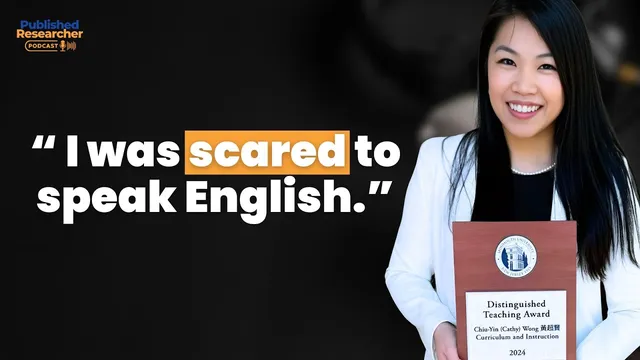
She published 5 papers in 12 months (Q1 Scopus-indexed journals)
Based on Academic English Now's video on YouTube. If you like this content, support the original creators by watching, liking and subscribing to their content.
Kathy Wong’s writing breakthrough came from professional development support and a protected writing schedule that treated writing time as non-negotiable appointments.
Briefing
Kathy Wong credits her publication momentum in top journals to a mix of disciplined writing time, a clear research focus, and a research agenda rooted in real classroom needs—especially her work on trans languaging. After arriving in the U.S., she described becoming “very quiet” when speaking English around native speakers, fearing judgment. That insecurity didn’t stop her; it shaped her later mission to normalize multilingualism in education and society, arguing that language learners shouldn’t be treated as deficits or forced into a single “native-speaker” standard.
Her path to becoming a published researcher began with a problem many academics recognize: no one taught her how to write research papers effectively. As a graduate student and early-career scholar, she still did research, but writing felt like a burden. The turning point came when she sought professional development workshops and secured support from her former dean, which helped her establish a writing schedule and rebuild confidence. She then adopted a practical method for protecting writing time—treating it like an appointment with herself. Instead of letting teaching obligations dictate her calendar, she tracked when she could focus best (she found a reliable window between 10:00 and 12:00 on weekdays), blocked those hours on a paper calendar, and removed distractions by closing email and keeping her phone away.
Wong ties her writing discipline to a larger “impact” goal. As a teacher educator, she wants her work to help teachers reach more students indirectly: one teacher can influence many learners over time, and writing can scale that influence beyond a single classroom. That motivation also shaped her research narrowing. Early on, her interests were too broad—ranging from interviewing ESL teachers to interviewing school leaders—making it hard to establish expertise and sustain writing. She later refined her focus by asking what genuinely excites her, including her own family’s multilingual life and her desire to support heritage language development.
Her research centers on trans languaging, which she defines as a teaching approach that encourages students to use their full communicative resources—including home languages—to make meaning and develop academic language. In her classroom scenarios, restricting students to only the “target” language can signal rejection of identity and reduce participation. In contrast, trans languaging invites students to draft ideas in their first language, then use scaffolds (like word banks and sentence stems) to express those ideas in the target language. In studies she references, both pre-service and in-service teachers favored trans languaging because it supports identity and learning; student feedback from a small group of learners described improved understanding of advanced content tasks when home languages were allowed.
Wong acknowledges that long-term outcomes still need more research, but her studies and related work suggest gains in academic knowledge and language proficiency, along with the ability to use targeted vocabulary in formative assessment. She is currently investigating how teachers can integrate trans languaging into assessment—an area she flags as a common concern.
On publishing culture, she pushes back on “publish or perish” pressure. While she values publication as a way to advance scientific conversation, she argues that intense incentives can distort behavior—encouraging inflated records, outsourcing writing, and sidelining negative results that don’t meet significance thresholds. She also notes that high-impact journals often prioritize novelty over replication, even though replication across contexts is essential for robust conclusions. Her proposed remedy is community: researchers benefit from shared writing spaces, peer support, and open discussion of work-in-progress.
Overall, Wong’s central message is that multilingualism can be normalized rather than policed, and that publication success is more sustainable when writing time is protected, research focus is sharpened, and studies are grounded in practical classroom problems.
Cornell Notes
Kathy Wong’s route to publishing in top journals blends practical writing systems with a research agenda grounded in classroom realities. After struggling to write effectively, she found professional development support, then protected writing time by scheduling focus blocks (10:00–12:00) and treating them like appointments with herself. Her scholarship centers on trans languaging—using students’ full linguistic repertoires, including home languages, to help them make meaning and participate confidently. She argues that monolingual “native-speaker” standards can silence learners and reject identity, while trans languaging supports understanding and academic language development. She also warns that “publish or perish” pressure can harm research integrity and discourage publication of negative results, and she advocates for researcher communities that make writing less isolating.
What personal and professional factors shaped Kathy Wong’s relationship with writing and publishing?
How does Wong recommend researchers create “writing space” when teaching, family, and other duties compete for time?
What is trans languaging, and why does Wong argue it improves learning compared with monolingual approaches?
What evidence does Wong cite regarding outcomes from trans languaging, and what remains uncertain?
How does Wong connect trans languaging to assessment, and what work is she doing now?
What is Wong’s stance on “publish or perish,” and how does it affect research quality?
Review Questions
- What specific scheduling and distraction-management tactics does Wong use to protect writing time, and why does she treat writing like an “appointment”?
- How does Wong’s definition of trans languaging differ from monolingual language teaching, and what identity-related argument does she use to justify it?
- According to Wong, what changes are needed so assessments can align with trans languaging instruction?
Key Points
- 1
Kathy Wong’s writing breakthrough came from professional development support and a protected writing schedule that treated writing time as non-negotiable appointments.
- 2
She identifies personal focus windows by tracking her own productivity and then blocks those hours on a paper calendar to reduce distraction.
- 3
Her research mission is tied to impact as a teacher educator: writing can scale classroom influence beyond individual students and classrooms.
- 4
Trans languaging encourages students to use home languages and other communicative resources to make meaning, then apply scaffolds to develop target-language academic expression.
- 5
Wong argues monolingual “native-speaker” ideology can silence learners by framing their identities as deficits rather than assets.
- 6
She says evidence for trans languaging shows gains in academic knowledge and language proficiency, while long-term outcomes still require more study.
- 7
She criticizes “publish or perish” pressure for distorting incentives, discouraging publication of negative results, and sometimes encouraging unethical practices; she recommends community-based writing support as a remedy.