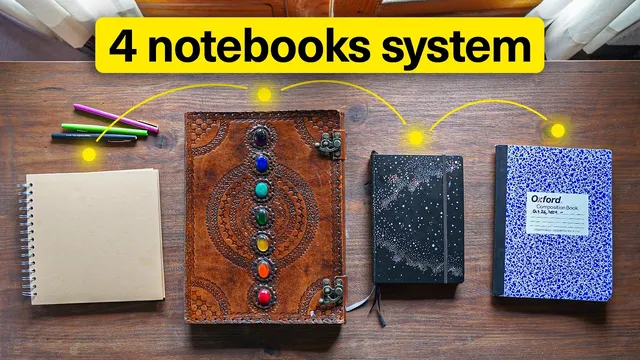
She Replaced Her Productivity Apps with 4 Notebooks - Here's What Happened
Based on Tiago Forte's video on YouTube. If you like this content, support the original creators by watching, liking and subscribing to their content.
Valdez defines productivity as intentional living, not speed or efficiency.
Briefing
A pen-and-paper journaling system can outperform digital productivity tools when it’s built around what feels sustainable and motivating—especially for people who struggle with anxiety, overcommitting, or “phone drift.” Lauren Valdez’s core claim is that replacing app-heavy workflows with a small set of notebooks helps her slow down, process emotions before acting, and make clearer decisions about what deserves a “yes.” The payoff is both psychological (more intentional living) and practical (fewer breakdowns, better recall, and less time lost to notifications).
Valdez frames productivity as intention rather than speed. She says digital task managers and calendars push her toward mindless acceptance—capturing emails, copying tasks, and saying yes by default—until the system collapses under friction. By contrast, handwriting becomes a deliberate pause. She credits the act of writing by hand with stronger brain engagement—more synapses and memory formation than typing—then ties it to her lived experience: the page creates distance from anxious thoughts and makes it easier to reach emotional clarity.
Her approach rests on two principles. First, “what is simple is sustainable”: she keeps the system minimal to avoid burnout, lost information, and the time sink of learning new tools. Second, “what is pleasurable is motivating”: writing is enjoyable for her—pretty pens, journals, and time outdoors—while staring at screens and managing apps feels draining. That emotional mismatch, she says, is why her digital systems repeatedly failed.
She also argues the choice isn’t “paper versus digital” so much as “tool versus moment.” Digital tools can help with quick captures, but she warns that picking up a phone often triggers notification checking and can erase the reason she reached for it in the first place. Handwritten checklists, she adds, deliver a more satisfying sense of completion.
The system itself uses four notebooks aligned to daily, weekly, monthly, and annual review cycles. “Morning pages” come from Julia Cameron’s The Artist’s Way: she writes fast for about 15 minutes to dump mental noise, including judgments and “rage writing,” so she can be present for the day. For task management, she follows the bullet journal method associated with Ryder Carroll, emphasizing manual updates and rollovers. Rewriting tasks forces a weekly re-check of whether she still wants them; she may roll items over multiple times before admitting she doesn’t.
Weekly review is intentionally lightweight: she selects two or three favorite photos from the week, prints them, and writes a brief “what happened” reflection with highs, challenges, and lessons—messy and concise, with permission to miss sessions. Monthly review becomes more embodied through new-moon and full-moon rituals every 28 days: she reviews highlights and lessons, chooses what to release, sets an intention for the next cycle, and checks alignment at the full moon. An annual birthday ritual lets her flip through the year’s moon notes to see growth and themes without re-reading everything.
To start, she recommends beginning with one notebook and a short timer, then making the practice pleasurable enough that it becomes something she craves. Flexibility is built in: skipping sessions is acceptable as long as she returns before the habit fully fades.
Cornell Notes
Lauren Valdez replaces app-based productivity with a small set of pen-and-paper notebooks built around two rules: “what is simple is sustainable” and “what is pleasurable is motivating.” Handwriting slows her down so she can process anxiety and emotions before working, and it reduces friction compared with phone and app breakdowns. Her system uses four notebooks: morning pages for daily emotional clearing, a bullet journal for task management with manual rollovers, a weekly review journal with photo-based reflections, and a “spell book” for new-moon/full-moon rituals and annual review. The result is more intentional decision-making, better memory of what she wrote, and fewer habits that collapse under digital distraction.
Why does switching from digital productivity tools to handwriting matter in Valdez’s system?
How do “morning pages” function as a daily practice?
What makes her task management work—especially the manual rollover requirement?
How does the weekly review stay lightweight and sustainable?
What role do new-moon and full-moon rituals play in her monthly and annual planning?
Review Questions
- How do Valdez’s two productivity principles (“simple” and “pleasurable”) influence the design of her notebook system?
- Describe how manual rollover in a bullet journal changes the decision-making process compared with simply carrying tasks forward in an app.
- What specific practices does Valdez use for daily, weekly, monthly, and annual review, and what purpose does each serve?
Key Points
- 1
Valdez defines productivity as intentional living, not speed or efficiency.
- 2
Her system is built on two rules: keep it simple enough to sustain and make it pleasurable enough to motivate.
- 3
Handwriting helps her slow down, process anxiety, and create distance from intrusive thoughts.
- 4
Manual updates—especially bullet journal rollovers—force a weekly re-check of whether tasks still deserve a “yes.”
- 5
She uses different notebooks for different review cycles: daily morning pages, weekly photo-based reflection, monthly moon rituals, and annual birthday review.
- 6
Digital tools are not rejected outright; they’re treated as less suitable when they trigger notification distraction or emotional autopilot.
- 7
Starting small (one notebook, short timer) and staying flexible (missing sessions is allowed) makes the habit more likely to stick.