Shipmas Day 6: Bring Any Idea To Life App (Nano Banana Pro API)
Based on All About AI's video on YouTube. If you like this content, support the original creators by watching, liking and subscribing to their content.
The app turns voice-recorded ideas into a rated concept “one-pager” with an overview and five generated visuals.
Briefing
A voice-to-product “one-pager” app turns spoken ideas into a structured concept page with AI-written analysis, a rating, and multiple generated visuals—fast enough to iterate on new concepts in minutes. The workflow is straightforward: record an idea, transcribe it with Whisper, then feed the text into Gemini 3 alongside Nano Banana Pro to produce five visuals plus an overview and a score for the idea.
The build centers on an ID-based input flow. Users can save multiple “IDs” from prior tests, then record new ones through the app’s interface. After recording, Whisper converts the audio into text, and the system immediately moves to analysis and visualization. The output resembles a shareable product sheet: a suggested title, an “analyzing your ID with Gemini” section, a numeric rating (for example, an 8/10), and a set of images that function like concept art and UI mockups. The app also includes suggested improvements, turning raw brainstorming into actionable next steps.
One demo idea becomes a tangible hardware concept: “Flora lens smart stick,” a plant-monitoring device with a metal rod measuring humidity/temperature and capturing images, designed for easy deployment via USB-C power and cloud connectivity. The generated visuals include a hero product shot with a camera in the soil, closeups, a mobile UI mockup, lifestyle photography, and a technical blueprint-style breakdown listing components such as a visual sensor, neural processor, lithium battery, hydrometer rod, and USB-C. The improvement suggestions get specific—adding a solar planner clip near windows to extend battery life, including a manual privacy shutter for indoor camera placement, and making the device head adjustable and tiltable.
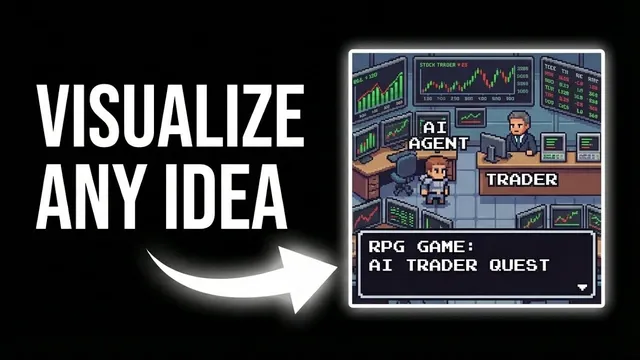
A second demo pushes the system into a more speculative direction: a video game where players manage and train fleets of AI agents that operate in financial markets. The concept blends RPG progression with crypto-style speculation, including mechanics like staking agents, yield sharing, and integration with prediction markets (explicitly referencing PolyMarket) and stock exchanges. Despite the premise sounding “ludicrous,” the app still returns a strong score (again, an 8/10) and generates a suite of visuals: an isometric command-deck UI with “bots,” code, and crypto-themed elements; a “command deck” style interface; a network map showing different market categories (PolyMarket, crypto, commodities, derivatives, forex); and a visual depiction of an agent executing a trade. The suggested improvements include adding a sandbox mode using “paper money,” creating guilds/syndicates for shared computational power, and using “boss battles” to represent high-volatility market events.
By the end, the creator runs through an agents customization screen featuring components like arbitrage logic, high-frequency CPU, risk dampener prediction engine, and quantum trading market analysis—then downloads and reviews the generated concept package. The core takeaway is speed-to-concept: speak an idea, get a rated one-pager with visuals and refinement suggestions, and iterate without getting stuck in manual design or lengthy writing cycles—making it a compelling tool for rapid product ideation and prototyping in the “Shipmas” daily build series.
Cornell Notes
The app workflow is designed for rapid ideation: record an idea by voice, transcribe it with Whisper, then use Gemini 3 and Nano Banana Pro to generate a concept “one-pager.” Each output includes a suggested name/title, an AI analysis, a numeric rating, five visuals, and specific improvement suggestions. A plant-monitoring device (“Flora lens smart stick”) demonstrates how the system can translate a spoken hardware pitch into product-style imagery, component breakdowns, and concrete accessory/privacy ideas. A second example—a financial-markets RPG where players manage AI agents—shows the same pipeline can handle speculative game mechanics, producing UI mockups, market “world map” visuals, and gameplay feature recommendations. The value is turning unstructured speech into structured, shareable product concept material quickly.
How does the app convert a spoken idea into a structured concept page?
What does the output look like for the plant-monitoring hardware idea?
Why did the financial-markets game concept still score highly despite sounding unrealistic?
What kinds of improvement suggestions does the system generate?
What visual elements help communicate the game concept’s structure?
Review Questions
- Trace the full pipeline from voice recording to final output: which tools handle transcription, analysis, and visual generation?
- Compare how the app’s improvement suggestions differ between the hardware concept and the game concept.
- What specific visual artifacts (UI, blueprint, maps, hero shots) were generated for each demo idea, and what purpose does each serve?
Key Points
- 1
The app turns voice-recorded ideas into a rated concept “one-pager” with an overview and five generated visuals.
- 2
Whisper handles audio-to-text transcription, while Gemini 3 and Nano Banana Pro drive the analysis and visualization generation.
- 3
Users can save and revisit multiple idea IDs, then run new recordings through the same pipeline.
- 4
The plant-monitoring demo (“Flora lens smart stick”) produced hardware-style visuals (hero shots, closeups, blueprint components) plus concrete accessory and privacy recommendations.
- 5
The financial-markets game demo generated RPG/crypto mechanics feedback and visuals like an isometric command deck and a market “world map,” scoring an 8/10.
- 6
Generated improvement suggestions are actionable and scenario-specific, including sandbox testing, guild/syndicate structures, and privacy/battery/accessory upgrades.