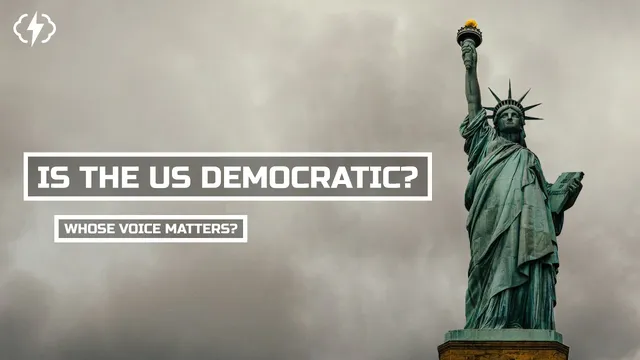
Should The US Be Considered A Democracy?
Based on Second Thought's video on YouTube. If you like this content, support the original creators by watching, liking and subscribing to their content.
A 2014 study analyzing nearly 2,000 policy issues finds average citizens’ preferences have near-zero statistical impact on policy once elite and organized-interest preferences are controlled.
Briefing
The United States’ claim to democratic rule is undermined by evidence that policy outcomes track the preferences of economic elites and organized interest groups more than those of average voters—and that structural voting barriers further weaken citizens’ ability to translate elections into change. The core takeaway is stark: when majorities disagree with powerful business interests, they often lose in practice, not just in rhetoric. That gap between democratic ideals and political reality matters because it challenges the legitimacy of America’s self-image as a global defender of democracy.
A central reference point is a 2014 study in *Perspectives on Politics* titled “Testing Theories of American Politics: Elites, Interest Groups, and Average Citizens.” Using data from nearly 2,000 policy issues, researchers tested competing theories of who holds power in the U.S.—majoritarian electoral democracy, economic elite domination, and two forms of interest-group pluralism (majoritarian pluralism and biased pluralism). The results point to a “nearly total failure” of median-voter and other majoritarian electoral democracy theories once elite and organized-group preferences are accounted for. In plain terms, average Americans’ preferences show only a minuscule, statistically non-significant impact on policy outcomes, while interest groups—especially business-oriented ones—have substantial independent effects. Net alignments of the most influential business groups move in the opposite direction of what average citizens want.
That finding is paired with a broader critique of civic life and institutional incentives. Politicians still court votes because elections provide democratic optics; without them, the system would look openly oligarchic. But the transcript argues that the mechanisms of representation are distorted. Gerrymandering lets incumbents draw district lines to exclude or “pack” voters, producing outcomes that can diverge sharply from proportional expectations—turning representation into a choice of voters by representatives rather than the reverse. The argument extends beyond map-drawing to voter suppression, including repressive voter ID laws, voter roll purges, and—more visibly—closing polling locations.
A concrete example is the Kentucky primary on June 23rd, where polling sites were cut from over 3,700 in a typical year to under 200. The transcript highlights Jefferson County having just one polling station for over three-quarters of a million residents, predicting multi-hour waits that would prevent many working voters from casting ballots. The claim is that such barriers deny the most fundamental democratic right—access to voting—while allowing officials to point to formal legality (“a polling station existed”) rather than real-world ability to participate.
The transcript concludes that these patterns are not accidental. With strong status-quo bias, corporate and wealthy influence over policymaking, and electoral systems that can be engineered to limit outcomes, the U.S. functions less like a representative democracy and more like an oligarchy. It frames the two-party system as political theater that alternates while corporate dominance persists—tax, environmental, labor, media ownership, and healthcare structures all benefiting the wealthy and connected. In that view, the country’s democratic standards are not merely unmet; the system is operating as designed, since at least the 1980s.
Cornell Notes
The transcript argues that the U.S. falls short of democratic ideals because policy outcomes align more with economic elites and organized interest groups than with average voters. It cites a 2014 study (*Perspectives on Politics*) analyzing nearly 2,000 policy issues, finding that median-voter and other majoritarian electoral theories fail once elite and interest-group preferences are considered. The study reports that average citizens’ preferences have near-zero statistical impact on policy, while business-oriented groups show strong, independent influence—often moving opposite to what the median voter wants. The transcript then links this to electoral distortions such as gerrymandering and voter suppression, including polling-place closures that create practical barriers to voting. Together, these points are presented as evidence that majority rule does not reliably determine outcomes.
What does the 2014 *Perspectives on Politics* study claim about who influences U.S. policy outcomes?
How does the transcript reconcile the importance of elections with claims that votes don’t meaningfully determine policy?
Why is gerrymandering presented as a democratic problem in the transcript?
What forms of voter suppression are highlighted, and what example is used to illustrate the impact?
What is the transcript’s bottom-line conclusion about the U.S. political system?
Review Questions
- According to the cited study, what happens to the explanatory power of median-voter theories once elite and interest-group preferences are accounted for?
- How do gerrymandering and polling-place closures each weaken the link between voting and policy outcomes?
- What kinds of policy areas does the transcript suggest benefit corporate and wealthy interests more than average citizens?
Key Points
- 1
A 2014 study analyzing nearly 2,000 policy issues finds average citizens’ preferences have near-zero statistical impact on policy once elite and organized-interest preferences are controlled.
- 2
Interest groups—especially business-oriented ones—show substantial independent influence on legislation, and their preferences often move opposite to what average voters want.
- 3
Elections can still be politically valuable for legitimacy and optics even if policy outcomes are driven by elites and organized interests.
- 4
Gerrymandering allows incumbents to draw district boundaries that exclude or pack voters, producing election results that can diverge from proportional expectations.
- 5
Voter suppression is presented as undermining democracy through both legal barriers (voter ID, roll purges) and practical obstacles like polling-place closures.
- 6
The Kentucky primary example illustrates how cutting polling locations can create multi-hour waits that effectively prevent many working voters from voting.
- 7
The transcript frames corporate dominance and structural status-quo bias as long-running features of the system rather than accidental failures.