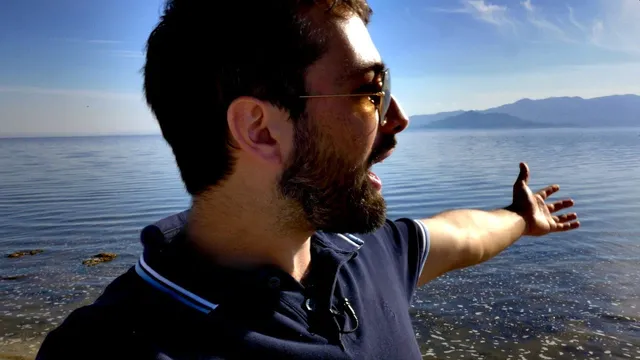
Should This Lake Exist?
Based on Veritasium's video on YouTube. If you like this content, support the original creators by watching, liking and subscribing to their content.
The Salton Sea formed after a 1905 irrigation and flood-control effort failed, allowing the Colorado River to flood a basin about 70 meters below sea level for roughly two years.
Briefing
The Salton Sea exists because a major irrigation mistake turned a desert basin into a temporary inland ocean—and the resulting lake has since become a cautionary tale about environmental neglect. In 1905, engineers trying to irrigate the American Southwest diverted water from the Colorado River while also attempting to prevent flooding. The plan failed: the river overtopped its channels and flooded a low-lying plain roughly 70 meters (over 200 feet) below sea level. For about two years, the basin filled with the river’s entire volume until flooding could be stopped, leaving behind the lake that still sits in California today.
Geography and geology help explain why the lake persists and why the region is unusually dynamic. The Salton Sea occupies a tectonically active area near the San Andreas Fault, where magma sits relatively close to the surface. Heat rises through mud volcanoes, and the region now uses that geothermal energy through seven geothermal plants that together generate enough electricity for more than 100,000 homes. Even so, the lake’s long-term survival has been far less stable than its accidental creation.
At first, the “miracle in the desert” seemed like a win. In the 1950s and 1960s, towns and resorts sprang up, celebrities visited, and fish were introduced—so successfully that anglers could catch fish with little effort. Birdlife flourished, and the lake briefly looked like a new Riviera.
That optimism collapsed as the lake’s water chemistry changed. The Salton Sea has limited inflow sources—mainly agricultural runoff—which carries salt into the basin. Because the lake sits below sea level, it has no natural outflow. Water leaves primarily through evaporation, which concentrates dissolved salts over time. The salinity has risen to about 50 grams per liter, higher than seawater, making it difficult for fish to survive. Large fish die-offs followed, producing strong odors, while algal blooms turned the water brown and degraded the ecosystem. Resorts closed, leaving behind abandoned shorelines and ghost-town remnants.
The lake’s condition also challenges the idea that “letting it evaporate” is simply nature correcting an error. The region did have lakes before the 1905 flood—water bodies that repeatedly formed and receded over thousands of years, often at higher levels. The modern disaster is therefore not a natural return to baseline so much as a slow slide driven by human choices and the absence of sustained management.
The broader takeaway is twofold: humans can reshape the planet on massive scales, including creating and destroying entire bodies of water. And without ongoing care, systems tend to drift toward disorder—towns crumble, ecosystems degrade, and the consequences become visible. The Salton Sea stands as a real-world lesson in what happens when an environmental “accident” is treated like a temporary convenience rather than a responsibility.
Cornell Notes
The Salton Sea was created by a 1905 irrigation failure when the Colorado River flooded a basin about 70 meters below sea level, filling it for roughly two years. Early on, the lake supported thriving recreation and wildlife, but its chemistry deteriorated because agricultural runoff adds salt while evaporation removes water without any outflow. Rising salinity (around 50 grams per liter) contributed to major fish die-offs and algal blooms that turned the water brown. Abandoned resorts and ghost towns now mark the environmental and economic fallout. The case highlights how human power can rapidly reshape landscapes—and how neglect can let those changes spiral into long-term damage.
Why did the Salton Sea form in the first place?
What role does the region’s geology play in the Salton Sea area?
Why does the Salton Sea’s salinity keep rising?
How did the lake’s changing chemistry affect wildlife and water quality?
Why isn’t “letting it evaporate” automatically the right solution?
Review Questions
- What specific failure in early irrigation planning led to the Salton Sea’s creation?
- Explain the cause-and-effect chain that links agricultural runoff, evaporation, and rising salinity.
- What evidence suggests the Salton Sea’s decline is tied to human management rather than a purely natural cycle?
Key Points
- 1
The Salton Sea formed after a 1905 irrigation and flood-control effort failed, allowing the Colorado River to flood a basin about 70 meters below sea level for roughly two years.
- 2
The lake’s location near the San Andreas Fault supports geothermal activity, which is tapped by seven geothermal plants powering over 100,000 homes.
- 3
Agricultural runoff is a key inflow that adds salt, while the lake’s below-sea-level position prevents natural outflow.
- 4
Evaporation concentrates salts over time, pushing salinity to about 50 grams per liter—higher than seawater.
- 5
Rising salinity has contributed to major fish die-offs and strong odors, alongside algal blooms that discolor the water.
- 6
The region’s resort boom in the 1950s–60s depended on a stable lake ecosystem that later collapsed as water chemistry worsened.
- 7
The Salton Sea illustrates how large-scale human interventions can create environmental systems—and how neglect can turn them into long-term problems.