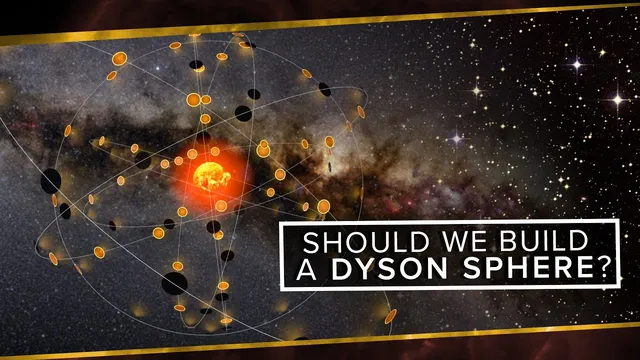
Should We Build a Dyson Sphere? | Space Time | PBS Digital Studios
Based on PBS Space Time's video on YouTube. If you like this content, support the original creators by watching, liking and subscribing to their content.
A solid Dyson sphere fails on multiple fronts: extreme structural stresses, unrealistic mass requirements, weak surface gravity, and inherent instability to perturbations.
Briefing
Dyson spheres—giant shells meant to harvest a star’s full power—are physically implausible, mainly because no known material could survive the crushing stresses, the mass requirements exceed what the inner solar system contains, and the structure would be unstable and effectively uninhabitable. Even if advanced materials existed, a solid sphere in a planetary-orbit scale would be a poor engineering bet: tiny disturbances would cascade into catastrophic failure, and the gravitational environment at the “surface” would be too weak to support a stable habitat.
The more viable path is a Dyson swarm: instead of one solid shell, a distributed set of small solar collectors in stable orbits. With enough collectors, the swarm could absorb the sun’s energy output from all directions while avoiding the single, fragile megastructure. The transcript argues this approach might also be achievable on a timescale that matters, because the first collector could be built with near-term capabilities—autonomous mining, space launch, and orbital construction—though the initial phase would be slow. Energy is the bottleneck at the start, taking roughly a decade to build the first collector; once operational, the added power enables replicator robots and further mining/manufacturing, creating an exponential growth loop. Within about 70 years, the plan reaches a partial swarm, with Mercury reduced to a debris field.
A key detail is the proposed supply chain. Stuart Armstrong’s concept starts by “cannibalizing” Mercury for its iron-rich core and oxygen-bearing crust. The idea is to manufacture giant, highly reflective hematite mirrors (iron oxide) from Mercury’s materials—thin, polished collector sheets on the order of a kilometer across. Low Mercury gravity makes it relatively efficient to launch mined material into space for assembly. Each collector would reflect sunlight into a solar power plant that beams energy onward, potentially using lasers or masers.
But the transcript doesn’t stop at “collect more sunlight.” It questions whether a swarm is the best route to Kardashev Type 2 status, noting that sunlight conversion is inefficient: only about 0.7% of the sun’s core hydrogen-fuel mass-energy becomes usable energy. A swarm also demands raw materials comparable to nearly all terrestrial planets combined. That leads to a more radical alternative: mass-to-energy conversion at far higher efficiency using anti-matter engines or black hole engines.
The centerpiece is the Kugelblitz concept—an artificial black hole sustained by feeding it matter against Hawking radiation. If such “100% efficient” converters could be maintained, only about a billion Kugelblitzes might match the sun’s output, far fewer than the hundreds of quadrillion collectors envisioned for a full swarm. The transcript suggests a plausible strategy: use a partial Dyson swarm to generate the enormous power needed to build Kugelblitzes in orbit (for example, around Jupiter), then scale up toward Type 3. This framework also offers a potential explanation for why galaxy-wide Dyson swarms aren’t obvious: civilizations might build partial swarms only long enough to bootstrap more efficient engines that are harder to detect.
After the astrophysics thread, the transcript pivots to quantum eraser mechanics, emphasizing that resolving interference at a screen requires coincidence timing with entangled partners detected elsewhere. The interference information is effectively “embedded” in the screen’s recorded photon positions, but it can’t be extracted until slower-than-light data comparisons link screen hits to detector triggers. The screen initially appears as a blur until coincidence data sorts photons by which detector their entangled twins struck.
Cornell Notes
Dyson spheres are ruled out as a practical megastructure: the stresses, mass requirements, weak surface gravity, and instability make a solid shell around a star untenable. A Dyson swarm is the workaround—many kilometer-scale collectors in independent stable orbits can absorb the sun’s energy without relying on one fragile structure. The transcript highlights a bootstrapping plan attributed to Stuart Armstrong: mine Mercury for iron and oxygen to create reflective hematite mirrors, start with limited autonomous infrastructure, then use the growing power supply to scale mining and construction exponentially. It then challenges whether sunlight harvesting is the most efficient path to Kardashev Type 2, proposing that black-hole-based mass-to-energy converters like Kugelblitzes could eventually outperform swarms, with partial swarms serving as the power source to build them. The discussion ends by connecting to quantum eraser experiments, where interference patterns emerge only after coincidence timing links screen photons to which detectors their entangled partners hit.
Why is a solid Dyson sphere considered implausible even with advanced materials?
How does a Dyson swarm avoid the main engineering failures of a Dyson sphere?
What is the Mercury-based supply chain proposed for building the first swarm collectors?
What makes the swarm’s growth potentially exponential, and what timeline is given?
Why does the transcript question sunlight harvesting as the optimal route to Type 2?
How does the Kugelblitz idea change the scaling problem, and what role does a partial swarm play?
Review Questions
- What specific physical constraints make a solid Dyson sphere unstable and non-viable, and how do those constraints differ from the Dyson swarm approach?
- Describe the bootstrapping loop that turns early swarm construction into exponential growth, including the stated limiting factor and approximate timeline.
- In the quantum eraser section, why can’t interference at the screen be determined until coincidence timing data from detectors is compared, and what does that imply about when information becomes accessible?
Key Points
- 1
A solid Dyson sphere fails on multiple fronts: extreme structural stresses, unrealistic mass requirements, weak surface gravity, and inherent instability to perturbations.
- 2
A Dyson swarm is the practical alternative: many small collectors in independent stable orbits can absorb stellar energy without relying on one monolithic shell.
- 3
Mercury is proposed as the initial material source because its iron-rich core and oxygen-bearing crust can be processed into reflective hematite mirrors for kilometer-scale collectors.
- 4
Swarm expansion could be exponential if energy from early collectors powers autonomous replicator robots that build additional mining and manufacturing capacity; the transcript cites ~10 years for the first collector and ~70 years for a partial swarm.
- 5
Sunlight harvesting is inefficient (about 0.7% conversion of core fuel rest mass to energy) and demands enormous raw materials, motivating higher-efficiency mass-to-energy engines.
- 6
Kugelblitz-style artificial black holes are presented as a potential endgame: in principle, only about a billion units could match the sun’s output, and a partial swarm could bootstrap their creation.
- 7
Quantum eraser interference patterns require coincidence electronics: the screen’s photon distribution only reveals interference after matching screen hits to which detector recorded the entangled partner, using slower-than-light data comparison.