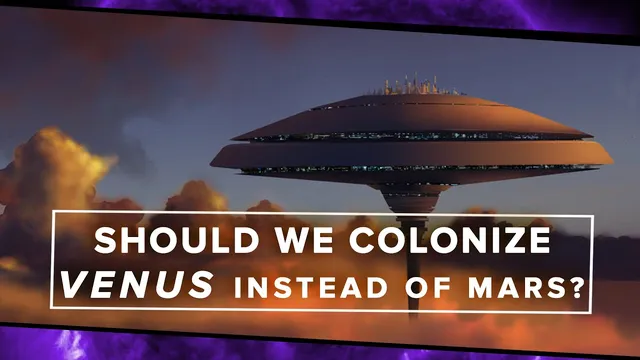
Should We Colonize Venus Instead of Mars?
Based on PBS Space Time's video on YouTube. If you like this content, support the original creators by watching, liking and subscribing to their content.
Venus can reduce mission round-trip time by about 30% to 50% compared with Mars, lowering radiation/weightlessness exposure and reducing supplies needed for crews.
Briefing
Venus may be a more practical target for long-term human settlement than Mars, largely because it’s easier to reach and gentler on the human body—if colonization happens in the planet’s upper atmosphere rather than on the surface. The case starts with logistics: Venus sits closer to Earth than Mars, so round trips can be 30% to 50% shorter depending on launch windows. Shorter voyages mean less time in weightlessness and radiation exposure, less food and water to carry, and lower fuel costs—an advantage that matters because building a colony requires transporting nearly everything from Earth.
Beyond distance, Venus offers conditions that are more favorable for energy and shielding. Being closer to the Sun provides roughly four times more available solar power than Mars. A thick atmosphere also offers stronger protection from space radiation and meteorites. In principle, the abundance of carbon dioxide could even support oxygen extraction. Most importantly for human health, Venus’s gravity is about 0.9 times Earth’s—far closer than Mars’s under 0.4. Prolonged low gravity is known to damage the body; astronauts in Earth orbit lose bone mass at about ten times the rate of advanced osteoporosis. While the exact impact of Martian gravity remains uncertain, it’s unlikely to be good. Venus’s higher gravity makes long-duration habitation a more realistic prospect.
The major obstacle is that Venus’s surface is effectively uninhabitable. Temperatures exceed 450°C due to a runaway greenhouse effect, and the atmospheric pressure is over 90 times Earth’s—comparable to diving about a kilometer underwater, beyond the crush tolerance of most submarines. Past landers have often failed catastrophically; even reinforced probes managed brief touchdowns before imploding. This “surfacism”—a cultural and engineering bias toward landing on solid ground—helps explain why Mars dominates public imagination and policy planning, even though Venus can be easier to reach and better suited to human physiology.
A workaround exists: colonizing around 50 kilometers (about 30 miles) above the surface, where conditions shift dramatically. At that altitude, temperatures drop to roughly 70°C—still hot, but within the range that Earth firefighting gear can handle near extreme heat sources. Pressure falls to nearly one Earth atmosphere, meaning people would need heat-resistant clothing and oxygen masks rather than full spacesuits for routine movement. Sulfuric acid aerosols in the air would still pose a hazard, but the environment becomes workable. The dense atmosphere at that height also allows buoyant structures—helium balloons or even air-filled habitats—while Venus’s gravity remains favorable.
NASA’s Systems Analysis and Concepts Directorate has taken the idea seriously enough to publish a conceptual plan for “cloud cities” in Venus’s upper atmosphere, branded as the High Altitude Venus Operational Concept (HAVOC). The concept remains far from deployment, and current discussion often treats Venus as training ground for other missions. Still, the gravity advantage and the possibility of an Earth-like “upper atmosphere” living zone make Venus a credible alternative to Mars for centuries-long human presence—especially if future technology can eventually manage atmospheric carbon sequestration and enable deeper settlement.
Cornell Notes
Venus could be a better long-term human colony site than Mars because it’s closer to Earth, offers more solar power, provides stronger atmospheric shielding, and has gravity closer to Earth’s (about 0.9 g). The surface is lethal—over 450°C and more than 90 Earth atmospheres—so “landing on Venus” runs into extreme heat and crushing pressure. The proposed solution is to live around 50 km above the surface, where temperature drops to about 70°C and pressure approaches 1 atmosphere, making daily life possible with heat-resistant clothing and oxygen masks. NASA has even outlined a conceptual “cloud city” approach (HAVOC). If this upper-atmosphere strategy proves workable, Venus could shift from a cultural afterthought to a serious habitation target.
Why does Venus score higher than Mars for the practical problem of getting people and equipment there?
What makes Venus’s surface a non-starter for human settlement?
How does the “upper atmosphere” idea change the habitability equation?
Why is Venus’s gravity a major advantage for long-term colonization?
What is HAVOC, and what does it propose?
What role does “surfacism” play in why Mars gets more attention than Venus?
Review Questions
- What specific mission and human-health factors make Venus potentially easier for long-term settlement than Mars?
- Why does the Venus surface fail for human habitation, and what altitude-based conditions are proposed to make living possible?
- How does Venus’s gravity compare to Earth’s and Mars’s, and why does that difference matter for long-duration stays?
Key Points
- 1
Venus can reduce mission round-trip time by about 30% to 50% compared with Mars, lowering radiation/weightlessness exposure and reducing supplies needed for crews.
- 2
Venus provides roughly four times more available solar power than Mars because it orbits closer to the Sun.
- 3
A thick Venus atmosphere offers stronger shielding from space radiation and meteorites than Mars’s thinner environment.
- 4
Venus’s gravity (~0.9 g) is much closer to Earth’s than Mars’s (<0.4 g), which matters because low gravity accelerates bone loss.
- 5
Venus’s surface is uninhabitable due to extreme heat (>450°C) and crushing pressure (>90 Earth atmospheres), causing landers to fail quickly.
- 6
A proposed alternative is cloud-city habitation around 50 km altitude, where pressure is near 1 atmosphere and temperature is about 70°C, enabling movement with heat-resistant clothing and oxygen masks.
- 7
NASA’s HAVOC concept outlines a cloud-city approach for Venus’s upper atmosphere, though it remains conceptual and not ready for deployment.