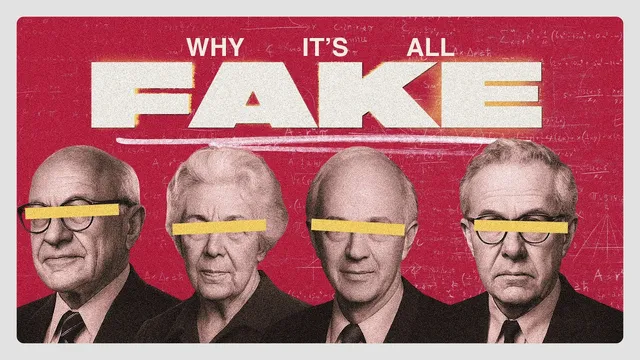
Should We Trust (Neoliberal) Economists?
Based on Second Thought's video on YouTube. If you like this content, support the original creators by watching, liking and subscribing to their content.
The transcript argues that distrust should focus on economics’ political function—building and legitimizing a capitalism that benefits powerful groups—not just on forecasting errors.
Briefing
Neoliberal economists deserve skepticism not because their forecasts miss the mark, but because the discipline is built to manufacture a version of capitalism that benefits the powerful—and then to treat that manufactured world as if it were natural law. The core claim is that economics functions less like neutral science and more like a toolkit for reshaping policy, markets, and even everyday life so that “there is no other choice” becomes the default conclusion for governments and investors.
A recurring example is how mainstream economic frameworks—especially supply-and-demand—are treated as universal truths while ignoring how prices and markets actually get made. Prices are portrayed as emerging from impersonal forces, yet real-world pricing often relies on conventions, formulas, and strategic decisions. The transcript argues that even widely accepted valuation methods are political: discounting functions used in corporate decision-making are linked to economic theory associated with Irving Fischer, and those methods help prioritize shareholder value. In this view, theory doesn’t just describe capitalism; it helps build the conditions under which future profits become the practical definition of value.
The argument then shifts from abstract theory to real-world “experiments” that translate economic ideas into governance. The transcript points to the Chicago Boys—Chilean economists tied to the University of Chicago—who advised Augusto Pinochet after a CIA-backed coup. Their post-coup program, described as including trade liberalization, privatization (including social security), and a regressive value added tax, is presented as paired with mass repression: torture, disappearances, arrests, and a severe 1982 crash. While GDP later rebounded, the transcript emphasizes that poverty remained high, education and healthcare were heavily privatized, and the richest 10% saw large income gains—framing the outcome as inequality rather than prosperity.
Other country cases are used to argue that shock-therapy style neoliberal reforms repeatedly fail or worsen conditions. Jeffrey Sachs is cited in connection with economic “shock treatment” for places like Bolivia, Poland, and Russia. More recent, more targeted interventions are described as “conservative” in scale but still damaging, sometimes backed by philanthropists who fund libertarian trials rather than socialist ones.
A central case study is Hernando de Soto’s property-titling theory, which claims that the poor in the global south stay poor because their assets are not formally recorded and therefore cannot be leveraged for credit. The transcript says the World Bank funded the Urban Property Rights Project in Peru and that results showed no increase in credit for the poor. In Egypt, evidence is described as showing little or no positive impact, with tenants harmed and rents rising as property became easier to sell—enabling speculation by wealthier owners. The transcript concludes that titling made wealth more liquid for the rich, increased foreclosures and evictions for the poor, and required courts and police enforcement.
Taken together, the message is blunt: economists are portrayed as producing and legitimizing policy tools that can intensify inequality, often through performative interventions that require state power and, at times, coercion. The takeaway is a call for distrust—because the discipline’s influence is treated as actively aligned with “violence against the poor,” not with public welfare.
Cornell Notes
The transcript argues that skepticism toward neoliberal economists should go beyond bad predictions. It claims economics is performative: theories and models help construct the capitalist reality they describe, often by supplying policy justifications that favor the rich. Examples include valuation frameworks that steer decisions toward shareholder value and property-titling programs that, in practice, increased rents, speculation, and evictions rather than expanding credit for the poor. The Chile case is used to show how neoliberal reforms can coincide with repression and long-run inequality even when GDP later rebounds. Overall, the transcript frames economists as influential architects of policy outcomes, not neutral analysts of economic truth.
Why does the transcript say economists should be distrusted even when their forecasts are wrong for the “right” reasons?
How does the transcript connect economic theory to real pricing and corporate decision-making?
What is the Chile example meant to demonstrate about neoliberal reforms?
What does the transcript say about property titling as a solution to poverty?
How does the transcript portray the role of power and enforcement in economic “experiments”?
Review Questions
- What does the transcript mean by economics being “performative,” and how do the examples of discounting functions or property titling support that claim?
- Which Chilean and World Bank-linked cases are used to argue that neoliberal reforms can increase inequality even when GDP later improves?
- How does the transcript connect economic theory to enforcement mechanisms like courts and police, and why does it treat that as central rather than incidental?
Key Points
- 1
The transcript argues that distrust should focus on economics’ political function—building and legitimizing a capitalism that benefits powerful groups—not just on forecasting errors.
- 2
Mainstream market concepts like supply and demand are portrayed as abstractions that hide how pricing is actually set through conventions, formulas, and strategic decisions.
- 3
Corporate valuation practices are linked to economic theory via discounting functions, which can embed shareholder value as the practical definition of worth.
- 4
Neoliberal reforms are presented as performative interventions that require governance capacity and often coercion, not neutral observation.
- 5
The Chile case is used to connect Chicago-linked neoliberal policy prescriptions with repression and long-run inequality despite later GDP growth.
- 6
Property titling is described as failing to expand credit for the poor in Peru and as harming tenants and raising rents in Egypt, while enabling speculation by wealthier owners.
- 7
The overall conclusion is a call for skepticism toward economists because their influence is framed as aligned with “prosperity for a select few” rather than broad welfare.