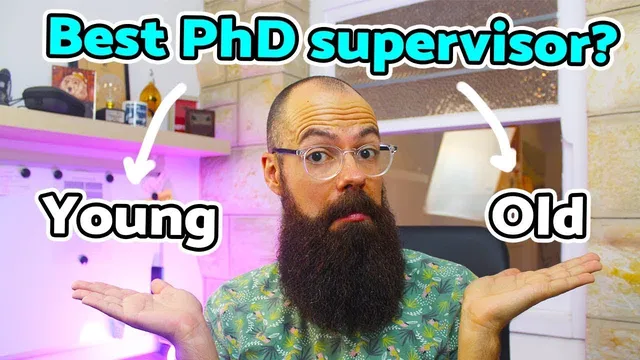
Should you select a young or an old famous PhD supervisor?
Based on Andy Stapleton's video on YouTube. If you like this content, support the original creators by watching, liking and subscribing to their content.
Younger supervisors are often more hands-on and motivated to ensure early PhD cohorts succeed, which can improve day-to-day progress and completion rates.
Briefing
Choosing a PhD supervisor—whether young and fast-rising or older and deeply established—shapes not just research outcomes but day-to-day support, career momentum, and financial stability over a multi-year degree. The central trade-off is straightforward: younger supervisors often bring higher drive, more hands-on attention, and willingness to take risks, while older supervisors tend to offer proven systems, stronger networks, and steadier funding.
Younger academics are described as “hungrier” because they’re early in their careers, eager to make an impression, and motivated to ensure their first cohorts of PhD students succeed. That urgency can translate into more time spent with students and more effort to push projects to completion. The upside extends beyond supervision style: the same ambition can mean more opportunities for grants and pay, plus closer day-to-day contact that helps students navigate uncertainty. Younger supervisors also tend to be less locked into a single niche. Having built early reputation in a particular area, they may still take more sideways steps—exploring adjacent ideas—because they’re still building their research identity and momentum.
Older supervisors, by contrast, are portrayed as having a durable “formula” for research success: established grant routines, predictable collaborations, and a lab hierarchy that has been refined over many PhD cohorts. That can be comforting when a student is entering an unfamiliar research landscape, because the supervisor knows the field deeply and has already guided many students through it. But the cost is structural: students may spend more time operating within the supervisor’s established framework rather than developing an independent trajectory. The hierarchy can also mean students remain in the supervisor’s shadow, with fewer upward positions and fewer chances to define a distinct career path.
Where older supervisors often stand out is access—stronger connections and collaborations that can expand a student’s experience through sabbaticals, lab visits, conferences, and international exposure. The transcript includes an example of a supervisor’s sabbatical leading to a student traveling from Australia to Durham for a short period, illustrating how networks can directly enrich a PhD. Older academics also tend to deliver more consistent funding. In academia’s “survival” game—grant applications, persistence, and hit rates—experience can produce larger grants that last longer, reducing the risk of financial gaps that might disrupt lab work.
Finally, younger supervisors are framed as better attuned to the modern academic “game,” which increasingly rewards promotion, public communication, and personal branding alongside traditional publishing. They may pursue awards, build visibility through media and public talks, and treat science as something that must be actively seen to matter. The practical takeaway is not simply “young is better” or “old is safer,” but whether the supervisor—regardless of age—is committed to the student, engaged in the student’s development, and aligned with the realities of academic careers today.
Cornell Notes
The choice between a young or older PhD supervisor comes down to different strengths and risks. Younger supervisors are often more driven and hands-on, take more research risks, and may be more flexible in exploring beyond a narrow niche. Older supervisors usually bring established systems, deeper field expertise, stronger networks, and steadier funding—though students can feel constrained by lab hierarchy and remain in the supervisor’s shadow. The transcript also highlights a modern shift: success increasingly depends on promotion and public visibility, where younger academics may be more fluent. Ultimately, the most important factor is the supervisor’s commitment to the student and fit with the student’s career needs.
Why do younger supervisors often seem more helpful during a PhD?
How can younger supervisors change a student’s research experience?
What are the main downsides of working under an older, established supervisor?
How do older supervisors tend to improve a PhD through connections and funding?
What does “the new academic game” mean, and why does it matter for supervisor choice?
Review Questions
- If you value independence and exploring adjacent research directions, what supervisor traits in the transcript would you prioritize?
- Which advantages of older supervisors are most likely to reduce risk during a long PhD, and what trade-offs come with them?
- How does the transcript connect personal branding and public communication to grant success or academic advancement?
Key Points
- 1
Younger supervisors are often more hands-on and motivated to ensure early PhD cohorts succeed, which can improve day-to-day progress and completion rates.
- 2
Younger academics may take more research risks and explore beyond a narrow niche, giving students more room to shape a research path.
- 3
Older supervisors typically offer proven systems for grants, collaborations, and research execution, which can reduce uncertainty for students entering a new field.
- 4
Older labs may have stronger hierarchies, which can limit students’ ability to develop a distinct trajectory and keep them closely tied to the supervisor’s identity.
- 5
Older supervisors often provide stronger networks and more consistent funding, enabling travel, collaborations, and fewer financial disruptions.
- 6
Younger supervisors may be better aligned with modern academic incentives like promotion, public communication, and personal branding—skills that can influence recognition and opportunities.
- 7
The most important selection criterion is whether the supervisor is genuinely committed to the student and fits the student’s career needs, not age alone.