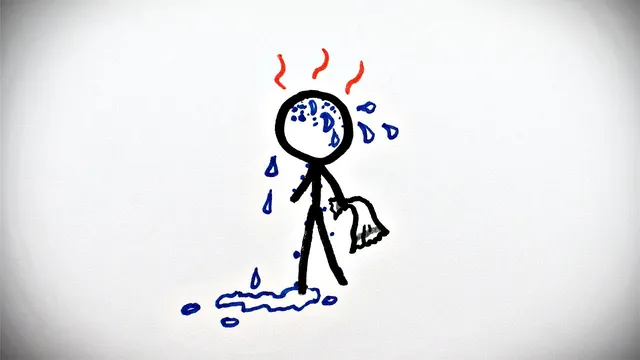
Should You Wipe Off Your Sweat?
Based on minutephysics's video on YouTube. If you like this content, support the original creators by watching, liking and subscribing to their content.
Evaporative cooling removes far more heat than liquid cooling because water absorbs about 540 Calories per liter when it evaporates versus about 37 Calories per liter when it only warms to body temperature.
Briefing
Wiping sweat off your skin usually reduces cooling efficiency because sweat works best when it evaporates. From a physics standpoint, evaporative cooling can remove far more heat from the body per hour than liquid cooling through direct heat transfer.
Two water-based cooling mechanisms explain the difference. In liquid cooling, cool water absorbs heat as it warms up. The heat capacity of water means that each degree Celsius rise corresponds to about 1 Calorie per liter per °C. If someone drank roughly a liter of freezing-cold water every hour, that water would warm to body temperature, removing at most about 37 Calories of heat per hour (the temperature gap from freezing to body temperature). That sets the scale for direct heat transfer.
Evaporative cooling is much more powerful. When water evaporates, it absorbs latent heat—about 540 Calories per liter—far exceeding the 37 Calories possible from warming the same liter of water. The limiting factor is how much water the body can evaporate. Under room-temperature conditions, a square meter evaporates only about a third of a liter per hour, and human skin area is roughly 1 to 2 square meters. That implies a sweaty person might lose on the order of 180 to 360 Calories per hour through evaporation—roughly 5 to 10 times the cooling power of liquid heat transfer.
Condition matters: evaporation strengthens in hotter, windier, and drier air, and weakens when it’s cooler or more humid. Still, the overall conclusion holds for human bodies—letting sweat evaporate is typically more effective than wiping it away.
Sweat also has practical caveats. If sweat is literally dripping off the skin, wiping it off won’t help evaporative cooling once it’s on the ground, and dripping suggests sweat is being produced faster than it can evaporate. In that case, wiping some may be acceptable. But for the best evaporative effect, smearing sweat around can increase surface area and keep more water available to evaporate.
The takeaway is straightforward: if sweat is not dripping, physics favors leaving it on; if it’s dripping, wiping is less useful than redistributing it so evaporation can do the cooling work. The discussion stays strictly in physics terms and explicitly avoids medical or hygiene advice.
Cornell Notes
Sweat cools the body mainly through evaporation, and evaporation removes far more heat than simply warming water. Liquid cooling works by transferring heat into water as it rises from freezing to body temperature, which yields only about 37 Calories per liter. Evaporation absorbs about 540 Calories per liter, so even with limits on how fast a human can evaporate water (roughly 180–360 Calories per hour based on 1–2 m² of skin area), it still beats liquid cooling by about 5–10×. Evaporation improves in hot, windy, dry air and drops in humid or cool conditions. If sweat is dripping, wiping may be less helpful because evaporative cooling is already failing; smearing sweat to increase surface area can help.
Why does evaporative cooling outperform wiping sweat off from a physics perspective?
What limits how much cooling a sweating body can achieve?
How do weather conditions change the effectiveness of sweat evaporation?
When is wiping sweat off more acceptable?
Why might smearing sweat be better than wiping it entirely when sweat is dripping?
Review Questions
- Estimate the cooling difference between liquid cooling and evaporative cooling for 1 liter of water using the given Calories-per-liter figures. What ratio do you get?
- Given skin area of 1–2 m² and an evaporation rate of about 1/3 liter per m² per hour at room temperature, what range of Calories per hour could evaporative cooling remove?
- How would higher humidity likely change the cooling rate, and why does that follow from evaporation physics?
Key Points
- 1
Evaporative cooling removes far more heat than liquid cooling because water absorbs about 540 Calories per liter when it evaporates versus about 37 Calories per liter when it only warms to body temperature.
- 2
A liter of freezing-cold water can remove at most roughly 37 Calories per hour through direct heat transfer, assuming it warms to body temperature.
- 3
Human evaporative cooling is limited by evaporation rate and skin area; with 1–2 m² of surface area, the estimated maximum is about 180–360 Calories per hour.
- 4
Sweat evaporation works best in hot, windy, and dry conditions and becomes less effective in cool or humid air.
- 5
If sweat is not dripping, leaving it on generally supports the body’s intended cooling mechanism.
- 6
If sweat is dripping, wiping may be less helpful because evaporative cooling is already failing; smearing sweat can increase surface area and improve evaporation.
- 7
The guidance here is physics-based and not medical or hygiene advice.