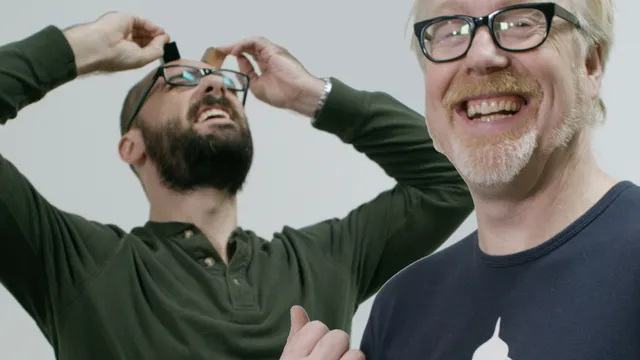
Showing My Desk to Adam Savage
Based on Vsauce's video on YouTube. If you like this content, support the original creators by watching, liking and subscribing to their content.
A pupil’s name traces to Latin “pupilla,” tying the “little doll” idea to both the eye’s pupil and the concept of a young student.
Briefing
A cluttered desk becomes a map of how ideas form: the objects on Michael David Stevens’ workstation double as hands-on physics lessons, memory aids, and tools for building spatial intuition. Adam Savage’s tour turns “mess” into a working philosophy—leave materials within reach, fidget with them, and let curiosity drive the next step of making.
The tour opens with a quick detour into biology and language: the eye’s pupil is named from Latin “pupilla,” meaning a little doll. Looking into someone’s eye reveals a tiny reflected self, and that “little doll” idea links to both the pupil in the eye and the pupil as a young student. From there, the desk’s centerpiece physics arrives in the form of a Sterling engine—powered by the heat difference between a hand-warmed surface and a cooler plate. The engine’s motion comes from temperature-driven gas behavior: as air gains kinetic energy when warmed, stronger average collisions push the pistons and wheel; rapid cooling shifts the pressure and forces the cycle to repeat.
Savage and Stevens then connect the engine’s temperature mechanics to classic demonstrations. The “egg sucking” bottle trick is reframed: it isn’t suction caused by oxygen disappearing, but pressure differences that evolve as the flame heats the air and then the system cools. As the egg’s shape maintains a seal, outside atmospheric pressure gradually wins once the air inside becomes weaker, pushing the egg inward. The conversation also generalizes the idea to everyday “suction” like straws—air pressure differences do the work, not a literal pulling force.
The desk’s physical clutter also serves as training equipment for the mind. Stevens highlights puzzle mechanisms—wire-style locking puzzles, centrifugal/inertia-based disassembly, and topology-inspired sphere dissections—that build three-dimensional visualization and finger strength. He describes a maker’s turning point: once structure can be imagined internally, building becomes faster and more iterative, especially when experimenting with new materials.
Material science shows up repeatedly. A density cube set lets him compare metals by feel and thermal conductivity; he even runs a forehead-guessing game to identify copper versus iron based on which feels cooler. He discusses patinas on lead and other metals, including how contact with wood oils and handling might explain dark brown or tarnished surfaces. There are also practical “desk tools” like erasable pens whose ink becomes invisible when heated, plus novelty objects with unusual optical or measurement properties.
The tour ends by tying the desk’s curiosity to public outreach: Brain Candy Live hits the road across the United States starting February 21, with stops in 40 cities. A final add-on shifts from objects to biology again—blinking. Typical blinks last 100–300 milliseconds, and people blink anywhere from about three to 30 times per minute depending on focus. Even with the planet’s population, the odds that everyone blinks simultaneously are astronomically low, making it a near-impossible event to witness.
Cornell Notes
A messy desk is treated as an engine for thinking: the objects within reach support hands-on physics, spatial visualization, and material intuition. The tour spotlights a Sterling engine that runs on temperature differences, then uses that same temperature-pressure logic to correct common explanations like the “egg sucking” bottle trick. Puzzle mechanisms are framed as training for 3D visualization and dexterity, while density and thermal-conductivity sets turn metal properties into tactile experiments. The desk’s mix of science tools and curiosities also feeds into Brain Candy Live, which brings these ideas to audiences on tour. The result is a practical philosophy: keep experiments visible, and let curiosity do the organizing.
Why does a Sterling engine run just from a hand, and what role does temperature play?
What’s the corrected explanation for the “egg sucking” bottle trick?
How do puzzles on the desk connect to building skills?
How can thermal conductivity be tested with a simple “feel” experiment?
What might explain patina differences on lead and other metals?
How unlikely is it for everyone on Earth to blink at the same time?
Review Questions
- What temperature-driven mechanism lets a Sterling engine cycle between pistons, and how does that connect to pressure differences?
- In the egg-in-bottle demonstration, what changes over time so atmospheric pressure eventually wins?
- How do the puzzle types described (locking, centrifugal/inertia-based, topology-like dissections) map to specific cognitive or motor skills?
Key Points
- 1
A pupil’s name traces to Latin “pupilla,” tying the “little doll” idea to both the eye’s pupil and the concept of a young student.
- 2
A Sterling engine’s motion comes from temperature differences that increase molecular kinetic energy, raising collision forces and shifting piston pressure cycles.
- 3
The “egg sucking” trick is best understood as pressure-driven: cooling weakens internal air pressure while the egg’s seal geometry prevents easy equalization.
- 4
Puzzle mechanisms can function as deliberate training for three-dimensional visualization and dexterity, not just entertainment.
- 5
Tactile experiments can estimate material properties: copper can feel cooler than iron because higher thermal conductivity changes how quickly heat transfers.
- 6
Metal patinas may reflect contact chemistry and handling (including oils from wood and repeated human touch), not only exposure to air.
- 7
Blinking is frequent and brief, but the probability that everyone blinks simultaneously is astronomically low.