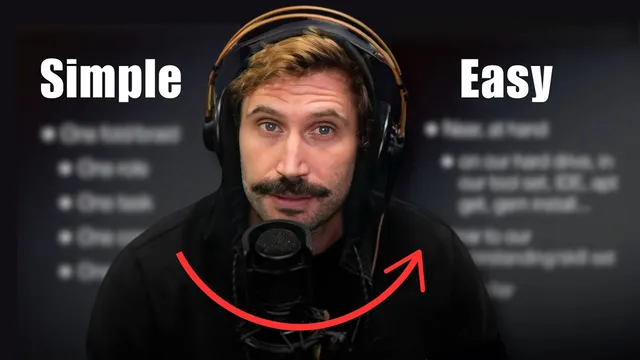
Simple Made Easy - Prime Reacts
Based on The PrimeTime's video on YouTube. If you like this content, support the original creators by watching, liking and subscribing to their content.
Simplicity is tied to structural independence: avoid “braiding” parts of a system so understanding and change don’t require pulling everything into one mental model.
Briefing
Simplicity in software isn’t a vibe or a matter of taste—it’s an objective property tied to whether parts of a system are “braided together” (entangled) or kept separate. The core claim is that reliability and long-term maintainability come from building systems whose components have minimal interleaving: one concept, one responsibility, and clear boundaries so changes don’t ripple unpredictably through the rest of the codebase.
The talk draws a sharp distinction between “simple” and “easy,” arguing that easy is relative to familiarity and current capability, while simple is about structural independence. “Simple” traces to ideas of a single fold or twist; “complex” to things folded or braided together. “Easy” is framed around nearness—near to understanding, near to the tools people already know, and near to what feels immediately usable. That framing explains why teams often chase technologies that let them move fast at the start (React-style familiarity with the DOM, quick installers, low ramp-up) while quietly accumulating entanglement that later slows everything down. Guardrails like tests and type checkers help catch errors, but they don’t replace the need for reasoning about behavior when the system inevitably changes.
A major practical thread is that complexity shows up as entanglement across constructs and artifacts. Even if a language feature feels straightforward to type, the long-term question is whether the running system can be understood, trusted, debugged, and modified. The talk argues that “incidental complexity” (extra complexity introduced by the chosen tools or constructs) is avoidable in many cases, while “problem complexity” (the real difficulty of the domain) is not. It also emphasizes that reliability depends on limiting what different parts of the system are allowed to “think about” at the same time.
From there, the discussion turns to what makes software entangled: state, objects that mix identity/value/state, methods that couple behavior to mutable context, inheritance and polymorphism patterns that can braid concerns, and control flow scattered with conditionals and rules. The proposed antidote is to prefer values and declarative data manipulation, use polymorphism “a la carte” (separating data structures, sets of functions, and the connections between them), and design abstractions that are small and strictly separated into “who/what” (specification) versus “how” (implementation). The talk warns against “abstraction” that merely hides complexity behind an interface—true simplification should reduce entanglement rather than disguise it.
The closing message is blunt: simplicity is a choice requiring vigilance, and the most important habit is repeatedly asking whether two things are intertwined for a reason—or whether they can be separated with clearer boundaries. In short, speed from “easy” can get you to the finish line early, but ignoring “simple” invites a long-term drag as complexity compounds and sprints turn into rewrites.
Cornell Notes
The talk distinguishes “simple” from “easy” to explain why software often slows down over time. “Easy” is relative to familiarity and capability—near to what people already know—so it can speed up early development. “Simple” is treated as an objective structural property: parts of a system should not be braided together (entangled), because entanglement limits understanding and makes change risky. Long-term reliability depends less on typing convenience and more on the behavior of the running artifact: whether it can be reasoned about, debugged, and modified. The practical prescription is to look for incidental complexity, separate concerns (“who/what” from “how”), and constantly ask whether two elements truly need to be intertwined.
How does the talk define “simple” versus “easy,” and why does that matter for software reliability?
What does “entanglement” look like in real code, beyond just having many files or classes?
Why are tests and type systems described as “guardrails” rather than the solution to complexity?
What design approach does the talk recommend for building abstractions that improve simplicity?
How does the talk treat state, and what makes state especially dangerous for simplicity?
What is the talk’s practical “checklist” for spotting incidental complexity?
Review Questions
- How does the talk justify treating “simple” as objective while “easy” is relative, and what are the implications for technology choices?
- Give two examples of entanglement that could exist even when code is neatly modularized. How would you detect them using the talk’s lens?
- What does it mean to separate “who/what” from “how” in abstraction design, and why does that reduce the risk of future change?
Key Points
- 1
Simplicity is tied to structural independence: avoid “braiding” parts of a system so understanding and change don’t require pulling everything into one mental model.
- 2
Easy is relative to familiarity and capability; chasing easy can accelerate early work while still accumulating entanglement that slows long-term progress.
- 3
Reliability depends on the behavior of the running artifact over time—whether it can be trusted, debugged, and modified—not on how convenient the constructs feel to type.
- 4
Tests and type systems act as guardrails; they don’t replace reasoning when requirements change and interactions become non-obvious.
- 5
State is especially entangling because it couples outputs to time/history, making failures harder to reproduce and understand.
- 6
Design abstractions as small specifications that separate “who/what” from “how,” and prefer “a la carte” polymorphism that keeps data, functions, and wiring independently chosen.
- 7
The recurring habit is to ask whether two elements are intertwined for a real reason or whether they can be separated to reduce incidental complexity.