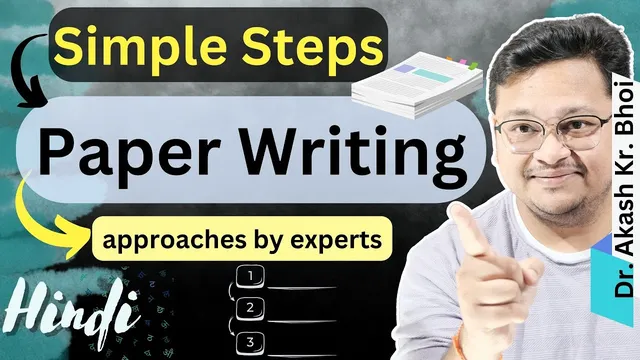
Simple Steps to Write a Research Paper || Hindi | Dr. Akash Bhoi
Based on eSupport for Research's video on YouTube. If you like this content, support the original creators by watching, liking and subscribing to their content.
Start by selecting a broad subject area, then narrow it to a specialized topic based on knowledge, interest, and a realistic scope.
Briefing
Research paper writing becomes far easier when the work is treated as a sequence of narrowing decisions—start with a broad subject, define a clear research gap and objective, then build the paper outward from literature and evidence into a structured draft that can be edited into a final submission. The core message is practical: pick a topic you can realistically specialize in, frame what you want to achieve, and let the literature review and outline drive what gets written next.
The process begins with selecting a subject area and then narrowing it. Instead of jumping straight into drafting, the guidance emphasizes choosing a broad area where knowledge and interest already exist, then reducing it to a specific topic—similar to how academic paths narrow from undergraduate to postgraduate to PhD. Once the topic is narrowed, the next step is framing a tentative objective: what the research aims to accomplish, and what it will measure or demonstrate. From there, a literature review becomes the foundation. The literature search should be systematic, and it can include structured methods such as meta-analysis; the point is to map what is already known and identify where the research gap sits.
After the literature review is completed, the workflow shifts to planning and drafting. A working outline should be created to define the paper’s structure and the order of sections. Then comes drafting: turning collected notes and findings into a rough draft that can later be edited. The editing phase is treated as iterative—refining the draft so that the research results (including experimentation outcomes, simulations, or hardware-based work) are clearly presented and tied back to the objective. The final draft is then prepared for submission to the target venue, whether that is a journal, conference, or book chapter.
Two complementary frameworks reinforce this sequence. One approach breaks writing into six steps: understand the assignment and project context, narrow the topic and frame the research question based on the objective, begin research in the chosen area, construct and outline the expected results, write the draft, and then produce the final draft for submission. Another framework focuses on the standard academic paper structure—IMRaD (Introduction, Methods, Results, Discussion)—noting that reviewers and editors look for these components and for logical evidence-based connections between them.
Beyond structure, the guidance highlights what must be explicitly connected inside the narrative: evidence and explanation, comparisons and contrasts between approaches, identification of issues and proposed solutions, and the cause-and-effect relationship between events and outcomes. It also stresses writing discipline: keep objectives aligned with the project, avoid personal bias by using third-person academic language, and ensure every section links to the next so the paper reads as a coherent chain rather than disconnected blocks.
Finally, the advice includes submission-ready tactics: draft the content first (especially methods, results, and discussion), then write or refine the abstract and title so they match what the paper actually delivers. Abstracts should be comprehensive but concise, and titles should be specific enough to include relevant keywords while still being distinctive. The overall takeaway is that strong research papers come from narrowing decisions, systematic literature work, evidence-driven drafting, and careful structural editing—rather than from rushing to write without a plan.
Cornell Notes
The transcript lays out a step-by-step method for writing a research paper that starts with narrowing a broad subject into a specific topic and research gap. It then frames tentative objectives, conducts a systematic literature review, and builds a working outline before drafting a rough version that can be edited into a final submission. Two organizing models are emphasized: a six-step workflow (topic → question/objective → research → outline → draft → final draft) and the IMRaD structure (Introduction, Methods, Results, Discussion). The guidance matters because it turns writing into a controlled process where each section is evidence-based, logically connected, and aligned with the research question and expected outcomes.
Why does narrowing the topic come before drafting, and how is it done?
What role does the literature review play in the overall workflow?
How should objectives and research questions be framed?
What is the recommended paper structure, and what do reviewers look for?
What writing practices improve clarity and academic tone?
In what order should sections like abstract and title be handled?
Review Questions
- What steps help transform a broad subject into a researchable topic with a clear research gap and objective?
- How do IMRaD sections need to connect logically to the research question, evidence, and outcomes?
- Why does the transcript recommend writing the abstract and title after drafting the main content?
Key Points
- 1
Start by selecting a broad subject area, then narrow it to a specialized topic based on knowledge, interest, and a realistic scope.
- 2
Frame a tentative objective and research question that clearly state what the study will achieve and what gap it targets.
- 3
Conduct a systematic literature review to map existing work and identify the research gap; use it to build the paper’s outline and claims.
- 4
Draft a rough outline and then write a rough draft before focusing on editing, ensuring methods and results match the objective.
- 5
Use a standard structure like IMRaD (Introduction, Methods, Results, Discussion) and ensure every required component is present.
- 6
Write in third person to maintain objectivity, and connect sections through evidence, explanation, and comparisons rather than isolated paragraphs.
- 7
Draft main content first, then refine the abstract and title so they accurately reflect the final results and discussion.