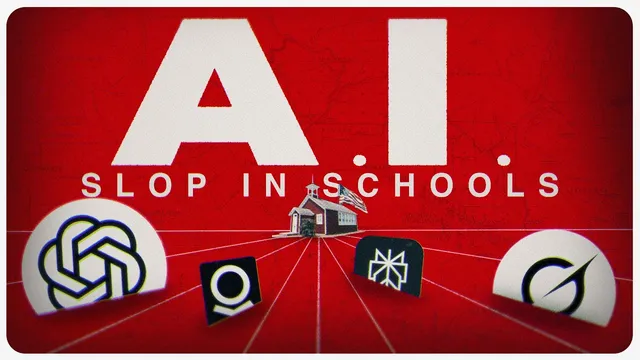
Slop School is Here
Based on Second Thought's video on YouTube. If you like this content, support the original creators by watching, liking and subscribing to their content.
PragerU-style materials are increasingly being approved for classroom use, including lesson plans that promote conservative interpretations of politics and society.
Briefing
A coordinated push is reshaping American education around nationalism, ideological conformity, and AI-driven cost cutting—while siphoning resources away from public schools and toward conservative-aligned alternatives. The central concern is that “patriotic education” initiatives and AI tutoring deployments are being used together to reduce critical learning, weaken teacher capacity, and steer students toward pro–white Christian nationalist narratives.
The effort begins with curriculum and media. PragerU materials—often framed as “historical accuracy” and “facts over feelings”—are already finding their way into classrooms, with multiple states approving PragerU content for use in public education. That content is paired with lesson plans that promote conservative claims about socialism, migration, and the role of oil companies. The concern isn’t just that the material is partisan; it’s that it is becoming normalized through school adoption.
That classroom pipeline is now being reinforced by a broader federal-aligned project aimed at “renewing patriotic education” for the U.S. semi-quincentennial. A new coalition, including the Department of Education and prominent conservative organizations, is described as building educational materials intended to make students “know America and love America,” even if that requires sacrificing academic priorities like math and science. The underlying message—education as loyalty training rather than broad intellectual development—signals a shift away from democratic literacy toward ideological formation.
AI is presented as the next lever, but the mechanism is framed as familiar: privatize, reduce staffing, and market selective outcomes. The White House’s push for AI opportunities in classrooms is linked to large-scale deployments and to private tutoring models that claim students can learn as much as in a full day by replacing teachers with computer-based instruction. One example discussed is “2-hour learning”/Alpha School, which markets rapid academic gains while allegedly relying on selective enrollment, heavy staffing relative to public schools, and incentives that reward high performers. The argument is that AI branding can persuade policymakers to expand cost-cutting in underfunded districts—where the staffing and student-selection safeguards present in premium programs are unlikely to exist.
Meanwhile, public education is portrayed as being weakened through budget cuts, regulatory rollbacks, and federal pressure. The transcript cites reductions to programs such as ESL support, withheld grants for teacher training and special education, and a broader climate of compliance—where schools face funding threats tied to speech and behavior around queer students and staff. The same pressure tactics are compared to college-level leverage, where universities are said to face financial consequences over campus controversies and then adjust to conservative demands.
As public schools lose capacity and credibility, the transcript argues that conservative and far-right alternatives are expanding—through vouchers, homeschooling networks, and new institutions backed by wealthy donors. Examples include homeschooling materials with explicitly Nazi-approved content and a new “classical” university described as aligned with a narrow, patriotic, white supremacist canon. The overall outcome is depicted as a two-track system: under-resourced public schooling focused on loyalty and surveillance, and better-funded private or semi-private education for the ruling class.
The stakes are framed as civic. Public education is described as a foundation for critical reading, math and science literacy, accurate history, and informed democratic participation. Without it, the transcript warns, more students will fall behind, fewer will develop the skills needed to challenge power, and ideological radicalization becomes easier—especially when students are funneled into environments that reward conformity rather than inquiry.
Cornell Notes
The transcript argues that American education is being reshaped through two linked strategies: ideological curriculum pipelines and AI-driven privatization. PragerU-style content is increasingly entering classrooms, while a federal-aligned coalition builds “patriotic education” materials that prioritize love of America over academic excellence. At the same time, AI tutoring programs are marketed as teacher replacements and cost savers, but their claimed success is attributed to selective enrollment, incentives, and marketing rather than AI alone—raising fears of staffing cuts in poorer districts. Combined with funding threats, program rollbacks, and voucher expansion, public schools are portrayed as losing capacity while conservative alternatives grow. The result, it warns, is weaker civic literacy and a widening divide in educational opportunity.
How does the transcript connect patriotic curriculum efforts to changes in classroom learning?
What role does AI play in the transcript’s critique of public education?
Why does the transcript argue that AI marketing can mislead policymakers?
What funding and regulatory pressures are described as weakening public schools?
How does the transcript describe the shift from public schooling to alternatives like vouchers and homeschooling?
What civic consequence does the transcript emphasize?
Review Questions
- What specific mechanisms does the transcript claim connect patriotic curriculum initiatives to reduced academic priorities?
- How does the transcript distinguish between AI’s marketed results and the structural factors (selection, staffing, incentives) it says drive those results?
- Which funding and compliance tools does the transcript describe as pressuring schools, and how do those tools shape classroom behavior?
Key Points
- 1
PragerU-style materials are increasingly being approved for classroom use, including lesson plans that promote conservative interpretations of politics and society.
- 2
A federal-aligned coalition is building “patriotic education” materials aimed at making students love America, with claims that academic excellence can be deprioritized.
- 3
AI tutoring is framed as a staffing and privatization strategy, not just a learning tool, with teacher replacement marketed as cost-effective.
- 4
Programs like “2-hour learning”/Alpha School are criticized for relying on selective enrollment, disguised staffing (“guides”), and cash incentives for top performers.
- 5
Federal funding leverage is described as pushing schools toward self-censorship and compliance on controversial issues, while also cutting or rolling back support programs.
- 6
Voucher expansion and lax homeschooling oversight are portrayed as enabling conservative and far-right alternatives to capture public funds.
- 7
The transcript argues that weakening public education undermines civic literacy and democratic participation, leaving more students unprepared to evaluate power and policy.