Snell's law proof using springs
Based on 3Blue1Brown's video on YouTube. If you like this content, support the original creators by watching, liking and subscribing to their content.
Fermat’s Principle selects the path that minimizes total travel time, not the shortest distance.
Briefing
Light bends at the boundary between two media because it chooses a path that minimizes travel time, even though the straight-line route between points in air and water is not optimal. Fermat’s Principle frames the tradeoff: light moves slower in water, so spending more distance in water can increase total time, while shifting the path to spend more time in air can reduce it. The result is a geometric balancing act—one that ultimately produces Snell’s law, the familiar rule from introductory optics.
A common first guess is that the shortest path between a point A in air and a point B in water is the straight line. That path is indeed the shortest, but it can force the beam to spend too long in water, where speed is lower. Moving the path so it spends less time in water can make the overall trip faster, yet pushing that adjustment too far also stops being beneficial because the beam then travels longer in air. The optimum sits between these competing effects, much like the brachistochrone problem’s balance between distance and speed.
Instead of using calculus to optimize the travel time, Mark Levi’s “springs” argument turns the optics problem into a mechanical equilibrium problem. The setup imagines a rod along the air–water interface with a ring that can slide left and right. Two springs connect the ring to point A (through air) and point B (through water). The geometry of the spring lengths acts like a candidate “path” for light: different ring positions correspond to different trajectories.
To make the mechanical model mimic Fermat’s Principle, the spring tensions are chosen so that the system’s potential energy matches the travel time that light would take along the corresponding path. That requires tensions to be inversely proportional to the speed of light in each medium. Real constant-tension springs don’t exist, but the key idea survives: the stable configuration of the mechanical system occurs when total energy is minimized, which mirrors the “fastest path” condition for light.
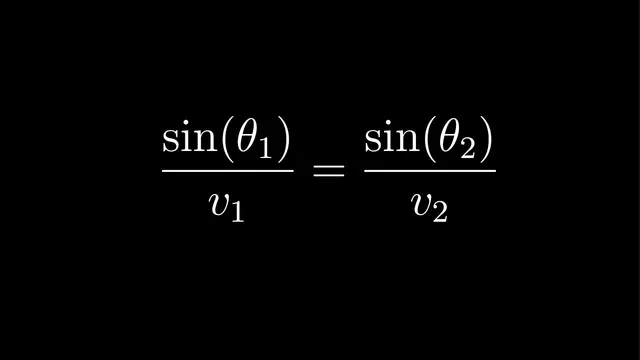
With the model in place, the equilibrium condition replaces calculus. At the stable position, the horizontal force component from the top spring must cancel the horizontal component from the bottom spring. Each spring’s horizontal component is the total force multiplied by the sine of the angle it makes with the vertical. Enforcing this balance produces the optical relationship known as Snell’s law: the quantity
sin(θ)/v
stays constant across the boundary, where v is the speed of light in the medium and θ is measured from the perpendicular to the interface. The bending of light thus emerges from a simple force-balance picture—no derivative required—while still reflecting the same time-minimization principle behind Fermat’s optics.
Cornell Notes
Snell’s law follows from Fermat’s Principle: light takes the path that minimizes travel time when its speed changes between media. A straight line between points in air and water is not generally fastest because light slows down in water, so reducing time spent in water can outweigh the added distance. Mark Levi’s springs construction converts the optimization into a mechanical equilibrium problem: a sliding ring on the interface connects to points A and B via springs whose effective tensions are chosen to reflect time in each medium. At equilibrium, horizontal force components cancel, and that force-balance condition yields Snell’s law, stating that sin(θ)/v is constant across the boundary. The approach avoids calculus by using geometry and stability instead.
Why isn’t the straight-line path between A (air) and B (water) always the fastest?
How does Fermat’s Principle determine the bending of light at a boundary?
What is the role of Mark Levi’s springs model in deriving Snell’s law?
Why does the derivation rely on force balance rather than calculus?
What exactly does Snell’s law say in this formulation?
Review Questions
- In Fermat’s Principle terms, what two competing effects determine the optimal path when light enters a slower medium?
- How does the springs setup translate “minimum travel time” into “minimum energy” and then into a force-balance condition?
- What geometric quantity involving θ and v remains constant across the interface, and why does equilibrium enforce that constancy?
Key Points
- 1
Fermat’s Principle selects the path that minimizes total travel time, not the shortest distance.
- 2
Because light is slower in water than in air, the beam bends to reduce time spent in the slower medium.
- 3
Mark Levi’s springs model maps candidate light paths to ring positions on an interface.
- 4
Choosing spring tensions inversely proportional to the speed of light makes mechanical energy correspond to optical travel time.
- 5
The stable configuration occurs when horizontal force components cancel, replacing calculus-based optimization.
- 6
Snell’s law follows as sin(θ)/v being constant across the boundary, with θ measured from the perpendicular to the interface.