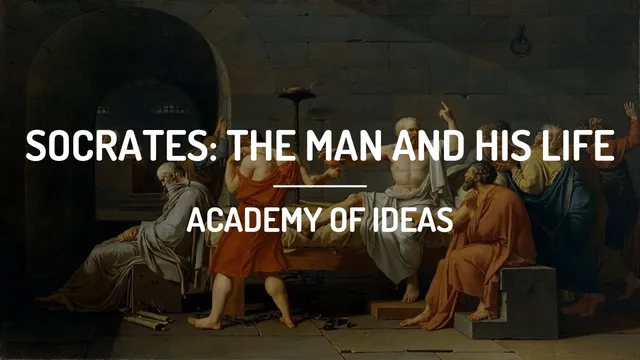
Socrates: The Man and His Life
Based on Academy of Ideas's video on YouTube. If you like this content, support the original creators by watching, liking and subscribing to their content.
Socrates’ “wisest man” reputation begins with a Delphi oracle that he took as a challenge to understand his own lack of wisdom.
Briefing
Socrates’ most enduring legacy traces back to a single oracle’s claim—he was “the wisest of all men”—and the chain reaction it set off: a mission to expose human ignorance, followed by a trial that ended in execution. Born in Athens in 469 BC and executed in 399 BC, Socrates left no writings, so later accounts differ; still, two moments stand out as widely treated as historically grounded: his response to the Oracle at Delphi and his subsequent trial and death.
Delphi, revered as the center of the ancient Greek world and dedicated to Apollo, carried the inscription “know thyself.” Pilgrims traveled to consult the Pythia, the oracle’s priestess, seeking guidance. When one of Socrates’ friends visited Delphi and relayed the oracle’s verdict, Socrates reacted with astonishment. He told himself he had no claim to wisdom “great or small,” then set out to test what the god could mean. In Plato’s Apology, Socrates describes searching the streets of Athens for someone wiser than himself—engaging politicians, poets, and craftsmen in conversation. The pattern that emerged was consistent: people appeared knowledgeable to themselves and others, yet they lacked real understanding of what matters most. Socrates’ “epiphany” was that the oracle pointed to a universal condition—most people are ignorant of how to live virtuously and therefore how to achieve happiness, while mistakenly believing they know.
That insight became Socrates’ life mission. He aimed to make others recognize they were trapped in a “cave of ignorance,” hoping that awareness would draw them into a philosophical quest for the knowledge required for the good life. Many Athenians, however, reacted defensively to his relentless questioning. Over time, his public reputation soured, and in 399 BC prosecutors brought charges that framed him as both religious and social threat: refusing to recognize the gods recognized by the state, introducing “other new divinities,” and corrupting the youth. The demanded penalty was death.
Understanding the trial also requires the political atmosphere. Athens had recently been defeated by Sparta in the Peloponnesian War, leaving the city fragile and searching for scapegoats. Socrates, widely disliked, became an easy target. At trial, he suggested the hostility itself would convict him, and he portrayed his work as a “gift of God” meant to improve citizens’ lives. He even argued that if condemned, Athenians would remain in a kind of waking sleep—continuing in ignorance because they had tried to silence the questioning that disturbed them.
Socrates was found guilty. When asked to propose an alternative penalty, he did not seek exile or escape; instead, he recommended free meals at the Prytaneum, a public honor reserved for those who benefited the city. The judges rejected the proposal and sentenced him to death by drinking hemlock. After the verdict, he warned that a harsher punishment would soon fall on the citizens for killing him. He reportedly drank the poison joyously and courageously, ending with the final instruction: “we owe a rooster to Asclepius—pay it without fail.” The explanation offered is that Socrates treated life itself as a kind of sickness; death, in his view, was the true cure.
Cornell Notes
Socrates’ response to the Oracle at Delphi—declaring him “the wisest of all men”—drives the central arc of his life. He tested the claim by questioning politicians, poets, and craftsmen and concluded that people often mistake confidence for knowledge, especially about how to live virtuously and achieve happiness. The oracle’s meaning, in this account, is that humanity is broadly ignorant of the most important knowledge while unaware of that ignorance. Socrates turned this into a mission: exposing ignorance through relentless questioning. His approach angered many Athenians, and amid political instability after the Peloponnesian War, he was charged with impiety and corrupting the youth, convicted, and executed by hemlock in 399 BC.
Why did the Delphi oracle matter so much to Socrates’ life?
How did Socrates interpret what he found in conversations with Athenians?
What was Socrates’ life mission after reaching that conclusion?
What charges led to Socrates’ trial, and why did they resonate in Athens?
Why did Socrates’ penalty recommendation after conviction anger the judges?
What is the meaning of Socrates’ last words about Asclepius?
Review Questions
- How does the oracle’s claim about Socrates being “the wisest” connect to the idea of recognizing ignorance?
- What role does Athens’ post–Peloponnesian War instability play in making Socrates a target for prosecution?
- Why would recommending free meals at the Prytaneum be read as provocative rather than conciliatory in the trial context?
Key Points
- 1
Socrates’ “wisest man” reputation begins with a Delphi oracle that he took as a challenge to understand his own lack of wisdom.
- 2
Testing the oracle required Socrates to question politicians, poets, and craftsmen and compare their confidence with their actual understanding.
- 3
The central conclusion attributed to Socrates is that most people are ignorant of how to live virtuously, yet believe they know the answer.
- 4
Socrates turned that insight into a public mission to awaken others to their ignorance and draw them into the pursuit of the good life.
- 5
Athenian political strain after the Peloponnesian War helped create conditions where Socrates could be treated as a scapegoat.
- 6
The indictment against Socrates combined religious accusations (impiety and new divinities) with a social one (corrupting the youth).
- 7
Socrates’ final act—drinking hemlock and ordering payment to Asclepius—was framed as a belief that death is the true cure.