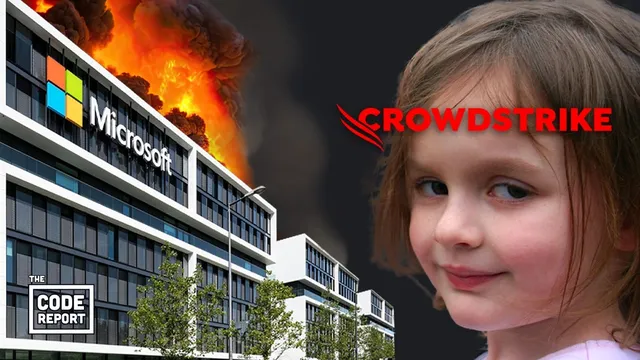
Some bad code just broke a billion Windows machines
Based on Fireship's video on YouTube. If you like this content, support the original creators by watching, liking and subscribing to their content.
CrowdStrike’s Falcon sensor integrates with Windows at low levels using kernel-mode drivers, putting it in the critical path of system operation.
Briefing
A faulty CrowdStrike update triggered widespread Windows “blue screen of death” failures on July 19, 2024, instantly bricking large numbers of enterprise machines and rippling into hospitals, airports, banks, and stock-market operations. The scale of the disruption—described as affecting millions to potentially billions of Windows systems—turned a routine software deployment into a global reliability crisis, not a targeted cyberattack.
At the center of the incident is CrowdStrike’s Falcon platform, which includes a “Falcon sensor” installed like standard software but integrated at a low level with the operating system. That integration often relies on kernel-mode drivers, meaning the security agent sits in the critical path of the computer. When the agent’s automated update contained bad code, systems that received it began failing hard enough to require recovery rather than a simple restart.
Recovery was also operationally painful. The affected machines needed to be rebooted into a fail mode so the problematic driver could be removed manually. For many employees, that meant IT teams had to perform the fix across large fleets, with limited self-service options. The result was a surge in emergency troubleshooting—compared to “surgeons in World War I”—as organizations scrambled to restore core services.
The disruption extended beyond IT desks. The London Stock Exchange faced interruptions, multiple airports in India reportedly went down and had to revert to manual boarding-pass processes, and hospitals struggled to continue patient care. Banks also reported inability to complete transactions, and even local businesses dependent on point-of-sale and drive-through operations were affected.
CrowdStrike moved quickly to frame the event as an operational failure rather than a security breach, emphasizing that it was not caused by an adversary. The company’s recommended remediation involved detaching the affected operating system disk, creating a snapshot or backup, mounting the volume on a new virtual server, navigating to the Windows driver directory, deleting a specific file (shown as “C291 CIS”), and then reattaching the corrected volume to the impacted server.
The broader lesson highlighted in the aftermath is structural: placing third-party security software with kernel-level access across massive enterprise environments creates a single point of failure. Even with strong auditing and incentives to prevent intrusions, one misstep in an automated update pipeline can cascade into systemic downtime. In that sense, the incident became less about “evil hackers” and more about how modern security tooling—designed to protect—can also magnify the blast radius when it fails.
Cornell Notes
CrowdStrike’s Falcon security agent, which uses low-level kernel-mode drivers, received an automated update containing bad code. Windows machines that installed the update began crashing into the blue screen of death, requiring more than a simple reboot—systems had to be restarted in fail mode and the faulty driver removed manually. The remediation process involved detaching the OS disk, mounting it on a new virtual server, deleting a specific driver file, and reattaching the corrected volume. The incident disrupted hospitals, airports, banks, and trading operations, illustrating how third-party security software in the critical path can become a large-scale reliability risk when updates go wrong.
Why did a security software update cause Windows to fail so catastrophically?
What made recovery difficult for organizations beyond the initial crash?
How did CrowdStrike describe the fix?
What real-world services were disrupted, and why does that matter?
What systemic risk does the incident highlight about enterprise security procurement?
Review Questions
- How does kernel-mode integration change the failure impact of a security agent compared with a normal user-space application?
- Why is manual driver removal in fail mode a bottleneck during large-scale outages?
- What does the incident suggest about balancing centralized security tooling with resilience and update safety?
Key Points
- 1
CrowdStrike’s Falcon sensor integrates with Windows at low levels using kernel-mode drivers, putting it in the critical path of system operation.
- 2
A bad automated update caused widespread blue screen failures on affected Windows machines, described as impacting millions to potentially billions of systems.
- 3
Recovery required rebooting into fail mode and manually removing the faulty driver, creating heavy operational load for IT teams.
- 4
CrowdStrike emphasized the event was not a security breach or cyberattack, and provided a disk-detach/mount/delete-file remediation workflow.
- 5
The outage disrupted major services including trading operations, airport operations, hospital care, and banking transactions.
- 6
The incident underscores a systemic reliability risk when third-party security software with deep OS access is deployed at massive scale.