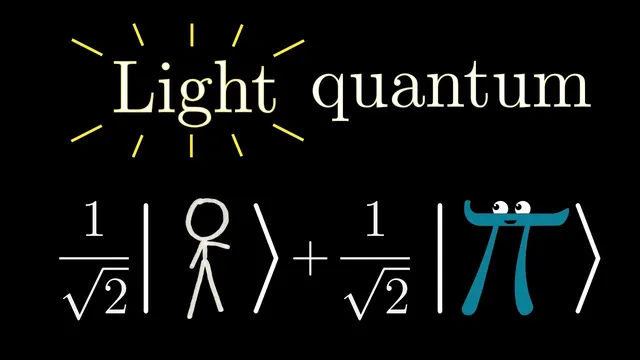
Some light quantum mechanics (with minutephysics)
Based on 3Blue1Brown's video on YouTube. If you like this content, support the original creators by watching, liking and subscribing to their content.
Maxwell’s equations in a vacuum are linear, so electromagnetic field solutions add to form valid superpositions.
Briefing
Quantum mechanics’ most counterintuitive feature—probabilities replacing classical “splits” of energy—can be built from the ordinary wave physics of light. Starting with Maxwell’s electromagnetic waves, the discussion shows how superposition, amplitudes, phases, and choice of basis already appear in classical polarization. The key shift comes when experiments reveal that light energy is quantized in indivisible packets: a photon carries a fixed amount of energy hf, so it cannot divide its energy between polarization components the way a classical wave would. That mismatch forces the squared amplitudes of a superposition to be interpreted not as energy fractions, but as probabilities for where the photon’s entire energy will be found after measurement.
The foundation begins in the late-1800s picture of light as coupled electric and magnetic vector fields. Maxwell’s equations imply that changing electric fields generate changing magnetic fields and vice versa, producing propagating electromagnetic waves whose electric and magnetic components oscillate perpendicular to each other and to the direction of travel. With that classical wave machinery in place, polarization becomes a clean laboratory for quantum-style math: a horizontally polarized electric field can be written as a cosine oscillation with frequency f, amplitude a, and phase shift ϕ, while vertically polarized light uses the orthogonal component. Because Maxwell’s equations are linear in a vacuum, two solutions can be added to form a superposition—exactly the same mathematical operation that later becomes central to quantum state descriptions.
Superposition in polarization naturally introduces phase-sensitive behavior. When horizontal and vertical components are in phase, the resulting polarization can be described in a rotated basis (for example, diagonal versus anti-diagonal). When the phase difference is 90 degrees and amplitudes match, the wave becomes circularly polarized. The choice of basis matters because different measurement devices “project” onto different directions: a polarizing filter absorbs energy from one polarization component, so it’s convenient to describe the incoming state in the filter’s aligned basis.
The quantum turn arrives with energy quantization. Classical wave energy scales like the square of amplitude, so a superposition with horizontal amplitude Ax and vertical amplitude Ay would suggest energy proportional to Ax² + Ay², and—crucially—energy could be continuously redistributed between components. Experiments instead indicate that electromagnetic energy comes in discrete amounts: for frequency f, the smallest nonzero energy is hf (Planck’s constant h times f). A photon therefore cannot exist as “half a photon” in one polarization and “half a photon” in another. When a diagonally polarized photon hits a vertically oriented polarizer, the classical expectation of partial absorption gives way to an all-or-nothing outcome: roughly half the photons pass and half are absorbed, with the passing photons emerging polarized along the filter.
That same logic extends to intermediate angles. For a photon whose polarization is 22.5 degrees off a filter, classical amplitude-squared reasoning predicts about 15% of the energy would align with the blocked component (sin² 22.5° ≈ 0.15). The quantum observation instead is probabilistic: about 15% of photons are fully blocked and about 85% pass entirely. The wave equations remain intact—superposition with amplitudes and phases still describes the state—but the interpretation changes. Squared amplitudes now encode probabilities for measurement outcomes, not divisible energy shares. In this way, the familiar wave math of polarization becomes a stepping stone to the broader quantum rule: quantum states are superpositions in a chosen basis, and measurement yields outcomes with probabilities proportional to the squared magnitudes of the corresponding amplitudes.
Cornell Notes
The discussion builds quantum intuition from classical polarization. Maxwell’s equations make electromagnetic waves linear, so different polarization components can be added as superpositions with amplitudes and phases, and the choice of basis depends on the measurement device. Classically, energy in a superposition scales with the square of amplitudes, suggesting energy could be split continuously between components. Quantum experiments show electromagnetic energy is quantized in indivisible packets hf, so a photon cannot carry “half the energy” in one polarization and “half” in another. As a result, squared amplitudes become probabilities for which polarization outcome the photon will fully realize after passing through a filter.
How do Maxwell’s equations justify using superposition for polarized light?
Why does phase matter for polarization, even before quantum enters?
What classical prediction fails once light is treated as photons?
What does the polarizer experiment show for a 45-degree photon?
How do intermediate angles translate into probabilities?
What stays the same, and what changes, when moving from classical waves to quantum photons?
Review Questions
- In what way does the linearity of Maxwell’s equations support the idea of adding polarization components as a superposition?
- Why can’t a diagonally polarized photon be thought of as carrying half its energy in each polarization component?
- How does the probability of passing through a polarizer relate to sin²(θ) or cos²(θ) for a photon at angle θ?
Key Points
- 1
Maxwell’s equations in a vacuum are linear, so electromagnetic field solutions add to form valid superpositions.
- 2
Polarization states depend on both amplitude and phase; phase differences can produce linear, diagonal, or circular polarization.
- 3
A polarizing filter effectively selects a basis by absorbing one polarization component and transmitting the orthogonal one.
- 4
Classical wave energy scales with amplitude squared, which suggests continuous energy splitting between components.
- 5
Experiments show light energy is quantized: a photon carries a fixed energy hf, so it cannot split energy between polarization components.
- 6
Squared amplitudes in a polarization superposition should be read as probabilities for measurement outcomes, not as divisible energy fractions.
- 7
Intermediate polarizer angles translate into probabilistic outcomes using the same amplitude-squared expressions (e.g., sin² and cos²).