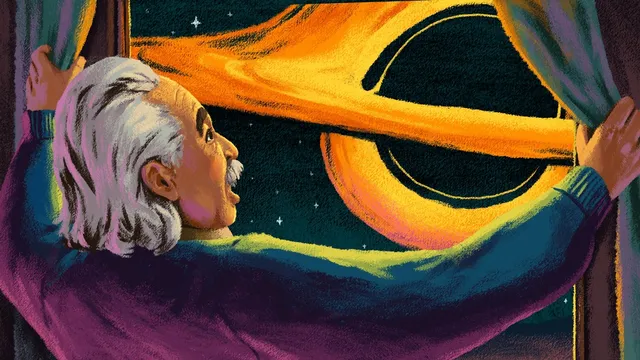
Something Strange Happens When You Follow Einstein's Math
Based on Veritasium's video on YouTube. If you like this content, support the original creators by watching, liking and subscribing to their content.
An outside observer sees infalling matter approach the event horizon with slowing motion and increasingly redshifted light that fades from view.
Briefing
Following Einstein’s general relativity leads to a counterintuitive picture of black holes: from the outside, nothing ever truly crosses the event horizon, while from the inside, passage through it is uneventful and inevitable. The key observational consequence is gravitational time dilation. A rocket aimed at a black hole would appear to slow down as it approaches the horizon, with its “fist-shaking” motion also slowing. Light from the infalling object becomes progressively dimmer and more redshifted until it fades from view. In principle, the outside universe receives photons emitted just before crossing, but the redshift can push them beyond detectability. If one could see those photons, the horizon would act like a frozen display of everything that has ever fallen in—though in practice the fading occurs because photons are emitted in discrete bursts, leaving a last detectable signal.
The mathematical backbone for this behavior comes from Einstein’s field equations, which link matter and energy to the curvature of spacetime. Newton’s gravity struggled with “action at a distance,” but Einstein replaced that with a geometric mechanism: mass curves spacetime, and objects move along the resulting geometry. The field equations form a coupled family of differential equations, so exact solutions are rare and highly structured.
The first major exact solution was Schwarzschild’s, found by Karl Schwarzschild during the First World War era. Assuming a simple, non-rotating, electrically neutral mass, Schwarzschild derived a metric describing spacetime outside the mass. The solution initially looked promising but produced two apparent singularities: one at r = 0 and another at the Schwarzschild radius r = 2M. The second “singularity” is not a physical breakdown in the same way; it marks the event horizon, where escape velocity reaches the speed of light. Inside that boundary, all future paths lead inward.
Early skepticism about black holes was fueled by the belief that some pressure would halt collapse. Electron degeneracy pressure can support white dwarfs up to the Chandrasekhar limit, and neutron degeneracy pressure supports neutron stars. But Oppenheimer and Hartland Snyder showed that beyond the maximum mass, collapse continues indefinitely. Einstein’s own reaction to the math highlighted the outside-observer paradox: the horizon seems to freeze infalling matter in time. Oppenheimer’s resolution was that the “freezing” is coordinate-dependent—an outside map makes crossing look impossible, while an infalling traveler crosses without noticing anything special at the horizon.
To make the geometry intuitive, the discussion uses spacetime diagrams and alternative coordinate views, including a “space flowing like a waterfall” model. It also introduces maximal extensions of the Schwarzschild solution, which reveal a richer global structure: black holes, white holes (time-reversed black holes), and a second asymptotically separate universe connected through an Einstein–Rosen bridge. Yet the bridge is not traversable in practice; the wormhole throat pinches off too quickly for any finite-speed traveler.
Rotation changes everything. Kerr’s solution for spinning black holes adds an ergosphere, frame dragging, and multiple horizons. Inside the inner horizon, the geometry can allow continued motion without immediately hitting the ring singularity, potentially leading to white-hole-like behavior and further universe extensions. Still, stability concerns and energy pileups near inner horizons threaten these idealized structures.
Finally, traversable wormholes require “exotic” matter with negative energy density to stay open. Morris and Kip Thorne identified mathematically allowed geometries for horizonless, stable wormholes, but the required matter properties clash with current expectations about what real physics permits. The overall takeaway is that relativity’s equations permit startling global possibilities, but physical constraints—especially stability and realistic matter—likely eliminate most of the science-fiction versions.
Cornell Notes
Einstein’s general relativity predicts that black holes create extreme gravitational time dilation. From far away, an infalling object appears to slow down and fade as its light becomes infinitely redshifted at the event horizon, so nothing seems to cross. From the infalling viewpoint, crossing the horizon is not locally dramatic; the “freeze” is largely a coordinate effect. Schwarzschild’s exact solution for a non-rotating mass reveals an event horizon at r = 2M and a deeper singularity at r = 0, while maximal extensions add white holes and a second universe connected by an Einstein–Rosen bridge that is not practically traversable. Rotation (Kerr) introduces frame dragging, an ergosphere, and inner horizons, but stability issues and the need for negative-energy “exotic matter” make traversable wormholes and white holes unlikely in real astrophysical settings.
Why does an outside observer never see an object cross a black hole’s event horizon?
What’s the difference between the Schwarzschild “singularity” at r = 2M and the one at r = 0?
How can black holes form if idealized solutions suggest eternal structures?
Why isn’t an Einstein–Rosen bridge (from the extended Schwarzschild solution) a usable wormhole?
What makes traversable wormholes so hard to realize in physics?
How does rotation change the black-hole picture in Kerr’s solution?
Review Questions
- What observational effect near the event horizon makes an outside observer’s view of infall appear to “freeze,” and how does redshift factor in?
- How do coordinate choices change the interpretation of the r = 2M divergence in Schwarzschild spacetime?
- Why do traversable wormholes require negative energy density, and what does that imply about their physical plausibility?
Key Points
- 1
An outside observer sees infalling matter approach the event horizon with slowing motion and increasingly redshifted light that fades from view.
- 2
The event horizon at r = 2M in Schwarzschild spacetime behaves like a one-way boundary because escape velocity reaches the speed of light.
- 3
Einstein’s field equations tie matter-energy to spacetime curvature; exact solutions like Schwarzschild’s and Kerr’s reveal how horizons and singularities emerge.
- 4
Maximal extensions of Schwarzschild spacetime introduce white holes and a second universe connected by an Einstein–Rosen bridge, but the bridge is not practically traversable due to causal and dynamical pinch-off.
- 5
Rotation (Kerr) adds an ergosphere and inner horizons via frame dragging, but stability concerns—such as infinite energy flux in idealized scenarios—undermine the most dramatic extensions.
- 6
Traversable wormholes require exotic matter with negative energy density; mathematically allowed geometries face strong physical objections based on realistic matter behavior.