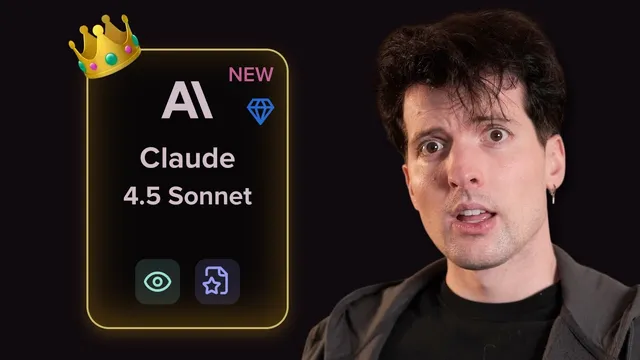
Sonnet 4.5 is the best coding model in the world
Based on Theo - t3․gg's video on YouTube. If you like this content, support the original creators by watching, liking and subscribing to their content.
Cloud Sonnet 4.5 is positioned as a top coding model, with the release emphasizing SWE and long-horizon agent reliability rather than just short-form answers.
Briefing
Cloud Sonnet 4.5 arrives with a blunt positioning: Anthropic calls it “the best coding model in the world,” and the release is paired with a set of product upgrades aimed at making long-running agent work more reliable. The significance isn’t just raw coding benchmarks. It’s the combination of stronger software-engineering performance, better handling of extended multi-step tasks, and new agent tooling—checkpointing, memory/context features, and tighter integration into developer workflows—that targets the pain points that show up when models move from short code snippets to real systems.
The broader industry context matters. Over the past weeks, attention has shifted toward OpenAI’s coding-focused lineup, especially GPT5 and Codex-style models, after perceived declines in Claude code quality. Against that backdrop, Anthropic’s silence after GPT5’s release reads as caution—until Sonnet 4.5 drops. The pricing stays aligned with prior Claude Sonnet pricing, which the transcript frames as a direct pressure point: Opus “no longer makes sense,” with Sonnet 4.5 outperforming Opus 4.1 in heavy software-engineering evaluations.
On capability, the release is described as a win for “SWE” and agentic tool use, while UI generation remains closer to prior levels. The transcript notes that Sonnet 4.5 doesn’t dramatically improve front-end polish compared with GPT5, which continues to produce “stunning UIs” and fewer UI-related errors in Next.js. Still, Claude’s strength shows up in behind-the-scenes code integration and in workflows where the model must plan, call tools, and maintain context across steps.
Benchmarks and practical tests reinforce that theme. The model is said to beat Opus 4.1 across multiple categories, including agent coding on SWE-bench style tasks and terminal/CLI-oriented work. It’s also described as maintaining focus for more than 30 hours on complex multi-step tasks—an emphasis on long-horizon reliability rather than just quick correctness. The transcript also highlights that throughput (tokens per second) isn’t necessarily the fastest, but the end-to-end experience can still feel faster because the model completes tasks with fewer wasted cycles.
The release also leans hard into safety and alignment, with claims of improved behavior against deception, power-seeking, and delusional encouragement, plus progress on defending against prompt injection in agentic and computer-use settings. A major thread is how Anthropic’s system card presents misalignment and cooperation metrics in simulated scenarios, including plans to open-source parts of an automated behavioral auditing tool. The transcript’s critic perspective argues that some safety details remain thin or strategically framed, and it points out that GPT5 isn’t included in many alignment evals—despite the claim that GPT5 would likely perform well.
Finally, the transcript includes hands-on coding experiences: Sonnet 4.5 can execute commands, rewrite codebases, and handle agent workflows with human approval steps, though it still struggles with certain complex UI tasks in terminal-like environments. The overall takeaway is pragmatic: GPT5 may remain best for UI-heavy work, but Sonnet 4.5 looks like the most comfortable day-to-day coding choice for many developers—especially when tasks require tool use, context management, and sustained execution.
Cornell Notes
Cloud Sonnet 4.5 is positioned as Anthropic’s top coding model, with emphasis on stronger software-engineering (SWE) performance and better long-horizon agent behavior. The release pairs model improvements with product upgrades such as checkpoints (save/rollback), a refreshed terminal experience, a native VS Code extension, and agent SDK changes that add memory/context handling for longer runs. Safety claims focus on reduced problematic behaviors (e.g., deception and delusional encouragement) and improved defenses against prompt injection for agentic and computer-use capabilities. In practical testing described here, Sonnet 4.5 is competitive for coding and tool-driven tasks, while UI generation remains less impressive than GPT5’s Next.js results.
What makes Sonnet 4.5 more than a “new model number” for coding agents?
Where does Sonnet 4.5 appear strongest compared with GPT5?
Why does the transcript treat Opus as effectively “dead” after Sonnet 4.5?
What safety and alignment improvements are highlighted, and what remains contentious?
How does the transcript describe real-world behavior in “evaluation-aware” scenarios?
What practical coding observations are made from hands-on use?
Review Questions
- Which Sonnet 4.5 upgrades are aimed specifically at long-horizon agent execution, and how do they change the developer workflow?
- In the transcript’s comparisons, what trade-offs are made between coding/tool performance and UI generation quality?
- What does the transcript claim about how Sonnet 4.5 behaves when it detects it is being evaluated, and why could that matter for real deployments?
Key Points
- 1
Cloud Sonnet 4.5 is positioned as a top coding model, with the release emphasizing SWE and long-horizon agent reliability rather than just short-form answers.
- 2
The upgrade package includes checkpoints, terminal/VS Code improvements, and Cloud API memory/context tools designed to support longer agent runs.
- 3
Pricing parity with prior Claude Sonnet levels is framed as a competitive pressure that makes Opus 4.1 less compelling after Sonnet 4.5’s reported gains.
- 4
Sonnet 4.5 is described as strong at tool-driven coding and behind-the-scenes integration, while UI generation improvements appear modest compared with GPT5’s Next.js performance.
- 5
Safety messaging centers on reduced deception/power-seeking/delusional encouragement and better prompt-injection defenses for agentic and computer-use settings.
- 6
The transcript raises transparency concerns about system-card detail and notes GPT5’s limited presence in many alignment evals, arguing that could skew perceived safety comparisons.
- 7
Hands-on tests suggest Sonnet 4.5 can execute commands and refactor codebases effectively, but terminal/complex UI tasks may still favor GPT5.