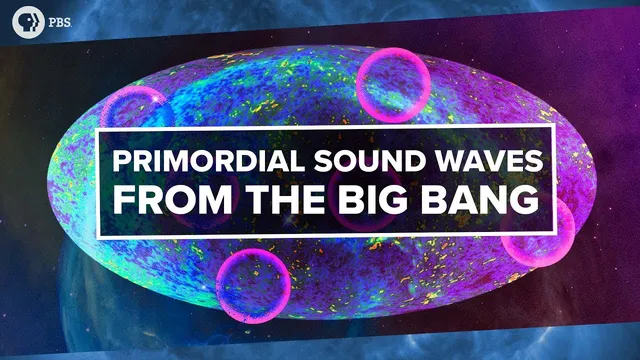
Sound Waves from the Beginning of Time
Based on PBS Space Time's video on YouTube. If you like this content, support the original creators by watching, liking and subscribing to their content.
BAO are relic sound-wave scales imprinted on the large-scale distribution of galaxies.
Briefing
Baryon acoustic oscillations (BAO) are the universe’s fossil record of the first sound waves—an imprint now visible in the large-scale distribution of galaxies—and they provide a “standard ruler” for measuring cosmic expansion. During the first few hundred thousand years after the Big Bang, the cosmos was a hot, dense baryon–photon plasma: light was constantly scattered by free electrons, making the medium opaque, while radiation pressure and gravity drove pressure–density ripples. Those ripples propagated as sound waves at over half the speed of light, expanding as the universe expanded.
The key transition came at recombination, when the temperature fell to about 3000 Kelvin and electrons combined with nuclei to form neutral atoms. Once electrons were bound, light could no longer scatter freely across all wavelengths, so matter and radiation decoupled and the universe became transparent. Crucially, the sound waves “froze” at that moment: the characteristic radius of the density shell became fixed to the distance sound could travel by recombination—about 500,000 light-years, which later corresponds to roughly 150 megaparsecs in today’s units after cosmic expansion. Dark matter, unaffected by radiation pressure, continued to clump under gravity, pulling baryons into the same large-scale structure and setting the stage for later galaxy formation.
Although the early universe’s density waves were more complex than a single clean ring—gravity and radiation pressure caused oscillations whose detailed imprint appears in the cosmic microwave background—BAO still leave a measurable signature. In modern galaxy surveys, the sky looks like a random scatter of galaxies until statistical methods reveal a preferred separation: galaxy pairs show a slight excess at about 150 megaparsecs. The signal is extracted using redshift surveys, which convert the stretching of light (redshift) into distance estimates and allow researchers to build a three-dimensional map of galaxy positions. By counting galaxy–galaxy separations within distance slices, scientists detect clustering from dark matter peaks plus the subtle BAO “bump” from the surrounding acoustic shell.
BAO measurements matter because they independently test the universe’s expansion history—especially the evidence for dark energy. Supernova observations first indicated accelerating expansion, but the claim required corroboration from a different method. BAO provides that check because the sound-horizon scale is predicted from early-universe physics and can be cross-calibrated against the cosmic microwave background. The resulting BAO distances agree with supernova-based measurements, supporting an accelerating universe and reinforcing the interpretation of dark energy as consistent with Einstein’s cosmological constant, behaving roughly unchanged over time.
The transcript also pivots to community discussion: questions about speculative “negative mass” ideas and whether they could imply exotic cosmic fates are treated with caution. The recurring theme is that extraordinary claims need extraordinary evidence, and any new framework must reproduce the extraordinary precision of established physics—general relativity and quantum field theory—before it can be taken seriously.
Cornell Notes
BAO are relics of the universe’s earliest sound waves, created when gravity and radiation pressure acted on tiny density fluctuations in a baryon–photon plasma. At recombination (around 3000 K), photons decoupled from matter, the plasma became transparent, and the characteristic sound-wave scale “froze” into a fixed comoving distance. That scale later appears in galaxy surveys as a small statistical excess of galaxy pairs separated by about 150 megaparsecs. Because the scale is predicted from early-universe physics and verified in the cosmic microwave background, BAO act as a standard ruler to measure the expansion history. BAO results match supernova evidence for accelerating expansion and support dark energy consistent with a cosmological constant.
What physical conditions produced BAO in the early universe?
Why did recombination “freeze” the BAO scale?
How does a primordial “ring” become a measurable feature in today’s galaxy surveys?
What makes BAO a useful tool for dark energy studies?
Why is statistical detection necessary—why doesn’t BAO look obvious in a sky map?
Review Questions
- Explain how radiation pressure and gravity jointly create BAO in the baryon–photon plasma, and why recombination stops the wave’s evolution.
- Describe the observational method used to detect BAO in galaxy surveys, including the role of redshift and pair-separation statistics.
- How do BAO measurements independently test the dark-energy conclusions drawn from supernova distance measurements?
Key Points
- 1
BAO are relic sound-wave scales imprinted on the large-scale distribution of galaxies.
- 2
In the early universe, a baryon–photon plasma was opaque because free electrons scattered light, enabling pressure–density ripples.
- 3
Recombination at roughly 3000 K decoupled light from matter, causing the BAO sound horizon scale to “freeze” into a fixed distance.
- 4
Modern BAO detection relies on redshift surveys and statistical pair counting, revealing a small excess of galaxy pairs near ~150 megaparsecs.
- 5
BAO act as a standard ruler to measure the expansion history across cosmic time.
- 6
BAO results align with supernova evidence for accelerating expansion and support dark energy consistent with a cosmological constant.