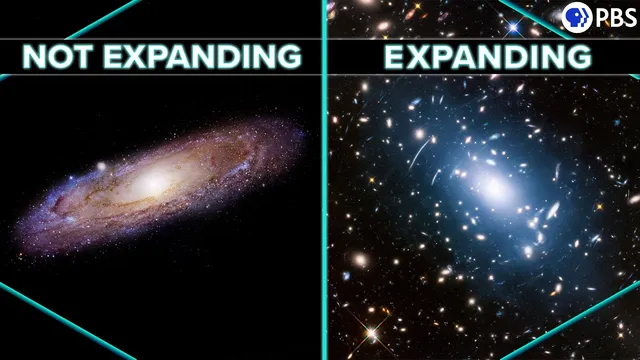
Space DOES NOT Expand Everywhere
Based on PBS Space Time's video on YouTube. If you like this content, support the original creators by watching, liking and subscribing to their content.
Cosmic expansion is captured by an evolving scale factor in the FLRW metric, producing the Hubble flow where recession speed increases with distance.
Briefing
Cosmic expansion doesn’t mean every gravitationally bound system is getting pulled apart in lockstep with the universe’s overall growth. On the largest scales, distant galaxies recede in the Hubble flow, and general relativity ties that recession to an evolving “scale factor” in the Friedmann–Lemaître–Robertson–Walker (FLRW) model. But once gravity binds matter into structures—planets, stars, galaxies—the local spacetime geometry stops behaving like the smooth, evenly expanding FLRW background. The result is a universe that expands globally while remaining locally stable inside bound systems like the Milky Way.
The key distinction is between the idealized FLRW picture and the spacetime around real, clumped mass. FLRW assumes matter is homogeneous and isotropic, so the metric’s spatial grid expands or contracts uniformly everywhere. That uniformity is what makes the “space is expanding everywhere” slogan sound plausible. Yet zooming in reveals that massive objects warp spacetime in ways that the FLRW approximation cannot capture. Near a compact object, the Schwarzschild metric describes a static, inwardly “pinched” geometry rather than an expanding one. Crucially, the spacetime inside a gravitationally bound system doesn’t “fight” the surrounding expansion, because there isn’t an extra expanding grid underneath the gravitational field. Gravity isn’t something laid on top of spacetime; it is the spacetime geometry itself. So the Milky Way’s internal structure doesn’t thin out or get stretched like rubber as the universe grows.
The balloon analogy—galaxies glued to a balloon and carried apart as it inflates—helps illustrate how recession speeds scale with distance, but it breaks down when applied to bound systems. In the balloon picture, the galaxy seems held together against an expanding material substrate. The transcript reframes that: the bound system’s own spacetime geometry is what matters, and it stays effectively static relative to the system even as the broader universe evolves.
To address what “new space” means, the transcript leans on the mathematical flexibility of general relativity: space can be subdivided indefinitely, so expanding coordinates can be re-gridded without requiring new patches to appear between existing ones. Every point in today’s universe can be traced back along geodesics to earlier times, linking the present to the big bang without “popping” new regions into existence. At the smallest scales, however, general relativity conflicts with quantum mechanics, introducing the Planck length as a minimum meaningful scale. The discussion notes that the Planck length is built from constants (G, ħ, c), so it would remain fixed if those constants don’t change; expansion would then correspond to adding more Planck-scale “units” rather than stretching them.
Finally, dark energy enters as a subtle twist: its energy density in empty space stays constant as space expands, so the total dark energy content grows with the amount of space. That growth matters only on cosmic scales—where vast regions of empty space dominate over matter—not inside bound systems, where the matter-to-empty-space ratio stays effectively unchanged. The upshot: the universe likely expands forever, but the Milky Way remains a relatively static bubble, isolated from other regions as cosmic horizons recede.
Cornell Notes
On the largest scales, the universe’s expansion shows up as the Hubble flow: distant galaxies recede faster the farther away they are. General relativity models that behavior with the FLRW metric, where an evolving scale factor grows or shrinks uniformly under assumptions of homogeneity and isotropy. But those assumptions fail inside gravitationally bound systems. Around massive objects, the Schwarzschild metric (static, inwardly pinched geometry) replaces the FLRW description, and the spacetime inside bound structures doesn’t “stretch like rubber” due to the surrounding expansion. “New space” is largely a coordinate/geometry effect in GR, while quantum gravity issues (Planck length, transplanckian problem) complicate what the smallest “stuff” of space really is. Dark energy’s constant density increases total energy with more volume, yet it doesn’t disrupt bound systems like the Milky Way.
What observational pattern signals cosmic expansion, and how is it distinguished from local motion?
Why does the FLRW model imply uniform expansion, and what assumptions make that possible?
How does the Schwarzschild metric change the story inside gravitationally bound systems?
What does it mean to say “space expands” without stretching space like rubber?
How can “new space” appear if GR lets spacetime be subdivided indefinitely?
Why doesn’t dark energy’s constant density automatically tear apart galaxies?
Review Questions
- What role do the FLRW assumptions of homogeneity and isotropy play in predicting uniform expansion, and where do those assumptions fail?
- Explain why the Schwarzschild metric implies that space inside a gravitationally bound system doesn’t participate in the global expansion in the same way as the FLRW background.
- How does the transcript reconcile “space expansion” with the idea that geodesics don’t originate or terminate by new patches appearing?
Key Points
- 1
Cosmic expansion is captured by an evolving scale factor in the FLRW metric, producing the Hubble flow where recession speed increases with distance.
- 2
Local gravitationally bound systems (planets, stars, galaxies) do not keep stretching with the universe’s global expansion.
- 3
The FLRW description assumes matter is homogeneous and isotropic; clumping breaks that approximation and changes the relevant spacetime geometry.
- 4
Around compact masses, the Schwarzschild metric replaces FLRW and yields a static, inwardly pinched spacetime rather than an expanding one.
- 5
The gravitational field is the spacetime geometry itself, so there isn’t an extra expanding “background grid” that bound systems must resist.
- 6
“New space” is largely a geometric/coordinate effect in GR, consistent with tracing spacetime paths (geodesics) back to the big bang without requiring new regions to appear between old ones.
- 7
Dark energy’s constant density increases total energy with more volume, but it doesn’t disrupt bound systems like the Milky Way because matter-to-empty-space ratios there remain effectively stable.