SPACE STRAW
Based on Vsauce's video on YouTube. If you like this content, support the original creators by watching, liking and subscribing to their content.
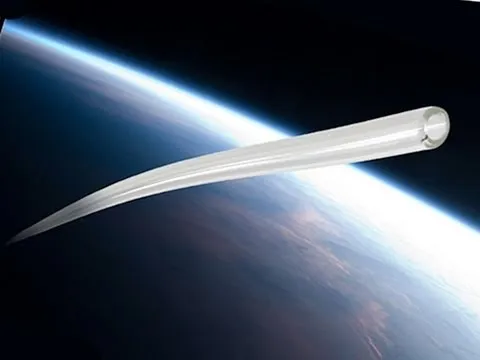
Atmospheric pressure is the maximum force available to push matter upward; without enough pressure, no “suction” can lift water to space.
Briefing
Earth’s atmosphere is a remarkably thin “skin” held in place by gravity—so thin that, if the planet were the size of an apple, the air from ground to space would be only about as thick as apple skin. Yet that skinny layer does real work: it creates pressure, enables weather, and even determines what kinds of forces can act on matter. The atmosphere’s thinness is exactly why a “space straw” fantasy can’t drain the oceans. Even if one end of a straw were in the ocean and the other in space, the surrounding air pressure at Earth’s surface limits how strongly anything can be pushed upward. A vacuum doesn’t pull matter toward it; it only allows higher-pressure air to push inward. At sea level, atmospheric pressure is about 15 pounds per square inch (65.4 newtons). That pressure can lift pure water only about 10.3 meters (33.9 feet), far less than the ~100,000 meters to reach space. Outer space can’t “suck” water into orbit because the atmosphere simply isn’t heavy or pressurized enough to provide the needed force.
Pressure differences also explain buoyancy. Air pushes harder at your feet than at your head, but the difference is too small to matter for humans. For lighter objects—like helium balloons—the imbalance becomes decisive. Buoyancy is the upward force from a surrounding fluid or gas that partially counteracts an object’s weight. In a perfect vacuum, a person would weigh slightly more (about a fifth of a pound) than they do with air present, underscoring that air contributes a small but real effect.
The atmosphere also isn’t static in the sense of “new air” constantly arriving; Earth’s mass is mostly recycled. At birth, a new human doesn’t add atoms to the planet so much as rearrange existing ones: the body’s molecules come from food, drink, and breathed air that ultimately originated on Earth. Still, Earth does lose some matter. Hydrogen and helium are too light to be retained by gravity and eventually escape into space or get stripped by solar wind. Earth also gains mass, largely from infalling space dust and meteorite fragments—estimated at 10 to 20 million kilograms per year.
When gains and losses are balanced against the mass-equivalent of energy Earth radiates away and the energy it receives from the Sun, the net effect is tiny: Earth becomes about 50 million kilograms lighter each year, which is only about 0.0000000000001% of its total mass. For practical purposes, the atoms in bodies and the air people breathe have been here for billions of years.
That recycling becomes startling when looking at molecules. A single breath contains roughly 10 sextillion molecules, and Earth’s entire atmosphere holds about the same number of molecules as there are breaths the planet has taken—about 10 sextillion breaths. Carbon dioxide, a waste product from metabolism and a plant fuel, doesn’t linger forever in one place: estimates suggest it takes about one year to mix through a hemisphere and about 10 years to mix through the troposphere and stratosphere. With carbon dioxide making up about 5% of exhaled gases, and only a fraction tied to brain metabolism, the math still lands on a chilling conclusion: even in a brand-new location, each breath contains at least a few molecules that were once inside someone’s brain—possibly years ago, possibly from a parent during childbirth. So the atmosphere is not just a protective layer; it’s a crowded archive of shared chemistry, and every breath is a reunion with the past.
Cornell Notes
Earth’s atmosphere is an extremely thin layer—so thin that it would be comparable to apple skin on an apple-sized Earth—yet it supplies the pressure that powers weather and limits how far matter can be pushed upward. A “space straw” can’t drain the oceans because atmospheric pressure at sea level (about 15 psi / 65.4 newtons) can lift water only ~10.3 meters, while space is ~100,000 meters up. Buoyancy comes from pressure differences in a fluid: air pushes more strongly at your feet than your head, which is why helium balloons rise even though humans don’t. Earth’s mass is mostly recycled through biological and atmospheric circulation, though small losses occur as light gases escape and small gains come from space dust. Because gases mix on timescales of about 1 year (hemisphere) and 10 years (troposphere/stratosphere), exhaled molecules—especially carbon dioxide—can return to people’s lungs, making it mathematically likely that some molecules in any breath were once in someone’s brain.
Why doesn’t a vacuum “suck” water out toward space in the way a straw fantasy suggests?
How does buoyancy follow from pressure differences across the body?
Does Earth gain or lose mass overall as people are born and live their lives?
What makes the “your breath contains history” claim mathematically plausible?
How does carbon dioxide connect breathing, plants, and long-term mixing?
Review Questions
- What numerical pressure limit prevents a “space straw” from lifting ocean water into space, and how does that compare with the distance to space?
- Explain buoyancy using pressure differences and why helium balloons rise while humans don’t.
- Why does atmospheric mixing over years make it likely that some molecules in a breath were once inside a human brain?
Key Points
- 1
Atmospheric pressure is the maximum force available to push matter upward; without enough pressure, no “suction” can lift water to space.
- 2
A vacuum doesn’t attract matter directly; higher external pressure pushes into the low-pressure region.
- 3
At sea level, atmospheric pressure is about 15 psi (65.4 newtons), which can lift water only about 10.3 meters—far short of space’s ~100,000-meter altitude.
- 4
Buoyancy arises because pressure is higher lower down; helium balloons rise because they are lighter than the displaced air.
- 5
Earth’s mass is mostly recycled through biological and atmospheric circulation, but small net losses occur as light gases escape and small gains occur from infalling space material.
- 6
Atmospheric mixing timescales (about 1 year for a hemisphere, ~10 years for the troposphere/stratosphere) allow exhaled molecules to spread widely.
- 7
Because each breath contains about 10 sextillion molecules, even tiny fractions of carbon dioxide tied to metabolism can imply that some molecules in any breath were once in someone’s brain.