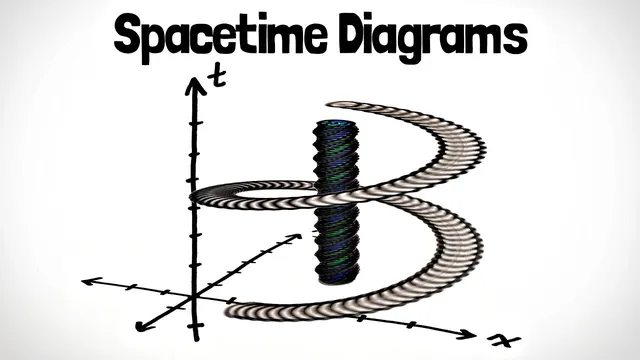
Spacetime Diagrams | Special Relativity Ch. 2
Based on minutephysics's video on YouTube. If you like this content, support the original creators by watching, liking and subscribing to their content.
Relativity focuses on invariants: it distinguishes viewpoint-dependent descriptions from properties that remain unchanged across perspectives.
Briefing
Relativity starts with a simple but powerful question: when the same physical motion can be described from different perspectives, which parts of the description are merely viewpoint-dependent, and which parts stay the same? The core promise is that universal truths emerge by tracking what changes and what doesn’t when observers shift position, orientation, or measurement conventions. In the Earth–Moon example, the apparent paths differ wildly depending on viewpoint—circular motion, back-and-forth motion, or a spiraling trajectory—but a key feature remains consistent: the maximum separation between Earth and Moon is the same. That kind of invariance is the target of relativity, because it identifies facts that hold across perspectives, making them more “fundamental” than statements tied to a single location or orientation.
To make these ideas precise, the discussion builds from geometry. A cat’s coordinates on an xy grid depend on how the axes are drawn: rotate or translate the coordinate system and the cat’s numerical (x, y) values change even if the cat never moves. Position, in that sense, is relative. But distance behaves differently. If the axes are shifted or rotated rigidly—sliding the origin and rotating the coordinate directions—the measured separation between two points stays the same. The example with two cats shows this directly: after changing the axes, the components of their separation change (e.g., 4 and 3 instead of 5 and 0), yet the Pythagorean theorem still yields the same overall distance.
That invariance has a caveat: distance as a raw number is not automatically universal. If the tick marks on the axes are rescaled—doubling the spacing—then the numerical distance changes. The more robust invariant is the ratio of distances measured in the same physical units. When the “meter stick” used to define distance scales along with the axes, the numerical distance in “stick lengths” remains unchanged. The takeaway is metrological: describing a distance requires specifying what it’s measured against.
With these geometric tools in place, motion becomes easier to visualize using spacetime diagrams. Time is placed on the vertical axis and space on the horizontal axis. A stationary object appears as a vertical line at fixed x, while a moving object traces a slanted line that encodes how position changes as time passes—without implying the object actually moves through 2D space along the diagonal. A world-line is the traced path of an object on such a diagram, and it faithfully records the object’s motion: slide the diagram downward at a constant rate and the object’s position can be recovered along the path.
The discussion then extends the perspective-shift idea to spacetime diagrams. Sliding the spatial axis left or right changes the coordinate values at a given time but not the separation between objects at that time. Sliding the time axis up or down changes the absolute start time but not the duration of motion. For two-dimensional spatial motion, rotating the spatial axes preserves distances at a fixed time. All of this is “static” relativity—changing viewpoint without yet considering observers whose own motion changes the perspective. That missing ingredient—perspectives from moving frames—is flagged as the next step toward special relativity.
Cornell Notes
Relativity is framed as a search for invariants: when observers change perspective, some descriptions of motion change while certain properties remain the same. Coordinates like (x, y) depend on how axes are drawn, so “position” is relative. Distances remain invariant under rigid shifts and rotations of the axes, and even under rescaling when distances are expressed as ratios to a reference length. Spacetime diagrams then translate motion into geometry by plotting time vertically and position horizontally, turning an object’s history into a world-line. Shifting spatial or temporal axes changes coordinate values but preserves spatial separations at the same time and temporal intervals at the same location—setting up the later leap to moving observers in special relativity.
Why are coordinates like (3, 2) considered viewpoint-dependent rather than universal truths?
What stays invariant when the axes are shifted or rotated, and why does that matter?
How can distance change as a number even when the physical separation hasn’t changed?
What exactly is a spacetime diagram, and how does a world-line represent motion?
What invariances hold when spatial or temporal axes are slid on a spacetime diagram?
Review Questions
- In what sense is “position is relative,” and how does the cat-on-a-grid example demonstrate it?
- Explain the difference between distance as a raw number and distance as a ratio to a reference length.
- On a spacetime diagram, what does the slope of a world-line represent, and what invariances remain when axes are shifted?
Key Points
- 1
Relativity focuses on invariants: it distinguishes viewpoint-dependent descriptions from properties that remain unchanged across perspectives.
- 2
The Earth–Moon example illustrates how different apparent trajectories can share a common invariant feature (maximum separation).
- 3
Coordinates (x, y) depend on axis placement and orientation, so position expressed as coordinates is not universal.
- 4
Rigid translations and rotations of axes preserve Euclidean distance between points, making distance a key invariant in spatial geometry.
- 5
Rescaling tick marks changes distance as a number, but expressing distances relative to a reference length preserves the invariant ratio.
- 6
Spacetime diagrams encode motion by plotting time vertically and space horizontally, turning an object’s history into a world-line.
- 7
Shifting spatial or temporal axes on a spacetime diagram preserves spatial separations at the same time and temporal intervals at the same location, setting up the next step: moving observers.