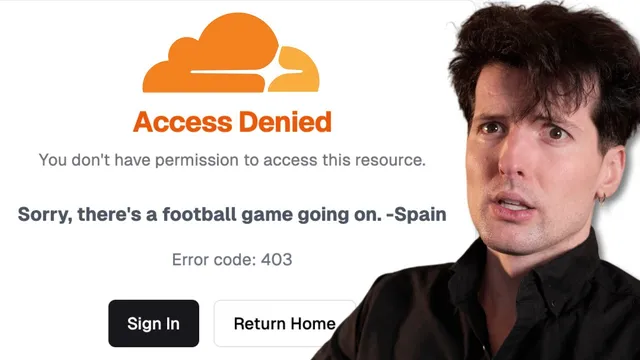
Spain blocks half the internet
Based on Theo - t3․gg's video on YouTube. If you like this content, support the original creators by watching, liking and subscribing to their content.
Spain’s match-day enforcement orders require ISPs to block Cloudflare IP addresses, leading to widespread access failures during football games.
Briefing
Spain’s courts and regulators have ordered internet providers to block Cloudflare IP addresses during football matches, causing broad outages that can knock unrelated websites and services offline—not just piracy sites. The core issue is how shared infrastructure works: Cloudflare’s IP addresses are reused across many customers and services, so blocking an IP tied to alleged illegal streaming can unintentionally block everything else that happens to be hosted behind the same addresses.
The transcript frames Cloudflare as a ubiquitous layer in modern web delivery and defense. Cloudflare is used on a large share of websites for functions ranging from content delivery and hosting support to denial-of-service (DoS) protection. Many domains resolve to Cloudflare IPs, and Cloudflare sits in front of traffic to filter bots and suspicious requests—often via browser “challenge” checks that attempt to distinguish real users from automated traffic.
That shared reliance becomes the mechanism for the Spanish disruption. When a court action identifies IP addresses associated with illegal sports streaming, the order does not stop at the site operator or even the hosting provider. Instead, the ruling effectively pushes enforcement upward: internet service providers are required to block those IPs. Because IP addresses are reused across many customers, the enforcement can spill over into legitimate services that have no connection to piracy.
The transcript illustrates the chain of dependencies behind a normal URL request: domain registration maps names to IP addresses; DNS resolves the domain to an IP; and protection layers sit in front of traffic to mitigate abuse. In the piracy scenario, the “right” legal target would be the streamer or the hosting service enabling infringement. But the Spanish approach—described as going “five layers down”—skips the more direct targets and mandates ISP-level blocking based on infrastructure-level identifiers.
The consequences described are practical and wide-ranging. During match days, users may lose access to services built on Cloudflare or similar platforms, including apps and government-related online functions. The transcript also argues that the decision sets a dangerous precedent by allowing sports-rights enforcement to translate into blanket technical censorship.
The broader technical backdrop is IPv4 scarcity. The transcript claims the internet still leans heavily on IPv4, which forces providers to reuse IP address blocks rather than assigning a unique IP per service. That reuse is presented as a structural reason why IP-based blocking is so blunt: one blocked IP can represent many unrelated services.
The proposed fixes are twofold: accelerate adoption of IPv6 to reduce the need for IP reuse, and ensure judges and regulators understand how internet routing and shared infrastructure actually work before issuing orders. In the meantime, the transcript recommends VPN use for people in Spain to avoid ISP visibility and match-day blocks, while urging public pressure on authorities and criticizing the court’s handling of appeals involving Cloudflare.
Cornell Notes
Spain’s match-day enforcement orders require ISPs to block Cloudflare IP addresses tied to alleged illegal sports streaming. Because Cloudflare IPs are reused across many unrelated customers, the blocks can take down legitimate websites and services during football games, not just piracy sources. The transcript links the problem to how the internet works: DNS and IP routing send traffic through shared infrastructure layers, so banning an IP is a blunt instrument. It also points to IPv4 scarcity as a reason IP reuse is common, making IP-level censorship especially disruptive. The takeaway is that legal actions aimed at infringement can cascade into broad internet outages when they target shared technical identifiers instead of direct offenders.
Why does blocking Cloudflare IP addresses during football games cause outages beyond piracy sites?
How do DNS and IP address reuse make enforcement “five layers down” possible?
What role does IPv4 scarcity play in the ability to reuse IP addresses?
What does Cloudflare’s DoS protection and “browser check” mechanism have to do with the situation?
What interim workaround is suggested, and what longer-term fixes are proposed?
Review Questions
- How does IP address reuse turn a targeted enforcement action into broad service outages?
- Which layers of the URL-to-connection chain (registration, DNS, IP routing, protection) are most affected by IP-level blocking?
- Why does the transcript argue that IPv6 adoption would reduce the harm of IP-based censorship?
Key Points
- 1
Spain’s match-day enforcement orders require ISPs to block Cloudflare IP addresses, leading to widespread access failures during football games.
- 2
Cloudflare IPs are shared across many unrelated customers, so IP-level blocking can unintentionally disable legitimate services.
- 3
The transcript attributes the bluntness of IP blocking to how DNS and IP routing route traffic through shared infrastructure layers.
- 4
IPv4 scarcity and the resulting need to reuse IP address blocks are presented as a structural driver of the problem.
- 5
The described legal approach targets infrastructure identifiers rather than direct offenders, creating a dangerous precedent for internet governance.
- 6
The transcript recommends VPN use as a short-term mitigation for people in Spain while criticizing the court’s handling of appeals.
- 7
Long-term solutions proposed include faster IPv6 adoption and requiring technical competence in judicial decisions about internet operations.