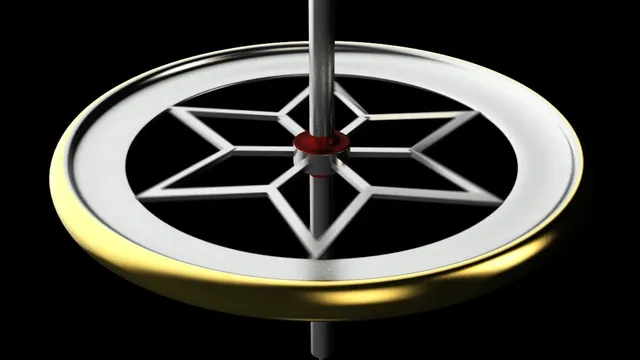
Spinning
Based on Vsauce's video on YouTube. If you like this content, support the original creators by watching, liking and subscribing to their content.
A spinning gyroscope doesn’t tip directly toward an applied force because torque from a force on a rotating body produces an effect 90° ahead in the rotation direction.
Briefing
A spinning gyroscope can look like it “defies gravity,” but the stability comes from how rotation reshapes motion: torques don’t tip the spin axis immediately—they act 90° ahead in the direction of rotation, producing a sideways “procession” instead of a simple fall. That same geometry shows up across everyday motion on Earth, from bicycle wheels to drifting airplanes, and it explains why the “outward force” people feel during turns is really inertia, not a real push away from the center.
The lesson starts with a simple gyroscope trick. A gyroscope held upright will normally fall, but once a string is threaded through a hole and wound around the spinning disc, pulling the string makes the axis appear glued in place. If it spins long enough, the axis seems to move only because Earth and the observer are moving; the device itself is behaving consistently. The name “gyro-scope” also points to a historical use: Leon Foucault’s 1852 demonstration used a gyroscope to “scope” Earth’s rotation.
Why does spinning resist tipping? The transcript builds the idea from circular motion. A ball moving around a center has velocity tangent to its path, so its direction changes continuously. That change requires a centripetal force—provided by tension in a rope, the structure of a disc, gravity, or a track. Crucially, the outward “centrifugal force” people feel is not an actual outward force; it’s the inertia of an object that would keep moving straight if the centripetal constraint were removed. In orbit, removing the centripetal force would let the ball continue along the tangent path.
From there, the gyroscope’s signature behavior emerges. When a force acts on a spinning object, the resulting torque doesn’t rotate the object toward the force direction; it produces an effect 90° ahead in the rotation. The transcript links this to procession: if a gyroscope is tilted, the tilt doesn’t stay put—it “glides” around the spinning axis. A cardboard-disc demonstration shows the same pattern: blowing on different sides of a spinning disc makes it tilt in different directions, and applying the force where the tilt is greatest makes the tilt move around.
As the gyroscope slows, friction and air resistance gradually sap its spin. With less angular momentum, each part of the disc experiences a progressively steeper effective orbit around the gyroscope, so the axis tilts further until it hits the ground and stops.
The same rotational mechanics scale up to Earth. A helicopter can’t simply hover while the planet rotates beneath it because the ground, air, and helicopter share the Earth’s spin. But a thrown “magic” paper airplane would drift east or west due to the Coriolis effect: motion relative to Earth’s rotating frame changes with latitude and speed. The transcript also describes vertical Coriolis behavior—objects dropped from high up drift east, and things thrown straight up curve west—because higher altitude means a larger circular path and different tangential speed.
Finally, the transcript connects spinning to weight changes via the “Eötvös effect” (spelled “utsh effect”): measurements show lower apparent weight when traveling east and higher when traveling west. The explanation is inertial “lift” from Earth’s rotation: gravity acts like a centripetal constraint, and the inertial tendency to move tangentially slightly reduces the effective normal force. The result is a small but measurable apparent weight difference, such as about a 0.9% reduction for an airplane flying east at the equator.
Cornell Notes
Spinning objects stay stable because circular motion requires a centripetal force, and the outward “centrifugal” feeling is inertia rather than a real outward push. A gyroscope’s key twist is that torque acts 90° ahead of where it’s applied, so tilting produces procession: the tilt glides around instead of falling straight down. As friction and air resistance slow the spin, the axis eventually tips further until the gyroscope stops. The same rotating-frame geometry scales to Earth, where the Coriolis effect makes thrown or falling objects drift east or west, and where Earth’s rotation slightly changes apparent weight (the Eötvös effect).
Why does a spinning gyroscope appear to resist gravity and keep its axis “glued” in place?
What’s the difference between centripetal force and the “centrifugal force” people feel during turns?
How does the transcript connect circular motion to the gyroscope’s 90°-ahead torque behavior?
What is procession, and how do the cardboard-disc and bicycle-wheel examples illustrate it?
How does the Coriolis effect explain east–west drift for thrown objects?
What is the “utsh effect” (Eötvös effect) and why does traveling east or west change apparent weight?
Review Questions
- In your own words, why is the outward “centrifugal” sensation during circular motion better described as inertia?
- Describe procession: what does the 90°-ahead torque rule predict for the direction of a gyroscope’s tilt response?
- How do the Coriolis effect and the Eötvös effect both depend on Earth’s rotation, yet lead to different observable outcomes?
Key Points
- 1
A spinning gyroscope doesn’t tip directly toward an applied force because torque from a force on a rotating body produces an effect 90° ahead in the rotation direction.
- 2
The outward “centrifugal force” people feel is not a real outward force; it’s inertia resisting the centripetal constraint that keeps motion curved.
- 3
Centripetal force is what continuously changes an object’s velocity direction for circular motion; removing it lets the object continue along the tangent path.
- 4
Procession is the gyroscope’s hallmark behavior: the tilt glides around as the applied torque and the body’s rotation stay out of phase.
- 5
Friction and air resistance reduce spin over time, changing how strongly each part of the gyroscope can maintain its effective orbit, until the axis eventually falls.
- 6
Earth’s rotation creates Coriolis drift: thrown or falling objects curve east or west because their tangential velocity persists while the rotating frame’s local speed changes.
- 7
The Eötvös (“utsh”) effect links apparent weight changes to rotational inertia: traveling east or west slightly alters the effective normal force through inertial lift.