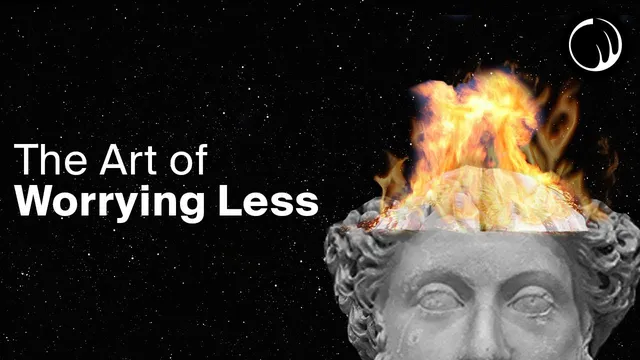
Stoicism & the Art of Worrying Less
Based on Pursuit of Wonder's video on YouTube. If you like this content, support the original creators by watching, liking and subscribing to their content.
Stoicism recommends preparing for plausible risks, then stopping once prevention is no longer possible and shifting attention back to the present.
Briefing
Worry is unavoidable, but it becomes self-defeating when it targets what can’t be controlled—especially the future’s unknowns. Stoicism offers a practical balance: stay alert to what might go wrong and prepare rationally, then stop feeding anxiety once prevention is no longer possible and return attention to the present.
The core stoic move is a sharp boundary between internal and external control. People can’t reliably manage other people’s reactions or the world’s unfolding, but they can manage interpretations, emotional responses, and decisions. That distinction reframes worry as a cost-benefit problem. Preparing for likely risks has value because it’s actionable; obsessing over unpredictable catastrophes has no value because it can’t change outcomes and drains the only time that actually exists—the present.
Stoicism also challenges the way fear inflates scenarios. Seneca’s line—“we are more often frightened than hurt”—captures a pattern where imagination does more damage than reality. Epictetus makes a similar point: people aren’t usually troubled by real problems so much as by imagined anxieties about those problems. The transcript extends this by arguing that someone, somewhere, is living through a version of a “worst case” right now and is often no more ruined than anyone else. Humans are adaptable; they adjust to circumstances and remain functional even under pressure.
At the same time, the message doesn’t pretend hardship is trivial. There’s a spectrum of suffering, including cases where recovery may be unlikely. But even then, worrying doesn’t change the fact that the feared event hasn’t happened yet. The argument leans on time as a corrective force: many worries from the past evaporate, replaced by new concerns that also fail to materialize as feared. History “ends” in imagination far more often than it does in life.
Still, the transcript acknowledges a paradox in applying stoic ideas. Eliminating worry entirely may be unrealistic because trying to “worry less” can itself become another object of worry. The more workable goal becomes reducing unnecessary worry rather than erasing all unease. Accepting that discomfort is part of the human condition can, counterintuitively, loosen worry’s grip.
The practical endpoint is modest but actionable: aim to do one’s best, don’t turn that effort into a new anxiety about whether it will “solve everything,” and treat progress as a series of small victories. Human life is portrayed as cyclical—people dip in and out of hardship—but the stoic strategy is to be okay in the present while preparing where preparation is truly possible. In that frame, worrying less isn’t about achieving certainty; it’s about reclaiming attention from the future’s fantasies and investing it in what can be influenced now.
The transcript also includes a sponsorship for Blinkist, promoting condensed summaries of non-fiction books and related audio options, with a trial and discount offer via a link in the description.
Cornell Notes
Stoicism treats worry as a misallocation of attention: it’s useful to prepare for plausible risks, but harmful to obsess over unpredictable outcomes. The philosophy draws a control boundary—people can manage internal reactions and decisions, while external events and other people’s actions remain largely out of reach. Fear often outgrows reality, with Seneca and Epictetus used to argue that imagination causes more suffering than actual events. Even when hardships are severe, the feared situation hasn’t happened yet, and many past worries never come true. Since fully removing worry can be impossible (worry can turn on itself), the goal becomes reducing unnecessary worry through present-focused attention and repeated “mini victories.”
How does stoicism decide which worries are worth attention?
What is the internal-versus-external control distinction, and why does it matter for anxiety?
What do Seneca and Epictetus contribute to the argument about worry?
Why does the transcript argue that worst-case thinking is often unreliable?
How does time undermine worry, according to the transcript?
What paradox limits the goal of eliminating worry entirely?
Review Questions
- Which kinds of future concerns qualify as “rational preparation,” and which cross into rumination under the stoic framework?
- How does the internal/external control distinction change what a person should do when a feared event can’t be predicted or prevented?
- Why does the transcript claim that reducing worry may be more realistic than eliminating it completely?
Key Points
- 1
Stoicism recommends preparing for plausible risks, then stopping once prevention is no longer possible and shifting attention back to the present.
- 2
A strict control boundary helps: internal reactions and decisions are controllable; external events and other people’s actions are not.
- 3
Fear often exceeds reality; quotes from Seneca and Epictetus support the idea that imagination causes more suffering than actual harm.
- 4
Worst-case scenarios are frequently exaggerated because humans adapt to difficult circumstances and many “worst cases” are survivable in practice.
- 5
Time tends to erase many worries that never come true, making present-focused action more rational than betting on imagined catastrophe.
- 6
Fully eliminating worry may be unrealistic because worry can turn on itself; the practical goal is reducing unnecessary worry through repeated small wins.
- 7
Doing one’s best should not become a new source of anxiety about whether it will guarantee perfect outcomes.