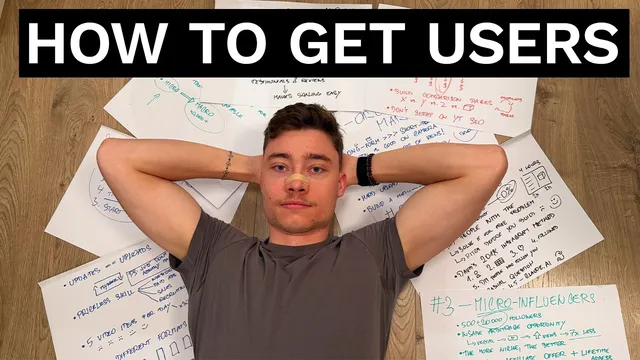
Stop f**king around in your startup, watch this
Based on David Ondrej's video on YouTube. If you like this content, support the original creators by watching, liking and subscribing to their content.
Distribution must be time-blocked and treated as equal to product development, not an afterthought.
Briefing
Getting the first 100 users for an AI startup hinges less on building a standout product and more on building a distribution engine—then starting immediately. The playbook starts with five rules: treat distribution as equal to product, pick a single ICP (ideal customer profile) and niche instead of trying to sell to everyone, solve a painful “painkiller” problem people already pay to fix, spend at least 45 minutes per day on distribution (time-blocked early), and don’t delay marketing until the product feels “ready.” The core warning is blunt: founders often spend months building while the market quietly decides the problem isn’t worth paying for.
From there, the strategy shifts into four low-cost (often free) acquisition methods, with organic content as the first pillar. Organic marketing should prioritize long-form videos over short clips because longer content builds trust faster. New founders shouldn’t wait to “get good on camera”—awkward first attempts and multiple takes are normal. The niche matters: targeting a small, specific audience beats chasing broad attention, even if it means fewer views. A practical growth tactic is to publish before the product launches using a waitlist (collect emails and possibly names/phones) or a pre-sale (offer a discounted monthly rate to early buyers). To keep output consistent, the advice is to use a “hard limit” for how long a video can take—aggressive founders might cap it at two to four days—so inspiration doesn’t turn into procrastination.
Organic growth also becomes a flywheel when product design supports marketing. Updates create new video ideas, and shareability can be engineered into the UI—examples include visible branding, natural sharing prompts like “Spotify Wrapped”-style summaries, or even subtle watermarks that reduce the need for constant calls to action. Video creation is framed as a transferable skill: better communication improves investor pitches, sales calls, paid-ad performance, and recruiting.
When video ideas dry up, the method is operational: brainstorm five ideas every day without judging them until later. Then, once a format works, repeat it aggressively—most founders make the winning content once and stop, wasting months of learning. If something doesn’t work, experiment with formats until something clicks, then “triple down.”
The second acquisition method is cold DMs—explicitly described as “unscalable” by design, because early-stage startups need free leads, personalized outreach, and rapid feedback. The key is messaging the right people: those already discussing the problem. The outreach should start with a free offer to generate users and testimonials, and it should include pitching before building to validate willingness to pay. Tactics include finding followers of niche accounts and DMing them with a simple question to earn replies, then using AI (the transcript names Claude models and Opus 4.5) to generate DM sales scripts and objection handling.
The third method uses micro influencers (500 to 20,000 followers). The advantage is pricing arbitrage: smaller creators often misprice brand deals or even accept affiliate arrangements. The recommended offer is an affiliate split (roughly 30%–50% of revenue) plus lifetime access, or bulk deals that trade stability for a 50%–60% discount. Because micro influencers can be inconsistent, the plan is to recruit 5–10 and hold them accountable with frequent check-ins. Influencers also double as product testers.
The fourth method is SEO, optimized around problem keywords rather than product keywords. Each problem becomes its own article and landing page with hyperspecific copy, and comparison pages (e.g., “X vs Y vs Z vs [startup]”) can capture curiosity from searches. AI is used to accelerate drafting and ideation, but the transcript advises writing 50%–80% of the words manually for authenticity. SEO compounds over time, while cold DMs can produce paying customers immediately—so the overall message is to start distribution now, validate fast, and scale what works.
Cornell Notes
The fastest path to the first 100 users for an AI SaaS is to treat distribution as a core product requirement and start marketing immediately—before the product is fully “ready.” Success depends on picking a narrow ICP and solving a painful, urgent problem people already pay to fix. Daily execution matters: time-block at least 45 minutes per day for distribution, and pitch before building to test willingness to pay. Acquisition tactics prioritize low-cost channels: long-form organic content published before launch (with waitlists or pre-sales), cold DMs to the right niche communities using free offers and testimonials, micro-influencer deals using affiliate splits or bulk discounts, and SEO built around problem keywords with separate landing pages and comparison content. The common thread is iteration: experiment until something works, then repeat it aggressively.
Why does “distribution” matter as much as product for early AI startups?
What does “painkiller” positioning mean, and how does it change customer acquisition?
How should organic content be structured to attract the first 100 users?
What makes cold DMs effective early on, and what’s the outreach workflow?
How do micro influencers create an “arbitrage opportunity” for startups?
What’s the SEO approach: keywords, pages, and how AI should be used?
Review Questions
- What are the five “steps for success,” and which one directly prevents founders from building the wrong product?
- How do waitlists and pre-sales reduce the risk of launching a product nobody wants?
- Describe a complete cold-DM workflow from identifying leads to collecting testimonials and validating willingness to pay.
Key Points
- 1
Distribution must be time-blocked and treated as equal to product development, not an afterthought.
- 2
Pick a single ICP and niche; selling to “everybody” is a major early mistake.
- 3
Target painful, urgent problems (“painkillers”), not low-urgency “vitamins.”
- 4
Start promotion immediately—use waitlists or pre-sales and pitch before the product is fully built.
- 5
Organic marketing should prioritize long-form content, consistent publishing, and niche-specific trust-building.
- 6
Cold DMs work best when outreach targets people already discussing the problem and begins with a free offer to generate testimonials.
- 7
Micro influencer deals should use affiliate splits or bulk discounts, with 5–10 creators and active accountability to reduce randomness.
- 8
SEO should be built around problem keywords with separate landing pages and comparison content, using AI for speed but manual writing for authenticity.