Stop Forgetting Everything: My System To Learn Fast
Based on Noah Vincent's video on YouTube. If you like this content, support the original creators by watching, liking and subscribing to their content.
Retention fails without retrieval; the transcript cites the forgetting curve to show how quickly most information disappears.
Briefing
Learning and memory don’t fail because people lack effort—they fail because information is shed fast without a retention system. The core claim is that most learners lose the majority of what they consume almost immediately: roughly half disappears within an hour, about 70% is gone after 24 hours, and by a month less than 5% remains. That steep, exponential drop is why “consume more” strategies—more books, more videos, more courses—often create information overload without improving long-term recall or real-world output.
The fix centers on two scientific principles: spaced repetition and active recall. Spaced repetition means revisiting material at increasing intervals rather than rereading once and moving on. Active recall means trying to retrieve the information from memory (or testing oneself) instead of passively reviewing. Each retrieval strengthens memory and helps prevent the forgetting curve from taking hold. The video also ties retention to how people learn: passive formats like lectures and reading yield lower retention rates than active methods such as discussion, practice, and teaching others. In parallel, it argues that learners should prioritize the “learning pyramid” behaviors—practice, writing, discussion, and teaching—rather than treating highlight-taking or watching as the main event.
Beyond memory mechanics, the system adds content-selection rules. It uses a “content hierarchy” to steer people toward higher-value sources first—books for deep, research-backed structure; then articles, newsletters, and long-form video; and it warns against defaulting to low-signal formats like shorts. It also invokes the Lindy effect: the longer something has survived, the more likely it is to keep surviving. For learning, that translates into focusing on time-tested ideas and foundational knowledge instead of chasing every new trend.
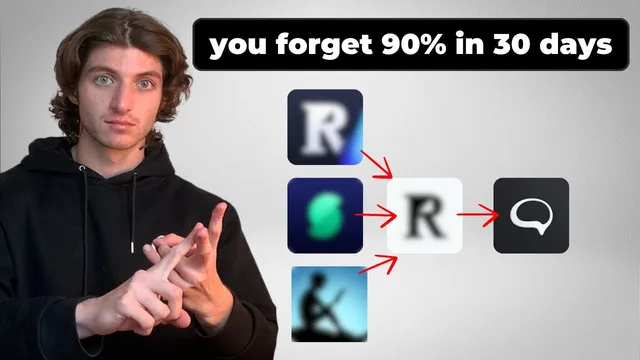
To operationalize all of this, the proposed workflow is an integrated tool stack built around Readwise as a central hub. Highlights from Kindle (books and PDFs), Snipd (podcast moments with AI transcripts), and Reader (articles, newsletters, video transcripts, PDFs saved for later) sync into Readwise. From there, Readwise Daily Review runs spaced repetition through daily sessions that prompt active recall of saved highlights. The final layer is Cortex, described as the creator-focused “second brain” where synced highlights become part of a writing and note workflow—organized by format and linked to permanent notes and content drafts.
The routine is structured around the day: short reading windows in the morning and during commutes, podcast capture and highlighting during downtime, and evening processing of saved articles and transcripts. Highlighting is framed as active: add notes about why something matters and how it might be used for future writing or projects. The video also includes setup guidance—syncing Readwise with Cortex via access token, configuring Kindle highlight imports (including a workaround for PDFs via “my clippings” when needed), and using Reader feeds to avoid algorithm-driven consumption.
The takeaway is practical: retention requires a system that captures, schedules retrieval, and routes insights into creation. The next step promised is turning captured highlights into reusable notes using a method called “Zle Caston,” aiming to convert learning into atomic building blocks for content.
Cornell Notes
The transcript argues that most learning is lost quickly unless retrieval is scheduled. It cites the Ebbinghaus forgetting curve: about 50% is forgotten within an hour, ~70% after 24 hours, and less than 5% after 30 days—so “more content” doesn’t fix the core problem. The solution is spaced repetition plus active recall, reinforced by learning behaviors that outperform passive consumption (practice, discussion, teaching). It then lays out a workflow: capture highlights from Kindle, Snipd, and Reader into Readwise, run Readwise Daily Review for daily retrieval practice, and sync everything into Cortex so highlights feed directly into notes and writing. The system matters because it turns scattered consumption into scheduled recall and reusable assets for content creation.
Why does consuming more content often fail to improve learning outcomes?
What two mechanisms are presented as the main antidotes to forgetting?
How does the transcript justify shifting from passive learning to active learning?
What does the “content hierarchy” recommend when choosing what to study?
How does the proposed tool stack turn highlights into scheduled review and usable notes?
What daily routine and highlighting behavior does the system recommend?
Review Questions
- How would you design a weekly review schedule using spaced repetition and active recall for a book chapter you highlighted?
- Which parts of the workflow ensure that highlights become reusable assets rather than dead-end bookmarks?
- Why does the transcript treat source selection (books vs. shorts) as part of retention, not just preference?
Key Points
- 1
Retention fails without retrieval; the transcript cites the forgetting curve to show how quickly most information disappears.
- 2
Spaced repetition requires revisiting material at increasing intervals, while active recall requires retrieving it from memory rather than rereading.
- 3
Passive learning methods underperform; practice, discussion, and teaching produce much higher retention rates than lectures or reading alone.
- 4
Choose higher-value sources first using a content hierarchy—books and deep research before lower-signal formats like shorts.
- 5
Capture highlights into Readwise from Kindle, Snipd, and Reader, then run Readwise Daily Review for daily retrieval practice.
- 6
Sync Readwise into Cortex so highlights feed directly into notes and writing instead of staying as scattered references.
- 7
Avoid information overwhelm by starting with one format, using small daily sessions, and focusing on implementation over quantity.