Stop Playing ADHD on Hard Mode
Based on Ali Alqaraghuli, PhD's video on YouTube. If you like this content, support the original creators by watching, liking and subscribing to their content.
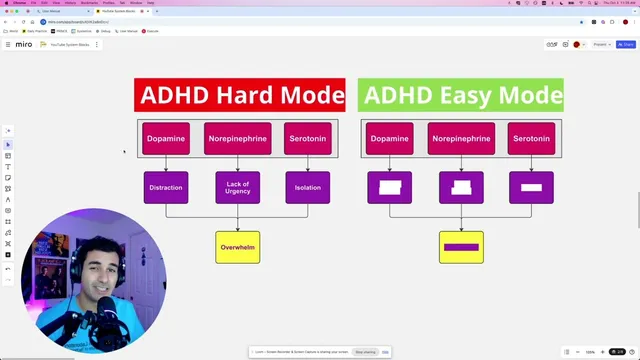
ADHD “hard mode” is amplified by three environmental factors: distractions, lack of urgency/structure, and isolation.
Briefing
ADHD “on hard mode” is driven less by personal failure and more by an environment that amplifies overwhelm: constant distractions, little or no urgency, and isolation. The core claim is that ADHD brains process neurochemicals differently, so when life is set up with too many competing stimuli, no deadlines, and fewer people around, symptoms intensify—making productivity harder and self-esteem take a hit. Overwhelm shows up as a “dance of ideas”: starting one task, switching to another, getting bored, and feeling like there are too many voices and options competing for attention.
The practical prescription is to redesign daily life so it becomes easier for the brain to choose the right action. For distractions, the method is “circuit design,” borrowed from circuit theory: electricity takes the path of least resistance, and the ADHD brain tends to pick the option that is easier and more immediately rewarding (often dopamine-linked). In real terms, that means removing tempting alternatives rather than relying on willpower. If Instagram sits next to a to-do list, the shiny app pulls attention; deleting or blocking it forces the to-do list to become the only low-friction choice. The same logic applies to notifications and physical surroundings—turning off non-urgent alerts, limiting app access, and keeping the room environment minimalist to reduce cues that hijack attention.
Urgency is treated as a design problem too, tied to norepinephrine. Instead of vague goals (“record a video sometime today”), the approach is time-bounded implementation intentions: specify a time and place, then commit to starting regardless of quality. A concrete example is scheduling a recording session for 11:30 a.m. and treating the task as “sit down and do it,” which creates a window where other supportive actions (cleaning, lighting, turning on a ring light) naturally follow.
Finally, serotonin is linked to social connection. Loneliness and isolation are described as especially damaging for people with ADHD—worsening mood, increasing depressive risk, and reducing the likelihood of productive engagement. The solution is to integrate people into routines: frequent meetings, shared work sessions, and regular interaction through workplaces or communities. The claim is that improving happiness through social support also improves productivity.
When these three levers—lowering distraction, manufacturing urgency with deadlines, and adding people—are aligned, the odds of reaching hyperfocus rise. Hyperfocus is framed as a state triggered by strong interest and curiosity, and the argument is that a better-designed environment can make tasks that normally feel mundane become engaging enough to pull attention into that deep-work mode. The overall message is that “easy mode” isn’t about becoming more disciplined; it’s about removing the conditions that make ADHD harder to manage, then building structure that the brain can follow.
Cornell Notes
ADHD “hard mode” is characterized by overwhelm: too many distractions, too little urgency, and isolation. The remedy is to redesign daily life using “circuit design” (remove high-reward temptations so the desired task becomes the path of least resistance), create time-bounded implementation intentions (set a specific time and place to start), and increase social connection (loneliness can worsen symptoms and mood). These changes target dopamine, norepinephrine, and serotonin respectively. The payoff is a higher chance of hyperfocus—deep attention that emerges when tasks become interesting enough to pull the brain in.
What does “ADHD on hard mode” look like in day-to-day behavior?
How does “circuit design” reduce distraction without relying on willpower?
Why does time-boundedness matter for urgency, and what does it look like?
What role does loneliness play, and how is it addressed?
How do these changes connect to hyperfocus?
Review Questions
- How does “circuit design” change the way someone should handle tempting apps or notifications?
- Give an example of a time-bounded implementation intention and explain why it’s more effective than a vague goal.
- What mechanisms link isolation to worse ADHD outcomes, and what concrete social strategies can counter it?
Key Points
- 1
ADHD “hard mode” is amplified by three environmental factors: distractions, lack of urgency/structure, and isolation.
- 2
Reducing distractions works best by removing high-reward temptations (e.g., deleting or blocking social apps) rather than trying to outlast them with willpower.
- 3
“Circuit design” treats task selection like a path-of-least-resistance problem: the desired action should be the easiest option available.
- 4
Urgency improves when goals are time-bounded with implementation intentions that specify a time and place to start.
- 5
Deadlines are most effective when they focus on initiating the task (“sit down and do it”) rather than on producing a perfect result.
- 6
Social connection supports mood and symptom management; frequent interaction and shared work routines can counter loneliness.
- 7
Aligning distraction control, time-bounded urgency, and social support increases the likelihood of hyperfocus.