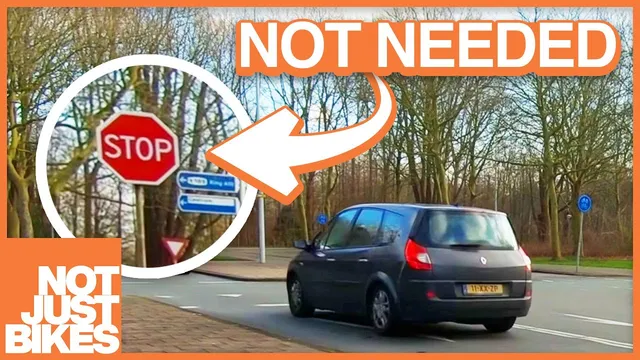
Stop Signs Suck and We Should Get Rid of Them
Based on Not Just Bikes's video on YouTube. If you like this content, support the original creators by watching, liking and subscribing to their content.
Stop signs often fail to produce consistent full stops and can create long queues without improving safety.
Briefing
Stop signs are inefficient and can be less safe for cyclists because they force vulnerable road users into longer, slower crossings—yet many cities keep them in place due to rule-following culture rather than safety outcomes. In practice, complete stops at stop signs are rare: neither drivers nor cyclists consistently stop, and even a staged San Francisco protest where cyclists fully stopped produced long queues stretching several blocks. That mismatch between the intended behavior and real-world behavior is a big part of why stop signs underperform.
The safety case centers on how stop signs change timing and attention. Bicycles are slow to accelerate from a full stop, so yielding can keep a rider moving through an intersection quickly. The transcript contrasts crossing times at a “Dutch Junction”: yielding at the stop sign takes under 2.5 seconds, while coming to a complete stop can take nearly 6 seconds—more than twice as long in the intersection. That extra time matters because cyclists are “vulnerable road users,” and during the slow movement they become easier to miss, especially when drivers have obstructed views from blind spots such as pillars.
Studies cited in the discussion add a quantitative layer: one study found 14% fewer crashes when cyclists are allowed to yield rather than stop, and another found that when crashes do occur, injuries are less serious. The underlying logic is that stop-sign rules imported from car traffic don’t translate well to bicycles. Car-focused laws assume fast movement and predictable sightlines, but cyclists accelerate differently and face different risk dynamics—so forcing a full stop can increase exposure without improving safety.
The transcript then argues that the Netherlands offers a model for replacing stop signs with design-based priority and traffic calming. Although stop-sign concepts appeared in the Netherlands during the German occupation in 1941, modern Dutch practice largely avoids stop signs, relying instead on junction layouts that control speed and clarify right-of-way. Priority markings with “shark’s teeth” indicate which road has precedence, and residential junctions use multiple calming elements—brick surfaces, narrow lanes, and especially raised junctions that function like a speed bump across the whole intersection. Continuous sidewalks and ramps set back from the junction help ensure drivers approach slowly even without signage.
This approach shifts attention from “the sign I stopped at” to the actual rule that matters: yielding the right-of-way. The transcript also notes that roundabouts can improve safety by reducing severe crash angles and slowing speeds, though they typically replace traffic lights rather than stop signs.
When stop signs do appear, the argument is narrower: they may be appropriate at junctions with poor visibility where stopping is safer for drivers. But the broader prescription is to remove stop signs first for bicycles, then redesign roads so car travel becomes as safe as Dutch streets—starting with the principle that good geometry and controlled speeds can do what signage often fails to do: reduce risk while keeping traffic moving.
Cornell Notes
Stop signs are portrayed as a road-design failure because they rarely produce full stops and can increase risk for cyclists. Allowing cyclists to yield instead of stopping is linked to fewer crashes (14% fewer in one cited study) and less severe injuries when crashes occur. The mechanism is timing and exposure: bicycles take much longer to accelerate from a full stop, so riders spend more time in the intersection and become easier to miss, especially with driver blind spots. The Netherlands is offered as an alternative, using priority markings (“shark’s teeth”), traffic calming, and raised junctions to control speed and clarify right-of-way without relying on stop signs. The key takeaway is that yielding rules and intersection design can be safer and more efficient than forcing universal stop behavior.
Why are stop signs described as inefficient in real traffic behavior?
How does a full stop specifically increase danger for cyclists?
What evidence is cited for yielding versus stopping at stop signs?
What Dutch design elements replace stop signs while still controlling right-of-way?
Why does the transcript say the key is yielding, not stopping?
When might stop signs still be justified?
Review Questions
- What timing difference between yielding and stopping is used to explain increased cyclist exposure at intersections?
- Which cited study result supports the claim that yielding can reduce crashes and injuries compared with full stops?
- How do Dutch junction features like raised intersections and “shark’s teeth” markings reduce reliance on stop signs?
Key Points
- 1
Stop signs often fail to produce consistent full stops and can create long queues without improving safety.
- 2
Allowing cyclists to yield instead of stopping is linked to fewer crashes (14% fewer in one cited study).
- 3
Full stops increase cyclist time in the intersection because bicycles accelerate slowly from rest, raising exposure to inattentive drivers.
- 4
Driver blind spots and obstructed views make longer intersection dwell time more dangerous for cyclists.
- 5
Dutch-style intersections replace signage with priority markings and traffic-calming geometry, including raised junctions and narrow, brick-paved approaches.
- 6
The safety-critical behavior is yielding the right-of-way, not fixating on the act of stopping at a sign.
- 7
Stop signs may still be appropriate in limited cases, such as junctions with poor visibility.