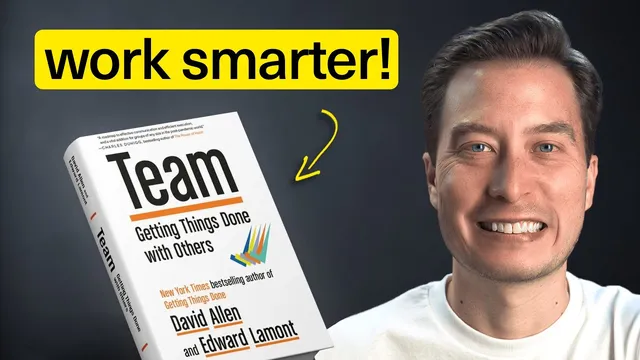
Stop Team Chaos! The GTD Way to Get Things Done Together!
Based on Tiago Forte's video on YouTube. If you like this content, support the original creators by watching, liking and subscribing to their content.
Make team projects formal enough that participants can see priorities and gaps without constant status meetings.
Briefing
David Allen’s follow-up to Getting Things Done reframes productivity around teams, arguing that collaboration works best when work is made transparent, outcomes are clearly owned, and next actions are always explicit. The central tension is practical: an individual’s “project” can be informal and even playful, but a team’s project list needs to be formal enough that everyone can see what’s happening—and what isn’t—without constant status meetings. When trust is high, that transparency reduces unnecessary communication and replaces recurring check-ins with shared clarity about priorities.
Accountability, in this framework, isn’t a vague cultural slogan. It comes down to two questions that should be asked in any meeting or situation: What is the desired outcome, and who owns it? Then, what is the next action—the very next step that moves the team toward that outcome? The ownership question creates real accountability because responsibility is unambiguous. The next-action question creates momentum by building a default bias toward action rather than discussion. This also exposes a common failure mode: teams add new goals without pausing to decide what existing projects must be stopped or reduced to make room. The result is an overloaded list that fuels frustration and, in many workplaces, burnout.
Allen’s team-oriented approach also highlights how goals should be structured. New ambitious targets often ignore the current workload and the capacity required to reach them. Instead, process goals can help when the endpoint is uncertain—such as entering a new industry or learning a new skill where the “right” outcome isn’t fully known yet. A process goal gives direction through measurable behavior in the short term. For example, rather than aiming immediately for revenue or profit in sales, a team might commit to a specific number of sales conversations per week, using that activity as the tangible lever that builds learning and progress.
Beyond projects, the framework emphasizes “areas of responsibility,” which can reveal why progress stalls even when projects look on track. If energy is consistently low, the bottleneck may be health-related—nutrition, sleep, or other foundational factors—rather than a lack of effort. Regularly revisiting these areas helps teams sustain the capacity required to execute.
Operationally, the method stresses negotiating what “done” means. Different people may interpret completion differently—for instance, hiring a designer could mean posting a job, shortlisting candidates, running interviews, selecting someone, or completing onboarding. Without alignment, teams miss the finish line or argue about it late.
Finally, the approach recommends specifying delivery timing in a way that creates space for planning. Counterintuitively, leaving deadlines completely open can be worse than setting a clear timeframe that remains negotiable. The underlying philosophy ties imagination to feasibility: people struggle to envision outcomes they can’t map to practical steps. Effective teamwork therefore requires both creative vision (what could be) and analytical planning (how, what, and by when) working together to turn goals into achievable execution.
Cornell Notes
The team-focused version of Getting Things Done centers on making collaboration legible: projects should be formal enough for shared visibility, and work should be organized around clear outcomes and ownership. Accountability becomes concrete through two recurring questions—what outcome is desired and who owns it, plus what the next action is. To avoid burnout and overload, teams should pause before adding goals and consider what must be cut or paused; when outcomes are uncertain, process goals offer measurable direction. The framework also urges alignment on what “done” means, attention to areas of responsibility that affect energy, and practical feasibility so imagination can translate into action.
Why does a team need a more formal “project” definition than an individual does?
How does the framework turn “accountability” into something measurable?
What’s the risk of setting new goals without reviewing the existing workload?
When should teams use process goals instead of outcome goals?
What does “areas of responsibility” add beyond project tracking?
Why does negotiating “when delivery is expected” matter, and what’s the counterintuitive lesson?
Review Questions
- In a team meeting, what two questions should always be answered to make accountability and action concrete?
- Give an example of a situation where a process goal would be more appropriate than an outcome goal, and explain what would be measured.
- How can misalignment on the definition of “done” derail a project, and what negotiation step prevents it?
Key Points
- 1
Make team projects formal enough that participants can see priorities and gaps without constant status meetings.
- 2
Use two recurring questions to operationalize accountability: desired outcome with an owner, and the next action as the immediate step.
- 3
Prevent overload by pausing or cutting existing work before adding new goals, rather than stacking targets on an already undoable list.
- 4
Adopt process goals when outcomes are uncertain, using measurable behaviors (like a set number of sales conversations) to build learning and direction.
- 5
Track “areas of responsibility” alongside projects so energy constraints—such as sleep and nutrition—don’t masquerade as task-management failures.
- 6
Negotiate what “done” means so different interpretations (e.g., posting a job vs. onboarding a hire) don’t create late-stage disagreement.
- 7
Specify delivery timing in a negotiable way; leaving deadlines completely open can reduce urgency and stall execution.