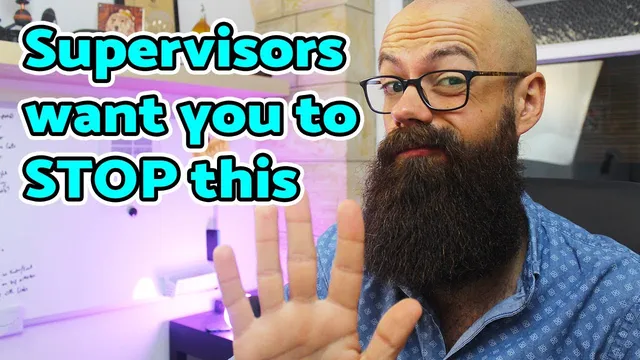
STOP THIS NOW...what your PhD supervisor wishes you'd stop doing
Based on Andy Stapleton's video on YouTube. If you like this content, support the original creators by watching, liking and subscribing to their content.
Arrive at supervision meetings with a solution or at least a set of options so brainstorming can target decisions rather than staying abstract.
Briefing
Academia runs more smoothly when PhD students bring solutions, surface problems early, and treat supervision meetings like structured work sessions rather than open-ended conversations. The most practical shift is to arrive with a proposed solution (or at least clear options) instead of waiting to “think out loud” in the meeting. That approach changes the interaction: supervisors can focus their brainstorming toward decisions, students avoid getting pulled into the supervisor’s preferred agenda, and meetings become faster and more outcome-driven—especially when time is tight.
A second theme is radical transparency about issues. Supervisors often prefer hearing about problems as soon as they appear, because early fixes are usually easier than letting issues “simmer” until they grow worse. The transcript emphasizes that honesty shouldn’t be punished: one supervisor story involves a major equipment mishap (a 20,000-piece item) handled immediately by going straight to the supervisor, which led to resolution rather than blame. The underlying message is straightforward: hiding problems doesn’t protect anyone; it typically makes the eventual fallout bigger.
The advice then turns to meeting behavior and documentation. Students are urged to stop acting like passengers during supervisor meetings. Instead, they should record decisions and next steps in real time—writing down what’s agreed, what actions follow, and what needs revisiting later. Even if a student can remember everything, visible note-taking signals that the supervisor’s points are being captured and preserved, creating a reliable reference for follow-ups. The transcript also frames this as a “mind game” that helps both sides: the supervisor sees engagement, and the student leaves with a concrete plan.
Writing habits are another pressure point. Students are cautioned against waiting for a “perfect result” before drafting papers. Since papers function as academic currency, the recommended workflow is to start early with lightweight drafts: bullet-point outlines that include results and brief interpretations, then present those to the supervisor for gap-finding. The goal isn’t a polished manuscript on day one; it’s momentum. By writing frequently and quickly, researchers can determine where each new result fits, and they may only need one or two additional experiments to close obvious holes.
Finally, the transcript addresses confidence. Impostor syndrome is described as a common early-PhD condition that makes students hesitate in discussions, proposals, and presentations. The suggested countermeasure is not to “feel” confident first, but to act confident—leaning into a more assured posture during meetings. That performance can change how supervisors and collaborators respond, often restoring momentum and keeping the research process moving.
Overall, the five “stop doing” items converge on one operational principle: make supervision more actionable by bringing structure (solutions, notes, drafts) and by removing friction (hidden problems, stalled writing, self-doubt).
Cornell Notes
The transcript lists five behaviors supervisors often want PhD students to stop: arriving without solutions, hiding problems, treating meetings as passive, waiting for perfect results before drafting, and underestimating oneself. Bringing a solution or options helps supervisors steer brainstorming toward decisions instead of getting stuck in open-ended idea mode. Early problem disclosure prevents small issues from growing into larger failures, and note-taking during meetings creates a clear record of decisions and next steps. Writing should start with simple bullet-point drafts based on results, so supervisors can identify gaps quickly and momentum stays high. Confidence matters too: acting confident can counter impostor-syndrome hesitation and keep research moving.
Why does arriving with a proposed solution change the supervisor-student dynamic?
What’s the practical downside of hiding problems until they “sort themselves out”?
How should students behave during supervisor meetings to avoid being “passengers”?
What does “stop waiting for the perfect result” mean for academic writing?
How does the transcript suggest handling impostor syndrome during PhD work?
Review Questions
- Which of the five behaviors would most directly improve the efficiency of your next supervisor meeting, and why?
- What would an early “bullet-point draft” look like for your current project (results + brief interpretation + tentative conclusion)?
- How would you respond if you discovered a serious problem mid-week—what’s your plan to surface it early and document next steps?
Key Points
- 1
Arrive at supervision meetings with a solution or at least a set of options so brainstorming can target decisions rather than staying abstract.
- 2
Surface problems immediately; early disclosure makes issues easier to fix and prevents them from escalating.
- 3
Treat meetings as an active work session by writing down decisions, action items, and follow-ups in real time.
- 4
Start paper drafts before results are “perfect” by using simple bullet-point outlines built around results and interpretations.
- 5
Draft frequently and quickly to maintain momentum and to learn where each result fits in the eventual narrative.
- 6
Counter impostor-syndrome hesitation by acting confident in discussions and proposals, which can improve how others respond and trust the work.