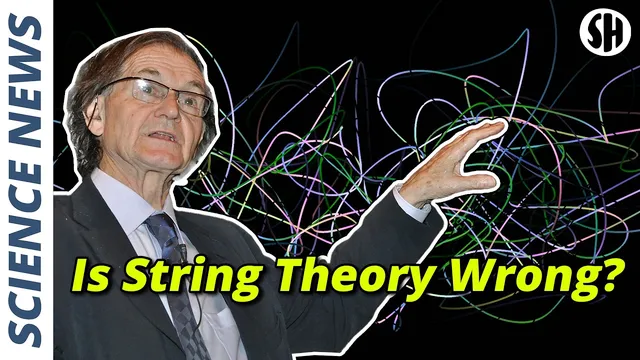
String Theory is “Fashion,” Penrose Said. We Finally Have a Response
Based on Sabine Hossenfelder's video on YouTube. If you like this content, support the original creators by watching, liking and subscribing to their content.
Penrose’s string-theory critique hinges on whether the universe’s available energy should excite extra-dimensional oscillations that would otherwise be dismissed as requiring Planck-scale energies.
Briefing
String theory’s extra dimensions face a renewed, concrete challenge from Roger Penrose—now met with a detailed technical response from string theorists. Penrose’s core complaint, laid out in his 2016 book “Fashion, Faith and Fantasy,” targets a basic mismatch: if extra spatial dimensions exist and are compactified to tiny sizes, then the energy in our universe should be able to excite “vibrations” (higher harmonics) of strings wrapping those dimensions. Penrose argues that the required energy is not as inaccessible as string theorists often claim, so the resulting effects should be observable—yet they are not.
In string theory, the extra dimensions must be small enough to have escaped direct detection. Strings can wrap around them, and the allowed oscillation modes depend on the compactification scale—much like the harmonics on a violin string. The usual argument for why higher harmonics aren’t seen is energetic: exciting those modes would require Planck-scale energies, far beyond any realistic collider. Penrose counters with a different intuition. Because the extra dimensions are present everywhere in spacetime (not confined to a single location), the relevant question isn’t whether a collider can locally “wiggle” them, but whether the total energy already filling our universe is sufficient to drive oscillations throughout.
Penrose emphasizes that Planck energy, though enormous compared with everyday particle physics, is still small compared with energy available in the universe. He compares it to the energy from roughly one tonne of TNT and notes that the energy Earth receives from the Sun in a second is about 10^8 times larger—suggesting that, on energy grounds alone, there should be enough to excite the extra dimensions across the entire cosmos.
The new reply paper takes up this line of attack and narrows the physics question. It agrees that Penrose’s critique deserves serious analysis, but argues that observable effects require more than just total energy. To produce a detectable oscillation, the energy must be effectively localized in spacetime rather than spread uniformly. The key quantity is not the global energy budget; it’s the energy contained within a relevant spacetime volume. Even if the universe contains vast energy overall, exciting extra-dimensional modes everywhere would still require creating the oscillation in a local region first and then allowing it to propagate.
Beyond the vibrating-extra-dimensions dispute, the response paper reviews several other Penrose objections. One point of agreement stands out: string theory’s equations for spacetime are not limited to Einstein’s equations plus a finite set of corrections. Instead, they involve infinitely many correction terms. Penrose worries that this forces an infinitely detailed specification of initial conditions—an ironic echo of the very problem string theory was meant to address. The reply paper treats this as a genuine open question, concluding that more work is needed.
The discussion ultimately matters less as a win-or-loss debate and more as a snapshot of how physics criticism and technical rebuttal can sharpen the subject. Penrose’s challenge forces string theorists to specify what energy localization means for observability, while the response highlights where the argument hinges on spacetime-local quantities rather than headline energy scales.
Cornell Notes
Roger Penrose’s criticism of string theory focuses on whether extra compact dimensions should be excited by the energy already present in the universe. He argues that, although Planck energies are huge, the total cosmic energy budget is large enough that extra-dimensional “vibrations” should occur and be observable. A new string-theory response accepts the need for careful analysis but says the relevant factor is not total energy; observable effects require energy localized in spacetime volume, so oscillations must be created locally and then spread. The exchange also finds common ground on a deeper issue: string-theory spacetime dynamics involve infinitely many correction terms, raising concerns about the need for infinitely detailed initial data. Both sides conclude that further work is required to settle these questions.
Why does Penrose think string theory’s extra dimensions should be excited despite the usual “Planck energy” argument?
What does the response paper change about the energy argument?
How does the “violin string harmonics” analogy function in the critique?
Where do Penrose and the response paper agree on a deeper structural problem in string theory?
What does the exchange suggest about what counts as a decisive argument in physics?
Review Questions
- In Penrose’s reasoning, why does the fact that extra dimensions are “everywhere” matter for the excitation argument?
- What does it mean, in the response paper’s framework, for energy to be “localized in a spacetime volume,” and why does that change the observability conclusion?
- How does the concern about infinitely many correction terms relate to the problem of specifying initial data?
Key Points
- 1
Penrose’s string-theory critique hinges on whether the universe’s available energy should excite extra-dimensional oscillations that would otherwise be dismissed as requiring Planck-scale energies.
- 2
String theory’s extra dimensions are compact and allow string modes whose wavelengths match the compactification scale, making higher harmonics the natural target for observability arguments.
- 3
The response paper argues that observability depends on localized energy in a spacetime volume, not on the total energy budget across the universe.
- 4
Even with abundant total energy, exciting extra-dimensional modes everywhere would still require local excitation followed by propagation.
- 5
Both sides agree that string-theory spacetime dynamics involve infinitely many correction terms, raising concerns about infinitely detailed initial conditions.
- 6
The dispute illustrates how physics progress can come from tightening the definition of the relevant quantity—global energy versus spacetime-local energy.