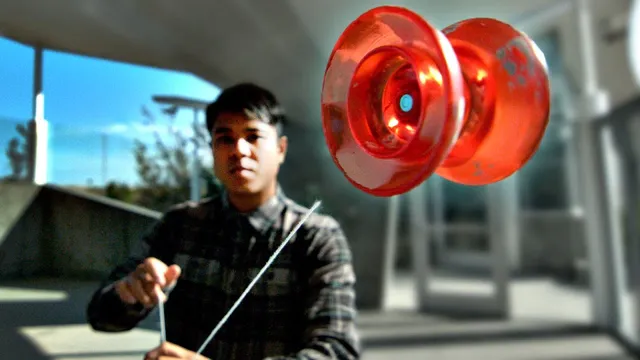
Stringless Yo-Yo!
Based on Veritasium's video on YouTube. If you like this content, support the original creators by watching, liking and subscribing to their content.
High spin rate (around six thousand revolutions per minute) provides gyroscopic stability, keeping the yo-yo’s rotation axis steady enough for the string to bind reliably.
Briefing
A stringless-looking yo-yo trick works because the yo-yo’s high spin rate and gyroscopic stability let it “rebind” a loose string to its spool at just the right moment. The key is energy and angular momentum: when the yo-yo is released, it unspools as it falls, converting gravitational potential energy into kinetic and rotational energy. Spinning around roughly six thousand revolutions per minute, it gains enough angular momentum to resist disturbances like a breeze, keeping its rotation axis steady.
The magic happens when Ben tugs the string from one side of the spinning yo-yo to the other. That lateral pull drags the string into contact with the yo-yo’s spool while the yo-yo continues spinning. As the string wraps and binds, the yo-yo effectively starts rolling up the string again—preventing further unravelling and stopping the yo-yo from simply falling off. In slow-motion, the binding moment is visible: the instant the string catches on the spool is what stops the runaway unspooling.
Catching the yo-yo with only a string also relies on how yo-yos roll up string in the first place. Inside the yo-yo are friction pads—described as silicone—separated by a small gap. When the string goes into that internal gap during the motion, friction pads grip it, allowing the spinning yo-yo to pull the string back in. Even if those pads aren’t present, wrapping the string around the axle creates substantial friction, similar to how a rope coiled around a bollard can hold a heavy ship at dock.
The transcript ties that grip to the belt friction equation, which predicts how the maximum force a coiled string can transmit grows exponentially with the wrap angle around the axle. That means only a few turns can be enough for the string to hold under tension and let the performer pull the yo-yo back.
Beyond the mechanics, the segment frames the skill as practice-driven: the performer’s ability comes from years of honing the motion, including learning through repeated attempts. The result is a trick that looks like it defies the usual “string attached” expectation, but ultimately follows straightforward physics—energy conversion, gyroscopic stability, and friction that ramps up with how tightly the string is wrapped.
Cornell Notes
The trick relies on the yo-yo spinning fast enough to stay stable and then using a tug to force a loose string to bind to the spool. When released, the yo-yo converts gravitational potential energy into rotational motion, reaching about six thousand revolutions per minute, which provides gyroscopic stability. A sideways tug pulls the string across the spinning yo-yo so it wraps and catches on the spool, stopping further unspooling. Rolling the yo-yo back up the string depends on internal silicone friction pads and/or axle friction, both of which increase holding power as the string wraps more tightly. The belt friction equation explains why even a few turns can transmit enough tension to pull the yo-yo back.
Why does the yo-yo need to spin so fast for the trick to work?
What exactly stops the yo-yo from unravelling further once the string is “loose”?
How does the yo-yo roll up a string that was previously unspooled?
Why does wrapping the string a few times make a big difference in holding power?
How does the performer “catch” the yo-yo if the string isn’t attached to it?
Review Questions
- How do gravitational potential energy and angular momentum combine to produce the yo-yo’s gyroscopic stability in this trick?
- Explain how a sideways tug changes the interaction between a loose string and the yo-yo’s spool.
- Using the belt friction equation conceptually, why does increasing the wrap angle around the axle dramatically increase the force the string can hold?
Key Points
- 1
High spin rate (around six thousand revolutions per minute) provides gyroscopic stability, keeping the yo-yo’s rotation axis steady enough for the string to bind reliably.
- 2
When released, the yo-yo converts gravitational potential energy into rotational motion as it unspools while falling.
- 3
A lateral tug pulls the loose string across the spinning yo-yo so it wraps and binds to the spool, stopping further unravelling.
- 4
Rolling the yo-yo back up the string depends on internal friction pads (silicone) and/or friction created by wrapping the string around the axle.
- 5
The belt friction equation explains why holding power grows exponentially with the string’s wrap angle, so only a few turns can be sufficient.
- 6
The trick’s success hinges on timing: the string must be positioned to catch at the moment the yo-yo continues spinning at high angular momentum.