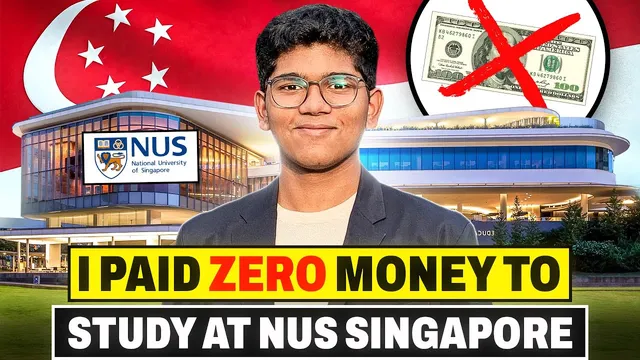
STUDY IN SINGAPORE FOR FREE! 🤯🔥 Ft. Armaan Dhanda
Based on WiseUp Communications's video on YouTube. If you like this content, support the original creators by watching, liking and subscribing to their content.
Armaan Dhanda’s NUS admission success was influenced by the late release of ISC board results in late July, which compressed the window for course evaluation.
Briefing
Admission to Singapore’s top universities can hinge on timing as much as grades, and one student’s path shows how that plays out in practice. Armaan Dhanda, a second-year undergraduate at NUS studying Chemical Engineering with a second major in Innovation and Design, earned the Science and Technology (S&T) scholarship worth 1.5 crore. His route included a failed first attempt, a year at St. Stephen’s College in Delhi, and then a successful NUS admission cycle—made possible by how late Indian board results landed and how quickly Singapore’s intake filled.
Dhanda’s Singapore story began in seventh grade, when a family trip to Singapore—arranged by his parents—sparked a long-running goal. He focused early on high grades, and later chose to skip SAT/ACT in favor of preparing for the Indian board exams (and related admissions pathways). He applied beyond India as well, including Canada, the UK, Hong Kong, and Singapore, but ultimately leaned toward Singapore over the US. His reasons were practical: the US felt too expensive, too far, and culturally “too open” for an 18-year-old coming from a sheltered environment. Singapore, by contrast, offered proximity to India (he cites short flight times and frequent return trips), strong educational resources, and a curriculum that is rigid enough to build fundamentals while still flexible for personal goals.
Safety and campus rules also mattered to his family. Dhanda pointed to Singapore’s drug-free environment and restrictions around alcohol and smoking as factors that made parents more comfortable—especially when families worry about sending children abroad. He also addressed a common concern from parents: whether Singapore is safe compared with India. His answer was blunt—Singapore is “probably safer” in that sense.
The scholarship details are where the financial picture becomes concrete. Dhanda described the S&T scholarship as a six-year agreement tied to a four-year degree, followed by six years in Singapore. It covers tuition fully, accommodation for all four years, a stipend of about $500 per month for food and other expenses, and flights from India to Singapore and back. He said only about five students receive it each year, and applicants can’t apply directly; the university nominates candidates based on grades, then invites them for an interview where they must articulate how they will contribute.
On academics, Dhanda contrasted his time at St. Stephen’s College with NUS. At St. Stephen’s, he described long daily lecture schedules and a heavy emphasis on structured instruction. At NUS, tutorials are compulsory but less frequent, attendance for lectures is often not enforced, and independent learning becomes central. He argued that this flexibility can be a major advantage—especially for students aiming for research careers—because it forces fundamentals while leaving room to manage time.
He also offered a pragmatic view of outcomes and costs. Dhanda suggested that NUS employment results are strong (he referenced official figures indicating graduates finding jobs within six months), while acknowledging that median salaries can look lower than the US until taxes and take-home pay are considered. For students without full scholarships, he estimated living expenses around $1,000 Singapore dollars per month on average, with on-campus housing lowering costs. He described part-time options such as research lab roles (often 10–20 hours per week at roughly $15–$16 per hour), library or supermarket jobs, internships (including virtual or hybrid), and tutoring high school students for higher hourly rates. His closing strategy was straightforward: prioritize grades for NUS admission, since earlier academic performance weighs more than tenth-grade results, while NUS College admissions consider a more holistic profile.
Cornell Notes
Armaan Dhanda’s path to NUS shows how Singapore admissions can turn on both academic performance and timing. After an initial unsuccessful attempt, he spent a year at St. Stephen’s College in Delhi and then gained admission to NUS, later receiving the Science and Technology (S&T) scholarship. The S&T scholarship is a six-year agreement tied to a four-year degree, covering full tuition, accommodation, a ~$500/month stipend, and flights, with about five recipients per year selected through nomination and an interview. Dhanda contrasts India’s more lecture-heavy structure with NUS’s tutorial-based system and greater reliance on independent learning. He also outlines realistic cost and income planning through part-time research work, campus jobs, internships, and tutoring, emphasizing that grades remain the dominant factor for NUS admission.
Why did Dhanda’s NUS admission succeed after an earlier attempt failed?
What exactly does the S&T scholarship cover, and what obligations come with it?
How does Dhanda compare learning structure between St. Stephen’s College and NUS?
What reasons did Dhanda give for choosing Singapore over the US?
How can students without full scholarships manage living expenses in Singapore, according to Dhanda?
What admission strategy did Dhanda recommend for students applying to NUS or NUS College?
Review Questions
- What timing factor around board results and course capacity did Dhanda identify as affecting admission outcomes?
- How does the S&T scholarship’s six-year agreement work, and what benefits does it include beyond tuition?
- Compare Dhanda’s description of lecture-heavy scheduling in India with NUS’s tutorial/independent-learning model. How might that change a student’s daily routine?
Key Points
- 1
Armaan Dhanda’s NUS admission success was influenced by the late release of ISC board results in late July, which compressed the window for course evaluation.
- 2
The S&T scholarship is a six-year agreement tied to a four-year degree, with full tuition coverage, accommodation, a ~$500/month stipend, and funded flights.
- 3
S&T recipients are nominated by the university (about five per year) and must pass an interview where they explain how they will contribute.
- 4
Dhanda credits NUS’s tutorial structure and lecture attendance flexibility with pushing students toward independent learning, contrasting it with St. Stephen’s more lecture-driven schedule.
- 5
Singapore’s appeal for his family included proximity to India, strong educational resources, and campus safety norms such as restrictions around alcohol and smoking.
- 6
For students managing costs without full scholarships, Dhanda outlined a mix of part-time research work, campus jobs, internships, and tutoring to offset living expenses.
- 7
For NUS admission, Dhanda emphasized prioritizing 12th-grade grades; for NUS College, he said selection is more holistic than marks alone.