Systematic Literature Review Software for Dissertation Writing | AI In Research
Based on Dr Rizwana Mustafa's video on YouTube. If you like this content, support the original creators by watching, liking and subscribing to their content.
Build the literature review outline first, using the research objectives, research questions, and hypothesis so every section stays aligned to the study’s purpose.
Briefing
A strong literature review starts with a tight outline tied directly to the research objectives, research questions, and hypothesis—then uses that structure to organize background, identify gaps, and connect prior work to the specific problem being targeted. The chapter should first establish context (what is known and why it matters), then map the research gap by showing how much work exists in the area and what limitations remain. Those limitations should be explicitly linked to the current research problem, culminating in a proposed solution framed through the research hypothesis.
Length and format vary by document type, but the underlying structure stays consistent across proposals, theses, and journal papers. For theses/dissertations, the word count is often in the range of 4,000 to 8,000–10,000 words depending on institute requirements. To avoid writing “blocks,” the process begins by building a clear chapter outline before drafting. A practical example is given around “green synthesis of pharmaceutical using ionic liquid,” where the topic is initially broad, then narrowed into specific research objectives, a defined research problem, research questions, and a hypothesis. From there, the literature review can be organized so the introduction covers the pharmaceutical industry, environmental impact, and the importance of green chemistry, followed by a focused review of ionic liquids—their properties, synthesis, and applications. The outline can be expanded if needed, but it should always remain aligned with what the study is actually trying to answer.
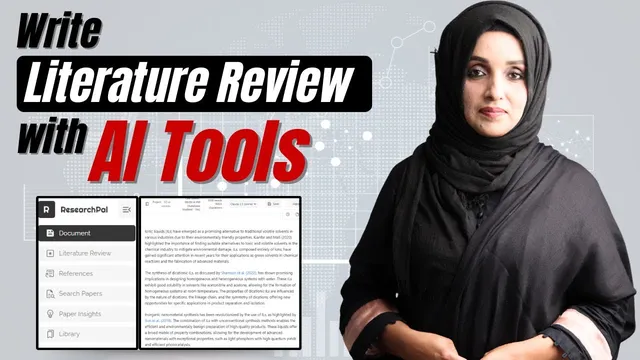
AI tools can accelerate the early stages—especially outline creation and literature discovery—but they don’t replace manual verification. Tools such as Gemini or ChatGPT can help generate an outline, provided the prompt includes the research objectives and research questions so the resulting structure stays focused on the intended literature search. For gathering sources, the transcript highlights a dedicated tool called ResearchPIL(E) for literature review and writing. The workflow described is: create a new project, select the domain and desired length (short/medium/long), run a search, and receive structured summaries plus links to recent research articles. The output can be pasted into a document editor for editing—changing tone, rephrasing, or adjusting length—and the tool can generate a reference list via a citation generator.
After collecting sources, the process shifts to evaluation and synthesis. The transcript warns that AI-generated summaries and citations may not always align, so manual checking is required. ResearchPIL(E) can also integrate with a library workflow: users can import references from a Zotero library or upload papers from manual research, then use paper “insights” to extract elements such as introduction, limitations, contributions, results, and discussion. For deeper synthesis, the tool supports chatting with selected papers to pull out information that can be quoted in the literature review chapter.
Finally, references must be quoted according to the institute’s required style and either chronologically (year-wise) or thematically (based on the outline). The chapter should end with a conclusion that summarizes what the literature has done, what is still missing, what the proposed research will contribute, and why that contribution matters for society.
Cornell Notes
A strong literature review is built from an outline that mirrors the study’s research objectives, research questions, and hypothesis. The review should move from background knowledge to the research gap, then connect limitations in prior work directly to the current research problem and proposed solution. AI tools can speed up outline creation and literature discovery by generating structured summaries and reference links, but manual checking is essential because citations and content may not always match. A dedicated literature tool (ResearchPIL(E)) can generate draft-ready text, provide editable paragraphs, and support library-based synthesis through paper insights and extraction of key sections like limitations and contributions. References must be organized and cited using the institute’s required style, either year-wise or theme-wise, and the chapter should close with a clear conclusion about impact.
What is the core job of a literature review chapter, and how should it connect to the research problem?
How does an outline prevent writing delays, and what should it include?
How can AI help early-stage writing without derailing focus?
What workflow is recommended for finding and organizing literature using an AI tool?
Why is manual verification still necessary even when AI provides citations and summaries?
How should references be organized and cited in the final literature review?
Review Questions
- How would you translate your research objectives and hypothesis into a literature review outline that avoids irrelevant sources?
- What steps would you take to synthesize multiple papers into a theme-based section while still manually verifying AI-generated citations?
- Which citation organization approach (year-wise vs theme-wise) would better fit your outline, and why?
Key Points
- 1
Build the literature review outline first, using the research objectives, research questions, and hypothesis so every section stays aligned to the study’s purpose.
- 2
Use a gap-driven structure: summarize what is known, then identify what remains missing or limited in prior work and tie those limitations to the current research problem.
- 3
Keep document expectations in mind: proposals are shorter, while theses/dissertations often fall around 4,000–8,000 to 10,000 words depending on institute rules.
- 4
Use AI to accelerate drafting and discovery (outline generation, structured summaries, editable paragraphs), but treat outputs as starting material rather than final truth.
- 5
Verify citations and content manually because AI-generated references and summaries may not always match or correlate correctly.
- 6
Synthesize literature through a library workflow: import from Zotero or upload papers, then extract key elements (limitations, contributions, results/discussion) for quoting.
- 7
Apply the institute’s citation style and organize references either year-wise or theme-wise based on the outline, then close with a conclusion about impact.