Taking Smart Notes in Roam
Based on Cortex Futura's video on YouTube. If you like this content, support the original creators by watching, liking and subscribing to their content.
Preserve surrounding meaning by copying whole paragraphs or sections into Roam, not just isolated highlights.
Briefing
Smart notes in Roam aren’t built from isolated highlights; they’re built by preserving the surrounding context from what’s read, then iterating on that material through quotes, comments, and explicit links. The core idea is to copy whole paragraphs or sections into Roam so the meaning doesn’t get stripped away. In a system that relies on direct backlinks, more connected content becomes more useful—especially when highlights alone would otherwise lose the surrounding setup and lead to “highlight-and-forget” behavior.
Many note-taking approaches emphasize underlining and highlighting, and that works when the highlighted text stays in place. But in Roam—where notes become movable building blocks—simple highlights can create a context gap. That gap often pushes people to highlight entire chunks just to stay oriented, yet those chunks still don’t turn into usable insights. The workaround is to bring the context along: copy the full paragraph, keep or add highlights inside it, then extract the specific sentence(s) that matter as quotes. Those quotes become anchors for commentary and linking.
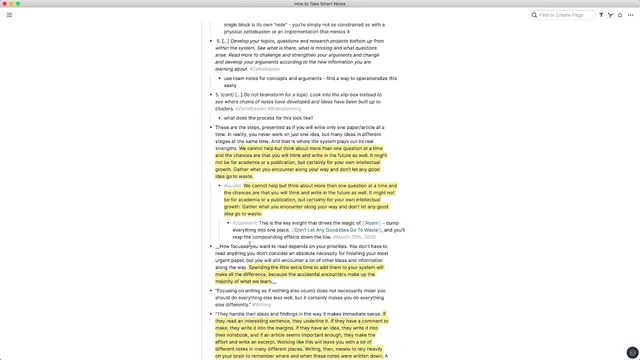
The workflow described starts with a “context block” copied from the source. Within that copied section, the reader highlights selected sentences and adds tags for what the passage is about. Then the reader pulls out the quote of interest, marks it as a quote (optionally keeping the highlight), and writes a comment in a nested block explaining the connection—such as how the idea relates to Roam itself or to a broader principle like “don’t let any good idea go to waste.” A key detail is time-stamping the comment with the date it was created. That timestamp enables a longitudinal view: returning days, weeks, or months later to add new blocks shows how the thought evolves while still tied to the original quote.
This nested structure also supports asynchronous insight building. Instead of treating reading notes as a one-time capture, the system encourages multiple passes: copy for context, highlight for emphasis, quote for precision, comment for interpretation, and link for retrieval. Because comments and quotes remain connected to their source context, it becomes easier to transclude (reuse) a quote elsewhere or embed it in a new place when a new idea emerges. Over time, these linked fragments accumulate into “critical mass” on a topic—fast—because each new insight can attach to existing context rather than starting from scratch.
A practical demo centers on notes taken from the book How to Take Smart Notes. Long paragraphs are copied in full, then specific sentences are highlighted and converted into quote blocks with comments. The result is a set of notes where the original author’s thought stays intact, while the reader’s evolving interpretations appear as dated nested comments. The approach concludes with a simple repeatable cycle: copy for context, highlight and quote inside Roam, write comments in sub-blocks tied to the quote and dated, link to concepts, and repeat as often as needed while reading.
Cornell Notes
Smart notes in Roam are built to preserve context, not to rely on standalone highlights. The method copies whole paragraphs or sections from a source into Roam, then highlights and extracts the specific sentence(s) as quote blocks. Each quote gets a nested comment explaining the connection to a concept (for example, how Roam helps “don’t let any good idea go to waste”), and that comment is tagged with the date to track how thinking develops over time. Because Roam’s structure supports direct backlinks and nested blocks, the same quote and its evolving commentary can be reused, transcluded, or embedded elsewhere without losing the original meaning. Repeating this cycle during reading creates fast accumulation of connected insights on a topic.
Why are highlights alone considered insufficient in Roam?
What does “copy for context” look like in the workflow?
How does the system turn a quote into a usable “smart note”?
Why tag comments with the date?
How do nested blocks and links support reuse later?
What repeatable cycle is recommended for taking notes while reading in Roam?
Review Questions
- How does copying whole paragraphs change the retrieval and usefulness of notes compared with keeping only highlights?
- Describe how a quote block and its nested dated comments help track the evolution of an idea over time.
- What role do explicit backlinks and concept tags play in turning reading notes into a connected knowledge base?
Key Points
- 1
Preserve surrounding meaning by copying whole paragraphs or sections into Roam, not just isolated highlights.
- 2
Extract only the specific sentence(s) you care about as quote blocks to keep notes precise.
- 3
Write interpretation as nested comments under each quote, linking the quote to relevant concepts.
- 4
Tag each comment with the creation date so later insights appear as an evolving thread tied to the original text.
- 5
Use Roam’s structure to reuse notes via transclusion or embedding without losing context.
- 6
Repeat the cycle during reading to build connected “critical mass” of insights quickly.