Tana's BIG next step
Based on CortexFutura Tools's video on YouTube. If you like this content, support the original creators by watching, liking and subscribing to their content.
Tana’s semantic functions add explicit meaning to field links, enabling recursive, multi-level searches.
Briefing
Tana’s latest upgrade adds “semantic functions,” a new way to make relationships between tags searchable across multiple levels—not just link nodes together, but treat those links as structured, recursive logic. The practical payoff is that users can define a relationship like “part of” once, then query entire hierarchies (tasks → projects → goals → areas, or paintings → movements → sub-movements → movements) without manually stitching together every step.
Previously, Tana’s field system already enabled powerful grouping. A field could connect nodes—for example, an “author” field linking a book to a person—so searches could pull all books by a given author. But those relationships were largely implicit: Tana understood the field as a concept, yet it didn’t provide a way to search the relationship chain across levels in a formal, reusable manner.
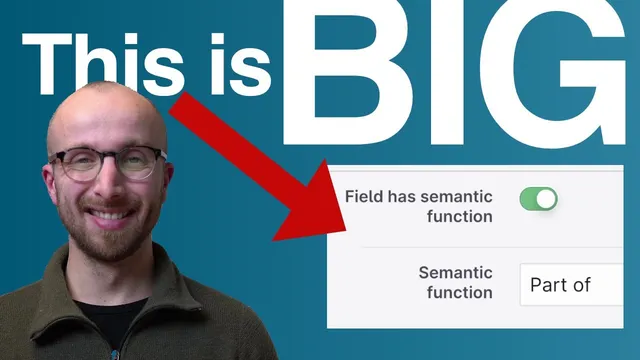
The new semantic functions change that. In the update, fields can be configured with a semantic function that describes the meaning of the link. The transcript focuses on one available semantic function: “part of.” With “part of,” a field can be set so that whatever is linked is treated as belonging to (and therefore discoverable through) a larger parent concept. That turns hierarchical tagging into something queryable recursively.
A goal-setting demo shows how this works in a second-brain setup built around Areas, Goals, Projects, and Tasks. Health and career are defined as top-level areas. Goals link to areas, projects link to goals, and tasks link to projects. The key upgrade appears when the task-to-project relationship is defined using semantic functions: the task’s “project” field is set to be an instance of the project super tag, and the field is marked with the “part of” semantic function. The same “part of” setup is applied at each level (project → goal → area). Once configured, a search can ask for “tasks where the project is part of the health area,” and Tana returns tasks across all relevant projects under health—without needing separate queries per project.
A second demo applies the same logic to art history. “Emerging Romanticism” is set as part of “Romanticism,” “French romantic paintings” as part of “Romanticism,” and “French realism” as part of “Realism.” Paintings are tagged with their specific movement (e.g., a painting linked to emerging Romanticism). Then a single recursive query retrieves all paintings associated with Romanticism, and a parallel query retrieves those associated with realism.
The broader implication is that users can build deeper relationship models inside Tana—across domains like philosophy, literature styles, authors, machines, inventions, or any nested classification—using semantic functions to search by meaning rather than by manual hierarchy traversal. The update’s excitement centers on how one semantic function (“part of”) already enables complex, multi-level discovery through recursive queries, and how future semantic functions could expand what kinds of relationships can be modeled and searched.
Cornell Notes
Tana’s semantic functions upgrade makes tag relationships searchable as explicit, meaningful links rather than just implicit connections. The transcript highlights the “part of” semantic function, which lets fields represent membership in a hierarchy. By setting “part of” across levels (tasks → projects → goals → areas), a single query can retrieve all tasks tied to a top-level area like “health,” even when they sit several layers down. The same approach works for art history: paintings tagged with sub-movements can be found through recursive queries starting from a broader movement like “Romanticism.” This matters because it turns structured tagging into reusable, multi-level search logic.
What problem does “semantic functions” solve compared with Tana’s earlier field-based linking?
How does the “part of” semantic function work in the goal-setting example?
Why does the health-area query return tasks from multiple projects without separate searches?
How is the art-history demo structured using the same semantic function?
What kinds of projects could benefit from semantic functions beyond productivity?
Review Questions
- In the health/tasks example, which fields must be configured with the “part of” semantic function to make the recursive query work?
- How does a query for “part of Romanticism” differ from manually listing each sub-movement’s paintings?
- What does semantic function add to a field beyond simply linking two tags or nodes?
Key Points
- 1
Tana’s semantic functions add explicit meaning to field links, enabling recursive, multi-level searches.
- 2
The “part of” semantic function treats linked items as belonging to a parent concept, which powers hierarchy traversal.
- 3
A goal-setting hierarchy (Areas → Goals → Projects → Tasks) can be queried from the top level to retrieve all relevant tasks in one step.
- 4
Semantic functions require configuration at each relationship level (e.g., task→project, project→goal, goal→area) to make recursion work.
- 5
The same “part of” logic applies outside productivity, such as art history hierarchies (movements → sub-movements → paintings).
- 6
With semantic functions, users can build deeper relationship models and discover items by high-level concepts rather than manual hierarchy navigation.