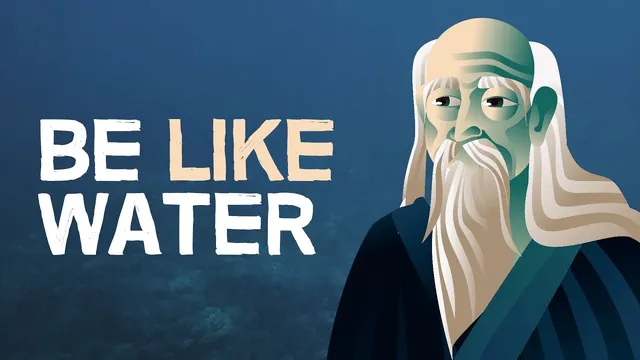
TAOISM | Be Like Water
Based on Einzelgänger's video on YouTube. If you like this content, support the original creators by watching, liking and subscribing to their content.
Taoist “be like water” treats flexibility and yielding as strengths that help people adapt to constant change.
Briefing
Taoist philosophy treats “being like water” as a practical survival strategy: stay flexible, yield when it matters, and adapt to change instead of clinging to rigid mental categories. The core claim traces back to Lao Tzu’s Tao Te Ching, where water becomes the model for the “supreme good”—soft and yielding, yet powerful enough to overcome hardness. In a world that constantly shifts, rigidity wastes energy fighting the inevitable; flexibility conserves energy and keeps perception open to complexity.
The argument begins with a critique of fixed thinking. Categorizing life into separate boxes can create short-term clarity, but it also narrows what people can see, locking them into ideas of how things “should” be. Taoism reframes this limitation through nature’s rhythms: the universe runs on the dance between opposites—yin and yang. Yang is associated with active traits such as speed, productivity, excitement, aggressiveness, and hardness; it also maps onto cultural values that reward standing one’s ground, confronting opponents, and insisting on unchanging opinions. Yin, by contrast, aligns with receptiveness, silence, non-reactivity, and softness—qualities often treated as weakness in modern life.
Water demonstrates why that judgment is backwards. Water can take the shape of its container, shift behavior with temperature, and persist through storms, evaporation, and freezing by adapting rather than resisting. That adaptability becomes moral and psychological: softness builds resilience in living things, while rigidity leads to brittleness. Lao Tzu’s contrast—living beings are soft and yielding, the dead are rigid and stiff—serves as a warning about minds that demand permanence. Since impermanence is unavoidable, resisting change drains people and makes them brittle, like dead wood.
Change itself is illustrated through a river metaphor. Small deviations resemble everyday twists and turns; major disruptions—moving countries, divorce, or death—still fit the same pattern: the river flows around obstructions, merges into the ocean, and does not struggle against annihilation. Even when water is trapped in a jar, it remains still until circumstances shift—suggesting that patience and readiness matter as much as action.
The “soft overcomes hard” principle is then applied to strategy. Taoism emphasizes “not forcing,” arguing that force is often exhausting and rarely effective long-term. Yet the message is not pacifism; it’s timing. The example of Andy Dufresne in Shawshank Redemption highlights a 19-year escape built on stealth, patience, and incremental leverage—using small tools and relationships to create the conditions for a decisive breakthrough. The final lesson is practical: adapt to circumstances, find value in what seems negative, and treat softness as strength. Through stillness, water clarifies; through motion, it nourishes. The takeaway is to avoid getting “set into one form,” and instead let life grow by bending, yielding, and responding like water.
Cornell Notes
Taoist “be like water” philosophy argues that flexibility and yielding are strengths, not weaknesses. Lao Tzu’s Tao Te Ching uses water as a model: it adapts to containers and temperatures, erodes hard materials, and survives by changing form rather than resisting reality. The approach challenges rigid thinking and cultural bias toward yang traits like speed, aggression, and unchanging opinions, urging more yin qualities such as receptiveness and non-reactivity. Because life is impermanent, fighting change wastes energy; flowing with it builds resilience. The message is strategic too: use “soft” methods and patience to create the right moment for decisive action, as illustrated by Andy Dufresne’s long, stealthy escape plan.
Why does Taoism treat rigidity as a problem for how people live?
How do yin and yang explain the cultural bias toward “hard” traits?
What does water’s behavior teach about adaptation?
How does the river metaphor connect impermanence to a “flow” mindset?
Does “soft overcomes hard” mean never using force?
How does Taoism suggest reframing negative circumstances?
Review Questions
- What specific mechanisms does Taoism use to argue that rigidity wastes energy in an impermanent world?
- How do yin and yang map onto cultural values, and what changes in behavior does the transcript recommend as a result?
- In the Shawshank Redemption example, how does long-term “soft” strategy create the conditions for a later decisive action?
Key Points
- 1
Taoist “be like water” treats flexibility and yielding as strengths that help people adapt to constant change.
- 2
Fixed mental categories can create clarity but also limit perception, making people stuck in how things “should” be.
- 3
Yin and yang offer a framework for understanding nature’s balance and for challenging cultural favoritism toward yang traits like aggression and unchanging opinions.
- 4
Water’s ability to change shape and persist through temperature shifts is used as a model for resilience through adaptation.
- 5
Impermanence is unavoidable; resisting it drains energy, while flowing with it preserves steadiness and effectiveness.
- 6
“Not forcing” is presented as a practical default, but decisive force can be used when timing and conditions are right.
- 7
Reframing negative circumstances—finding value in what seems useless or unwanted—is portrayed as a way to reduce burdens and live more calmly.