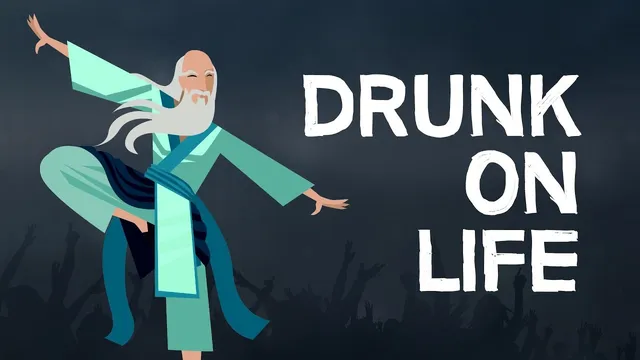
TAOISM | How to Get Drunk on Life
Based on Einzelgänger's video on YouTube. If you like this content, support the original creators by watching, liking and subscribing to their content.
Alcohol may temporarily reduce fear and inhibition, but it also dulls senses, impairs judgment and motor skills, and can contribute to violence and addiction.
Briefing
Western culture often treats drunkenness as a shortcut to bliss—loosening inhibitions, washing away sorrows, and making life feel more exciting. But alcohol also dulls the senses, weakens judgment and motor control, and can spiral into violence and addiction. The central question becomes less about avoiding pleasure than about finding a way to “get drunk on life” without numbing out: how to stay fully present through life’s highs, lows, fears, and grief.
A Taoist parable supplies the framework. In a teahouse, Lao Tzu, Confucius, and Buddha are offered “the juice of life.” Buddha refuses, arguing that birth, death, and life are suffering and that enlightenment means escaping the wheel of suffering—so taking a drink meant to intensify life would contradict the goal. Confucius takes a sip, dislikes the taste, and agrees it’s bitter and miserable. Lao Tzu drinks the whole bottle, then dances wildly, screaming, before returning to his seat. When asked how it was, he refuses to explain: “there’s nothing to be said.” The lesson is that life can’t be fairly judged from partial experience or from doctrines that pre-decide what should be avoided. If life is truly to be understood, it has to be lived in full.
The transcript draws two messages from that story. First, religions and ideologies shouldn’t be treated so rigidly that they block direct experience. Lao Tzu’s Tao Te Ching line—“Those who are stiff and rigid are the disciples of death. Those who are soft and yielding are the disciples of life”—is used to argue that inflexibility makes it hard to move with existence, which is always changing. Second, experiencing life requires immediacy: “drink it at once” and, in Lao Tzu’s image, “just… dance.” The speaker contrasts substance-based drunkenness with what it actually does: it closes the senses, making it easier to escape fear and emotion rather than meet them. When people drink to handle sadness, happiness, or anxiety, the result is a rejection of life through mind-altering numbness.
“Getting drunk on life” points in the opposite direction. Instead of blocking what overwhelms, it embraces the full emotional spectrum—fear included. Fear isn’t treated as proof that something is wrong; it’s framed as the body’s fight-or-flight response that appears when entering the unknown and fades when safety returns. The reward is “lucid involvement”: a conscious, intensified engagement with ordinary life—newness, risk, connection, nature, grief, joy, and even virtue pursued in a Stoic spirit.
The practical paradox is that life is already “drunk enough.” Full enjoyment comes from opening up without resistance and without clinging too tightly to moral judgments about what should or shouldn’t be happening. The goal isn’t to deny suffering or chase constant highs, but to ride the waves—welcoming sadness and delight alike—until life is simply lived as it is, an endless show everyone participates in.
Cornell Notes
The transcript argues that “drunkenness” as people usually mean it—especially alcohol—works by numbing the senses and escaping emotions. That may feel pleasurable short-term, but it reduces awareness, impairs judgment, and can lead to serious harm. A Taoist parable about Lao Tzu, Confucius, and Buddha uses the “juice of life” to make a different point: life can’t be judged fairly from doctrine or a small taste; it must be fully experienced. Lao Tzu’s refusal to explain—after drinking completely—signals that life’s meaning isn’t captured by rigid rules or partial engagement. “Getting drunk on life” therefore means embracing the full emotional range, including fear, with openness and present-moment curiosity rather than mind-altering avoidance.
Why does the parable treat partial judgment (Buddha’s refusal, Confucius’s sip) as inadequate?
What does “not taking religions or ideologies too seriously” mean in this context?
How does the transcript distinguish substance-based drunkenness from “drunk on life”?
Why is fear treated as something to welcome rather than eliminate?
What does “ride the waves” mean as a method for living fully?
What is the paradox at the heart of the “drunk on life” idea?
Review Questions
- How does the parable use the contrast between a sip and a full drink to argue about the limits of judgment?
- What mechanisms make alcohol-based drunkenness an escape, and how does “drunk on life” propose an opposite approach?
- In the transcript’s framework, how does fear function during growth, and what changes when safety is established?
Key Points
- 1
Alcohol may temporarily reduce fear and inhibition, but it also dulls senses, impairs judgment and motor skills, and can contribute to violence and addiction.
- 2
A Taoist parable uses “the juice of life” to argue that life can’t be fairly judged from doctrine or partial experience; it requires full engagement.
- 3
Rigid ideologies can block movement with reality; Tao Te Ching’s contrast between stiffness (death) and yielding (life) is used to support flexibility.
- 4
Substance-based drunkenness numbs emotions, so it often replaces coping with avoidance—drinking becomes a way to escape sadness, happiness, and anxiety.
- 5
“Getting drunk on life” means embracing the full emotional spectrum, including fear, as part of entering the unknown.
- 6
Fear is framed as a fight-or-flight response that fades when safety returns; the growth reward is lucid involvement and boundary-crossing elation.
- 7
The practical goal is to open up to life as it is—riding highs and lows without clinging—so life is lived rather than constantly managed or escaped.