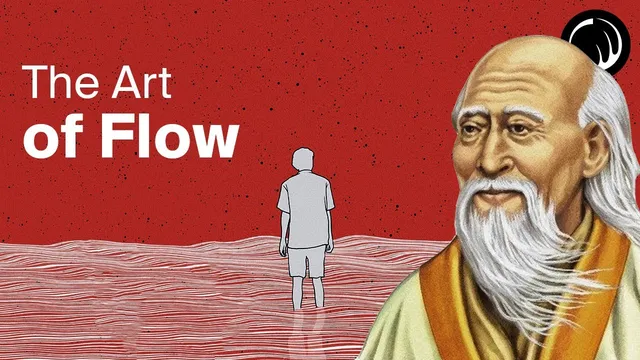
Taoism & the Art of Flow - The Philosophy of Lao Tzu
Based on Pursuit of Wonder's video on YouTube. If you like this content, support the original creators by watching, liking and subscribing to their content.
Taoism frames the Tao as an underlying natural order that generates and moves everything amid constant flux, beyond full definition by language or logic.
Briefing
Taoism’s core insight is that life works best when people align with the universe’s ever-changing “natural way” (the Tao) rather than forcing outcomes through rigid control. The Tao is portrayed as an underlying, incomprehensible substrate that generates and moves everything “for apparently no reason other than itself,” and Lao Tzu’s opening paradox—“the Tao that can be told is not the eternal Tao”—frames the philosophy as something that can’t be captured by logic alone. Instead, the emphasis falls on living: accepting flux, loosening attachments, and cultivating a fluid, intuitive harmony with how reality unfolds.
That practical orientation crystallizes in wu wei, often translated as “non-doing” or “effortless action.” The point isn’t literal passivity or doing nothing; it’s a mode of engagement where action feels spontaneous, deeply present, and almost self-propelling—closer to being carried by what one is doing than micromanaging it. The transcript links this to the modern “flow state,” describing shared features like deep focus, satisfaction, efficiency, and the disappearance of self-consciousness. Examples range from creative work that seems to “create itself,” to athletic moments where decisions arrive a step ahead, to everyday intuitions that feel right without being rationally justified.
The philosophy also draws a sharp contrast between authenticity and force. Nature’s “graceful yet indifferent” quality serves as a standard: when people push—whether in art, social performance, or personal branding—others often sense it as unnatural or fake. Taoism treats that sensitivity as evidence that truth and honesty align with the natural motion of things, while overreliance on intellect and striving can miss a deeper reality.
Still, the transcript doesn’t treat wu wei as a simple rule. It raises a counter-interpretation: perhaps “opposing action” is itself part of the Tao—“the Dao working against the Dao for the sake of its perpetuation.” It also questions whether surrender can be total once desire and intention are already entangled, and whether conscious effort can ever be fully separated from nature. Even so, it offers concrete support for the benefits of non-bracing in certain situations, citing how a person who doesn’t resist a fall or crash may be less likely to get hurt than someone who tenses and tries to control the outcome.
Ultimately, Taoism is presented as a set of ideals that may contain contradictions and limits, but still offers a valuable counterweight to a culture that insists things must always go “one’s own way” or that a better ideal is always just ahead. By urging people to step back from constant striving and to trust the intelligence of natural processes—like water’s patient erosion—the philosophy matters because it proposes a different way to live in the present: less force, more responsiveness, and a closer fit between human action and the world’s ongoing change.
Cornell Notes
Taoism centers on aligning human life with the Tao, an underlying, incomprehensible “natural way” that generates and moves everything amid constant flux. Lao Tzu’s paradox—what can be named isn’t the eternal Tao—pushes the philosophy toward lived practice rather than purely logical explanation. Wu wei (“non-doing” or effortless action) means engaging deeply without rigid control, resembling the psychological flow state through deep focus and reduced self-consciousness. The approach also values authenticity over forced performance, arguing that people can sense when behavior feels unnatural. At the same time, the transcript acknowledges tensions: surrender may be complicated, and “opposition” might itself be part of the Tao.
What does “Tao” mean in Taoist thought, and why does it resist definition?
How does wu wei differ from simply doing nothing?
Why does Taoism treat “forcing” as a kind of falseness?
What complications or counter-ideas arise around surrender and non-force?
Where does the transcript offer practical evidence that non-bracing can help?
How does Taoism function as a counterweight to common cultural habits?
Review Questions
- How does the transcript connect the Tao’s unnameability to the need for lived practice rather than purely logical explanation?
- In what ways does wu wei resemble flow state, and what key difference remains between the two?
- What are the transcript’s main reasons for doubting that surrender can be applied universally without contradiction?
Key Points
- 1
Taoism frames the Tao as an underlying natural order that generates and moves everything amid constant flux, beyond full definition by language or logic.
- 2
Lao Tzu’s paradox (“the Tao that can be told is not the eternal Tao”) supports the idea that the Tao is best approached through lived alignment rather than explanation.
- 3
Wu wei emphasizes effortless, deeply present action—engagement without rigid control—rather than literal inactivity.
- 4
Authenticity is treated as a natural signal: forced behavior often feels “unnatural” or fake because it clashes with nature’s motion.
- 5
The transcript acknowledges tensions in applying non-force, including the possibility that resistance and opposition are also part of the Tao.
- 6
Practical examples suggest that non-bracing can reduce harm in certain physical situations, even if total surrender remains philosophically complex.
- 7
Taoism is positioned as a corrective to a culture of constant striving and the belief that the “right way” must be found somewhere else.