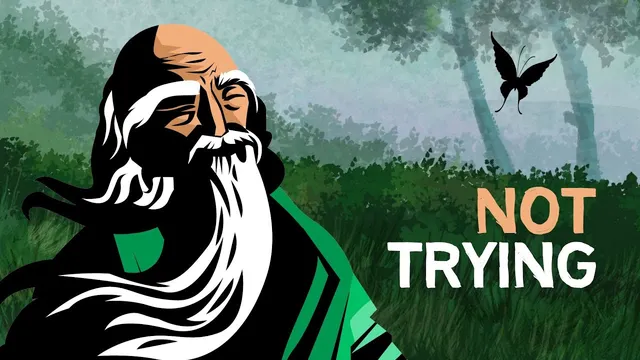
TAOISM | The Art of Not Trying
Based on Einzelgänger's video on YouTube. If you like this content, support the original creators by watching, liking and subscribing to their content.
Taoism frames many forms of striving as counterproductive because they impose fixed manmade ideas onto a world that is constantly changing.
Briefing
Taoism’s core message here is that many human efforts backfire because they try to force life into manmade categories—so the path forward is “not trying” in the sense of abandoning coercive striving and returning to the natural flow. The central claim is blunt: attempts to improve the world, chase happiness, or reshape the self often exhaust the body and mind while producing discontent, because the universe is in constant flux and cannot be controlled by rigid rules, moral systems, or fixed definitions.
The argument begins with a critique of counterproductive striving. People “stand on tiptoes” by pushing beyond what is stable, rush ahead without lasting results, and even dim their own light when they try to outshine others. Taoist sages treat many social inventions—rules, ethics, values, and rituals—as well-intentioned but ultimately distancing. Trying to alter what nature has intended is compared to swimming upstream: it’s exhausting and doesn’t get you anywhere. Beneath the changing world lies the Tao, described as an all-encompassing, undefinable force that can be felt and known without being fully comprehended. Human beings, however, try to make the unknowable manageable by naming and categorizing it, which creates an “artifice” that makes life seem understandable while causing people to lose contact with the Tao.
The transcript then targets “trying” itself, distinguishing it from a Taoist mode of action. Wu wei is introduced as “non-doing” or, in flow-state terms, “effortless action.” The key point is that “doing nothing” isn’t emptiness or stagnation; it’s a way of moving with the universe’s motion rather than fighting it. Since the world is in flux and even described as having entropy, progression exists in the natural flow—so the problem isn’t action, but forced action that comes from exhaustion and rigid control.
To make the idea concrete, three modern-looking patterns of trying are examined through Taoist texts. First is trying to improve the world: “must-save-the-world” attitudes can disrupt natural order by enforcing moral supremacy. Communism is used as an example of an ideology rooted in equality that spread through brutality, and a Zhuangzi story about Yen Hui seeking to govern Wei is used to show why outsiders who preach benevolence and righteousness can deepen division rather than heal society.
Second is trying to be happy. The pursuit of money, status, fame, power, or even knowledge is portrayed as a blind alley: it brings momentary pleasure but never the deeper happiness Taoists associate with contentment. A Lao Tzu passage contrasts what the world honors (wealth, eminence, long life, a good name) with what it finds happiness in (ease, rich food, fine clothes, beautiful sights, sweet sounds), arguing that both the poor and the rich “wear themselves out” in fear or frantic accumulation.
Third is trying to be something else—reshaping identity to fit an ideal. A Zhuangzi fable about animals and the wind illustrates envy of other natures, concluding that nothing is inherently better; judgment creates the hierarchy. The transcript then points to social pressures to alter appearance and identity to conform, arguing that such distortion creates imbalance. Practical guidance follows: take the middle path (stay centered and within one’s means), unlearn daily until inner stillness, and practice “fasting of the heart,” a form of non-action where nothing essential is left undone. In that emptiness, contentment becomes true happiness, and the Tao—sometimes framed as God in a theistic reading—can be felt rather than forced into concepts.
Cornell Notes
The transcript argues that Taoism treats many forms of “trying” as counterproductive because they impose rigid, manmade ideas onto a world that is constantly changing. The Tao—an all-encompassing force—can be felt and known without being fully comprehended, but naming and categorizing it can make people lose touch with it. Wu wei (“non-doing” / “effortless action”) is presented as the alternative: not passivity, but action that flows without coercion. Three examples—trying to improve the world, trying to be happy, and trying to be something else—are shown to produce exhaustion, division, and imbalance. The proposed practice is to take the middle path, unlearn daily, and reach inner stillness through “fasting of the heart,” where contentment replaces frantic striving.
Why does Taoism treat “trying to improve” as often self-defeating?
What is the Tao, and how can someone relate to it without fully understanding it?
How does wu wei differ from “doing nothing” in a negative, unproductive sense?
What do the examples of “trying” (world, happiness, self) have in common?
What practical steps does Taoism recommend to replace striving?
Review Questions
- How does the transcript connect rigid categorization (names, rules, moral codes) to losing contact with the Tao?
- In what ways does wu wei resemble “flow-state” behavior, and how does it avoid being mere passivity?
- Which of the three “trying” patterns—improving the world, chasing happiness, or reshaping the self—most strongly reflects the transcript’s idea of imbalance, and why?
Key Points
- 1
Taoism frames many forms of striving as counterproductive because they impose fixed manmade ideas onto a world that is constantly changing.
- 2
The Tao is described as all-encompassing and beyond full comprehension, yet still knowable through feeling and alignment rather than conceptual control.
- 3
Wu wei (“non-doing”) is presented as effortless action in harmony with the natural flow, not as useless inactivity.
- 4
Attempts to “improve the world” through moral supremacy can deepen division and produce brutality, even when the original intentions sound ethical.
- 5
Pursuing happiness through wealth, status, fame, or knowledge is portrayed as a blind alley that creates exhaustion and fear rather than contentment.
- 6
Trying to become someone else to match an ideal is treated as envy and conformity that disrupts balance, because no nature is inherently superior.
- 7
The recommended alternative is to follow the middle path, unlearn daily, and practice “fasting of the heart” to reach inner stillness and genuine contentment.