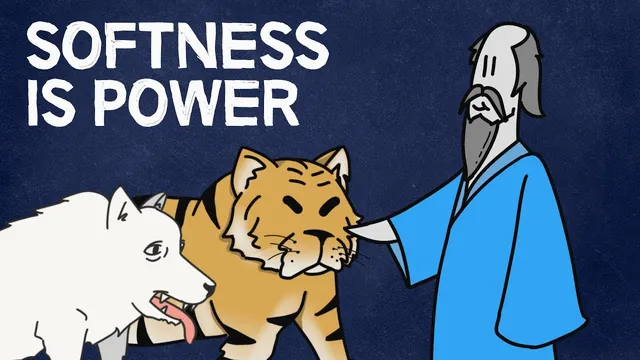
Taoism & The Underestimated Power of Softness
Based on Einzelgänger's video on YouTube. If you like this content, support the original creators by watching, liking and subscribing to their content.
Taoist “weakness” is defined as softness and yielding, not helplessness, and it can function as a strategic form of power.
Briefing
Softness—often dismissed as weakness—can outperform brute strength by preventing conflict, adapting to reality, and addressing problems at their roots. Taoist Lao Tzu frames “weakness” as softness and malleability rather than helplessness, arguing that yielding can overcome the hard and rigid. In a culture that prizes firmness, energy, and intimidation, the transcript flips the script: the most durable power may be the kind that avoids direct confrontation and instead shapes conditions so resistance never fully forms.
The argument begins with a familiar social pattern: people admire strength and fear weakness. Strength is linked to being unbreakable, assertive, and capable of fighting back, while weakness is associated with fragility, impotence, and being pushed around. Yet the core claim is that “lack of strength” does not equal “lack of power.” Softness can be strategic—less about surrendering and more about using flexibility, timing, and wisdom to reduce the need for force.
A story about a king illustrates the political payoff. The king hires only strong, brave men to protect him, but a philosopher recommends a different approach: rule in a way that makes people not only afraid to attack, but unwilling to want to. The king’s virtue and integrity win love and respect, shrinking the incentive for violence and breaking the cycle that tyrants fall into. By contrast, leaders who rely on intimidation may maintain control temporarily, but they generate constant opposition, isolation, and eventual internal collapse—an unsustainable system that becomes “destroyed from the inside out.”
From there, the transcript shifts from governance to prevention. Taoist advice—take care of difficult problems while they’re still easy, and do easy things before they become too hard—becomes a guiding principle. A caretaker named Liang demonstrates it with wild animals like tigers and wolves: he tames them not through force, but through understanding their nature, avoiding actions that trigger ferocity, and keeping them in a balanced emotional state. The result is calm coexistence; coercion would likely provoke retaliation or flight.
The same logic is applied to criminal justice. The transcript contrasts the United States’ large prison population—described as a harsh, blunt response driven by anger and fear—with Finland’s open-prison model. Finland’s facilities lack locks and gates, allow prisoners to work, study, and move into the city, and emphasize self-control and reintegration rather than punishment that worsens outlooks. Despite criticism, the reoffending rate is described as among the lowest in the world, supporting the claim that gentle approaches target root causes—such as difficult childhoods, poverty, limited opportunity, education gaps, or misfortune—rather than only managing consequences.
Finally, water becomes the central metaphor for Taoist “soft power.” Water yields on contact, bends with air, changes course when obstructed, and adapts to heat and cold. Though it can seem weak, it overcomes hard and rigid over time. The transcript extends this into everyday intelligence and survival: the “smartest guy in the room” is portrayed as the one who listens and asks questions, gaining insight through humility rather than dominance. Firmness is still valued, but excessive rigidity blocks adaptation. The closing takeaway is blunt: life depends on change, and change depends on flexibility—“The rigid and stiff will be broken. The soft and yielding will overcome.”
Cornell Notes
The transcript argues that Taoist “weakness” means softness and yielding, not helplessness—and that this kind of power can defeat rigidity. Lao Tzu’s principle is that the hard and firm invite resistance, while the soft approach prevents problems by shaping conditions early. Examples include a king who gains stability through virtue rather than fear, Liang the caretaker who tames tigers through adaptation instead of force, and Finland’s open prisons that emphasize reintegration and self-control rather than punishment. Water serves as the metaphor: it has no fixed form, adapts to obstacles, and ultimately overcomes the rigid. The practical conclusion is that survival and success depend on fitting reality through flexibility, not clinging to inflexible strength.
Why does the transcript treat “weakness” as a form of power rather than a lack of capability?
How does the king story connect softness to political stability?
What does Liang’s animal-taming example add to the argument?
Why does the transcript use Finland’s prison system as evidence for “soft power”?
How does water function as the transcript’s central metaphor for Taoist softness?
What does the transcript say about firmness versus rigidity in personal survival and learning?
Review Questions
- Which parts of the transcript treat prevention as more effective than direct confrontation, and what examples support that claim?
- How do the king and tyrant comparisons illustrate the difference between fear-based control and virtue-based legitimacy?
- What specific behaviors in Liang’s approach show “softness” as adaptation rather than surrender?
Key Points
- 1
Taoist “weakness” is defined as softness and yielding, not helplessness, and it can function as a strategic form of power.
- 2
Fear-based control tends to generate ongoing opposition, isolation, and instability, while virtue-based rule reduces the incentive for violence.
- 3
Soft power works through prevention—addressing problems early—rather than relying on force to fight problems after they erupt.
- 4
Liang’s animal-taming method treats success as timing and emotional balance, avoiding triggers that provoke aggression.
- 5
Finland’s open-prison model is presented as a practical application of softness: reintegration, self-control, and reduced reoffending.
- 6
Water symbolizes adaptive power: it changes course, lacks fixed form, and ultimately overcomes rigidity.
- 7
Personal survival depends on adaptability; rigid firmness can become incompatible with a changing world.