Tattoos on Math
Based on 3Blue1Brown's video on YouTube. If you like this content, support the original creators by watching, liking and subscribing to their content.
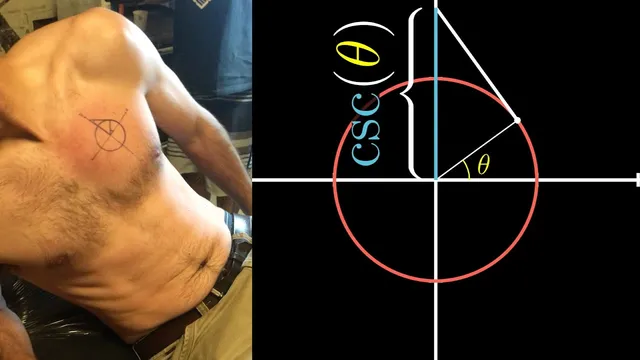
Cam’s CSC tattoo uses the cosecant function as a geometric “signature,” turning a naming convention into something visually permanent.
Briefing
A math tattoo built from the cosecant function turns a classroom convention into something permanent—and that permanence raises a bigger question: why do some mathematical ideas get “named” in ways that make them feel inevitable, even when they may be mostly conventional. Cam’s initials, CSC, became the trigger for a geometric tattoo representing cosecant, framed as a wordless signature written in pure math. The gesture is playful, but it also spotlights how naming can create an artificial durability: once a function like cosecant is established as a standard object of study, it gains a kind of cultural permanence that outlasts its practical necessity.
The tattoo’s geometry traces back to the unit circle. For an angle θ, the point on the circle links sine and cosine to distances from the x-axis and y-axis. Tangent and cotangent then appear through a tangent line drawn at that point: the distance along the tangent to the x-axis corresponds to tangent, while the distance along the same line to where it meets the y-axis corresponds to cotangent. From there, secant and cosecant enter as distances tied to where that tangent line intersects the axes. Secant is defined as 1 divided by cosine, and cosecant as 1 divided by sine; the diagram supports these definitions using similar right triangles. In the smaller triangle, the ratio of the side opposite θ to the hypotenuse is sine(θ) (with hypotenuse length 1). In the larger triangle, the corresponding ratio flips into the reciprocal relationship, matching the claim that cosecant(θ)=1/sine(θ).
What makes the story sharper is the contrast between elegance and necessity. All six functions—sine, cosine, tangent, cotangent, secant, and cosecant—can be given separate names because the diagram makes their roles feel symmetric: three functions relate naturally to lengths heading toward the x-axis, while the other three mirror them toward the y-axis. Yet in most real problem-solving, trig often relies on sine, cosine, and tangent alone. The remaining functions can be rewritten as reciprocals or ratios of those basics, meaning extra names can become “more words” without adding much computational value. Even the naming pattern—cosecant as the reciprocal of sine, secant as the reciprocal of cosine—can introduce avoidable confusion.
Historically, the separate names made more sense when calculations depended on printed tables of input-output values. If you couldn’t quickly compute 1/sin(θ) by hand or on a calculator, having a dedicated column labeled cosecant could be genuinely useful for sailors, astronomers, and engineers. But modern tools reduce that practical need, leaving the names as conventions that persist largely because education systems and mathematical culture preserve them.
The tattoo, then, becomes a metaphor for learning itself: students should ask whether a new concept is “core to the flesh” of mathematics and nature—or whether it’s inked on by human choices that could have been arranged differently. In that sense, cosecant and its relatives are less tattoos on the body of math than tattoos on the conventions surrounding it.
Cornell Notes
The cosecant tattoo uses the unit circle to turn a named trig function into a geometric object. For an angle θ, sine and cosine come from distances to the x- and y-axes, while tangent and cotangent come from distances along the tangent line at the unit-circle point. Secant and cosecant arise from where that tangent line intersects the axes, and similar right triangles justify the reciprocal relationships: secant(θ)=1/cos(θ) and cosecant(θ)=1/sin(θ). The deeper point is cultural: naming functions like cosecant can create “permanence” in teaching even when modern computation makes those extra names less necessary. The lesson is to distinguish concepts that are structurally essential from conventions that persist by habit.
How does the unit circle connect sine and cosine to geometry?
What geometric construction produces tangent and cotangent?
Why do secant and cosecant equal reciprocals of cosine and sine?
Why might students find cosecant, secant, and cotangent confusing or unnecessary?
What historical reason made dedicated names for these functions more useful?
What is the broader learning takeaway from the cosecant tattoo metaphor?
Review Questions
- How do similar right triangles on the unit-circle diagram lead to cosecant(θ)=1/sin(θ)?
- In what ways do sine/cosine and tangent/cotangent differ in their geometric interpretations on the unit circle?
- Why did function names like cosecant become more practical before calculators, and less necessary afterward?
Key Points
- 1
Cam’s CSC tattoo uses the cosecant function as a geometric “signature,” turning a naming convention into something visually permanent.
- 2
On the unit circle, sine and cosine correspond to distances tied to the x- and y-axes for a point at angle θ.
- 3
Tangent and cotangent arise from distances measured along the tangent line to the unit circle at the θ point.
- 4
Secant and cosecant come from where that tangent line intersects the axes, with similar right triangles justifying the reciprocal definitions.
- 5
Modern computation reduces the practical need for separate names like cosecant, since they can be rewritten using sine, cosine, and tangent.
- 6
Historically, dedicated names helped because printed tables provided quick access to reciprocals and ratios before calculators.
- 7
A useful learning habit is to ask whether a concept is essential to mathematics and nature or mainly a convention preserved by education and tradition.