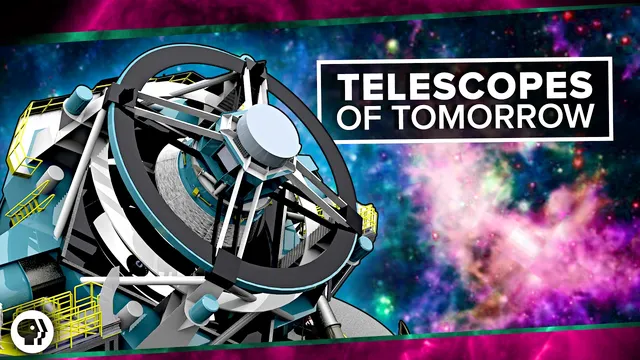
Telescopes of Tomorrow
Based on PBS Space Time's video on YouTube. If you like this content, support the original creators by watching, liking and subscribing to their content.
James Webb’s 6.5-meter mirror and infrared detectors are designed to detect much fainter objects—about 16 times fainter than Hubble—while seeing through dust that hides planet-forming regions.
Briefing
Astronomy’s next leap won’t come from a single “bigger telescope,” but from three different approaches aimed at different kinds of cosmic questions: deeper infrared vision from space, sharper visible-light imaging from the ground, and a time-lapse survey that watches the sky change night after night. Together, the James Webb Space Telescope, the Giant Magellan Telescope, and the Large Synoptic Survey Telescope are designed to push past today’s limits in sensitivity, resolution, and—crucially—how quickly and how often astronomers can observe.
James Webb is positioned as Hubble’s high-impact successor, built around a major jump in collecting power and a shift in wavelength. Webb’s 6.5-meter primary mirror (vs. Hubble’s 2.4 meters) gives it more than five times Hubble’s collecting area, translating into far greater sensitivity—enough to detect objects about 16 times fainter. Because Webb observes mostly in infrared, it can see through the dust that hides planet-forming regions around young stars. Longer wavelengths scatter less in gas-and-dust “nurseries,” letting infrared light escape where visible light gets blocked. Webb’s infrared reach also matters for the earliest galaxies: light from the universe’s first epochs has been stretched by cosmic expansion deep into the infrared, so Webb can potentially detect galaxies when the universe was only about 100 million years old. That capability is expected to help untangle whether stars formed first and later built galaxies, or whether galaxies assembled first and then formed stars—along with the role dark matter played in shaping the process.
Infrared comes with tradeoffs. The fundamental diffraction limit worsens with wavelength, meaning infrared images are inherently blurrier at a fixed aperture. Webb offsets this with sheer mirror size, aiming for image clarity comparable to Hubble’s visible-light sharpness. The bigger practical challenge is heat: infrared detectors must be kept extremely cold to avoid being overwhelmed by thermal glow. Webb’s instruments will be cooled to about 50 Kelvin (minus 223°C) using cryogenics and protected by a five-layer sunshield that blocks sunlight and also helps reduce contamination from small debris.
On the ground, the Giant Magellan Telescope targets visible wavelengths and tackles a different enemy: atmospheric turbulence. Even in the dry Atacama Desert, moving air warps incoming wavefronts, causing stars to twinkle and blurring images that would otherwise be diffraction-limited. GMT’s solution is adaptive optics at scale: flexible secondary mirrors will be deformed hundreds of times per second by thousands of computer-controlled actuators, guided by six sodium lasers fired about 90 kilometers upward to create artificial reference stars. With an effective aperture of 24.5 meters, GMT is designed to approach space-like resolution and enable high-contrast studies such as photographing exoplanets and analyzing the atmospheres of some of them. It may even help search for traces of the universe’s first star populations.
The Large Synoptic Survey Telescope, also in Chile, takes a third path: speed and coverage. With an 8.4-meter primary mirror and a car-sized 3.2 gigapixel camera, LSST will scan the entire southern sky every few nights for a decade, capturing 1,000 pairs of exposures nightly and storing 15 terabytes of data. That time-domain focus enables tracking fast-moving stars, hunting near-Earth asteroids, finding supernovae to refine understanding of dark energy, and catching optical counterparts to gamma-ray bursts. It will also support gravitational lensing studies by recording how distant objects “twinkle” as massive foreground bodies bend spacetime. The common thread is ambition with specificity: each telescope is engineered to answer a different set of “known unknowns,” while leaving room for the discoveries no one can yet predict.
Cornell Notes
The next generation of telescopes is being built around three complementary strengths: Webb’s infrared sensitivity from space, GMT’s adaptive-optics sharpness from the ground, and LSST’s rapid, wide-field monitoring of the sky over time. Webb’s 6.5-meter mirror and infrared capability let it see through dust and detect very faint, early galaxies—potentially as early as about 100 million years after the Big Bang. GMT’s 24.5-meter effective aperture targets visible light but uses adaptive optics with deformable mirrors and six sodium lasers to counter atmospheric blurring. LSST’s 8.4-meter mirror and 3.2 gigapixel camera prioritize cadence, scanning the southern sky every few nights for a decade to capture transient events and measure gravitational lensing effects. Together, they aim to sharpen views of planet formation, the early universe, exoplanet atmospheres, and cosmic evolution.
Why does the James Webb Space Telescope’s infrared focus matter for studying planet formation and early galaxies?
What sets the sharpness limit for telescopes, and how does Webb’s design compensate for infrared’s disadvantage?
How does Webb keep its infrared detectors from being overwhelmed by heat?
How does the Giant Magellan Telescope overcome atmospheric turbulence that blurs ground-based images?
What makes LSST different from Webb and GMT in terms of scientific strategy?
Review Questions
- How do diffraction limits and aperture size jointly determine image sharpness, and why does that create a tradeoff for infrared telescopes?
- Compare the main “limiting factors” for Webb, GMT, and LSST (heat, atmospheric seeing, and observational cadence). How does each telescope’s design address its limiting factor?
- What kinds of discoveries become possible when a telescope can observe the sky repeatedly over days, months, and years rather than only once?
Key Points
- 1
James Webb’s 6.5-meter mirror and infrared detectors are designed to detect much fainter objects—about 16 times fainter than Hubble—while seeing through dust that hides planet-forming regions.
- 2
Webb’s infrared capability supports early-universe studies by matching the wavelength shift caused by cosmic expansion, potentially reaching galaxies at roughly a 100-million-year cosmic age.
- 3
Infrared imaging is limited by diffraction and by detector heat; Webb counters these with a larger aperture and cryogenic cooling to about 50 Kelvin plus a five-layer sunshield.
- 4
The Giant Magellan Telescope’s adaptive optics system uses deformable secondary mirrors and six sodium lasers to correct atmospheric wavefront distortions in real time.
- 5
GMT’s effective aperture of 24.5 meters and corrected resolution aim to enable direct imaging of exoplanets and atmospheric spectroscopy for some targets.
- 6
LSST’s core advantage is cadence: it scans the southern sky every few nights for a decade, capturing transient events and enabling measurements like gravitational lensing from brightness variability.
- 7
The three-telescope plan targets different “known unknowns”—from star and galaxy formation to dark energy and gravitational lensing—while leaving room for unexpected discoveries.