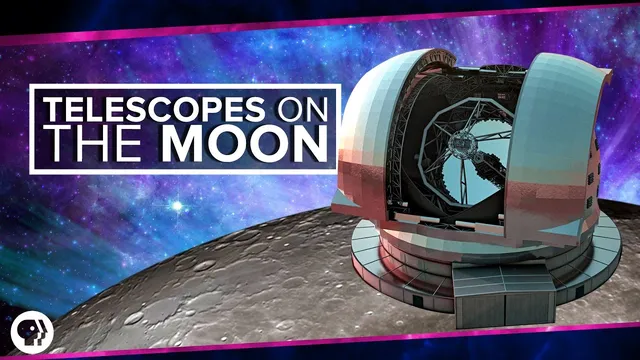
Telescopes on the Moon
Based on PBS Space Time's video on YouTube. If you like this content, support the original creators by watching, liking and subscribing to their content.
LUT on the Moon demonstrates that near-vacuum conditions enable sharper astronomy by eliminating atmospheric turbulence and atmospheric absorption.
Briefing
A small telescope on the Moon is already delivering unusually sharp views of the universe—because the lunar environment removes the two biggest limits on Earth-based astronomy: atmospheric turbulence and atmospheric absorption. The Chang’E 3 lander, which soft-landed in December 2013, has been operating ever since, including its Lunar Ultraviolet Telescope (LUT). Despite a modest ~15-centimeter aperture, LUT can observe near-ultraviolet wavelengths and visible light that Earth’s atmosphere blocks or blurs, producing clear images such as a near-UV view of the pinwheel galaxy. The Moon’s near-vacuum atmosphere means there’s no weather-like “seeing” from turbulence, no scattering that creates a bright blue sky, and stars remain visible even during lunar daytime.
The episode then pivots from what’s been achieved to what could be built next: much larger lunar telescopes. Aperture size still matters—both for collecting more light and for improving resolution via the diffraction limit, which scales inversely with diameter. LUT’s small size limits its sharpness, but it functions as a proof of concept for scaling up. The usual bottleneck for space telescopes is logistics: large mirrors must fit inside rockets and survive launch acceleration. Even advanced designs such as folding mirrors have practical limits, and mirrors are fragile enough that launch vibrations can ruin them.
On the Moon, engineers may be able to sidestep those constraints by constructing mirrors directly on the surface, where the platform is far more stable than a rocket. That opens the door to mirrors far larger than what can be launched. Two major technical challenges stand in the way: surviving the Moon’s harsh environment and solving the mirror-material problem.
The rover Yutu (Jade Rabbit) illustrates the environment’s brutality. With almost no atmospheric buffering, lunar temperatures swing from about 125°C in sunlight to −150°C or lower in shade, quickly halting mobility. Even after that, moondust becomes the killer: electrically charged regolith particles repel each other and form dust fountains in low gravity, sticking to electronics, clogging solar panels, and grinding moving parts.
Yet moondust may also be repurposed. NASA Goddard’s Pete Ching proposes mixing epoxy and carbon nanotubes with lunar dust to form a concrete-like material, then grinding it into shape and coating it with aluminum—an approach aimed at a ~50-meter mirror. Another path uses liquid mirror telescopes. On Earth, the Large Zenith Telescope spins a six-meter dish of mercury to create a parabolic mirror, but it can only point straight up and mercury is costly and evaporates. Researchers including Pete Worden (NASA Ames) and Ermanno Borra (University of Quebec) are instead exploring nonevaporating ionic liquids (molten-salt-like fluids) with a thin silver coating, potentially enabling liquid mirrors up to ~100 meters. Lower gravity could help the mirror form at large scales, and the resulting telescopes might not need complex pointing—making them attractive for cosmology.
Momentum is building beyond government missions. More Chang’E landings are planned, and private efforts such as the International Lunar Observatory Association and Moon Express have received approval for lunar landing, with plans for a small ~7-centimeter optical telescope. A manned base is also being discussed, which could support future giant lunar observatories. The core message is clear: the Moon’s stable surface and atmospheric advantages could turn it into a long-duration “lookout tower” for the clearest views of space—if engineers can tame dust, temperature extremes, and mirror construction at scale.
Cornell Notes
LUT on the Moon shows that lunar astronomy can beat Earth’s atmosphere: no turbulence, no atmospheric absorption, and stars visible day and night. The Chang’E 3 lander has operated since its 2013 landing, using a ~15 cm lunar ultraviolet telescope to observe near-ultraviolet and visible wavelengths that are difficult from Earth. The main limitation is aperture size, but the Moon may allow much larger mirrors because engineers could build them in place, avoiding rocket-size and launch-vibration constraints. Proposed mirror technologies include moondust-based composites coated with aluminum and liquid-mirror designs using nonevaporating ionic liquids rather than mercury. If these hurdles are solved, lunar telescopes could reach tens to ~100 meters and support cosmology with simpler pointing requirements.
Why does the Moon offer clearer astronomical views than Earth for certain wavelengths?
What makes aperture size so central to telescope performance, and how does LUT fit into that?
What environmental factors cripple lunar hardware, as illustrated by the Yutu rover?
How could engineers build very large mirrors on the Moon without launching them as fragile payloads?
Why are liquid mirror telescopes harder on Earth than on the Moon, and what replaces mercury?
Review Questions
- What three lunar conditions make near-UV and visible observations especially effective compared with Earth?
- How do diffraction limits connect aperture diameter to achievable resolution, and why does that matter for scaling from LUT to future lunar telescopes?
- Which two lunar hazards—thermal extremes and moondust—most directly explain why Yutu failed, and how might those hazards be mitigated or repurposed for telescope construction?
Key Points
- 1
LUT on the Moon demonstrates that near-vacuum conditions enable sharper astronomy by eliminating atmospheric turbulence and atmospheric absorption.
- 2
The Chang’E 3 lander’s ~15-centimeter Lunar Ultraviolet Telescope has been operating since its 2013 soft landing, producing near-UV observations such as of the pinwheel galaxy.
- 3
Scaling to larger telescopes depends on aperture size, but the Moon may allow mirrors to be built in place, avoiding rocket-size limits and launch-induced damage.
- 4
Yutu’s failures highlight two core lunar engineering problems: extreme day-night temperature swings and electrically charged moondust that sticks to and damages equipment.
- 5
One proposed large-mirror approach repurposes moondust into a composite material (epoxy + carbon nanotubes + lunar dust) shaped and aluminum-coated for reflectivity.
- 6
Liquid-mirror telescopes could scale to tens of meters if nonevaporating ionic liquids replace mercury, with silver coatings forming the reflective surface.
- 7
Private and international lunar plans—along with additional Chang’E missions—are laying groundwork for progressively larger lunar observatories, starting with small optical telescopes.